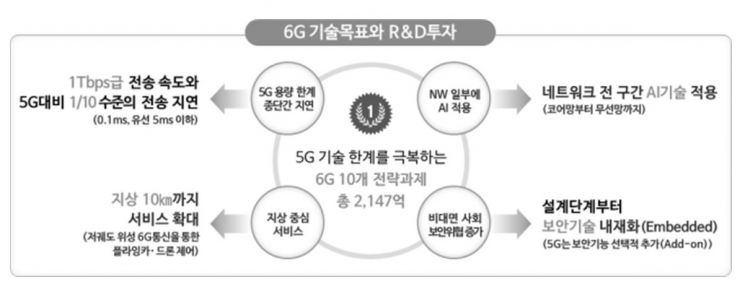
[Asia Economy Reporter Koo Chae-eun] The government will invest 200 billion won over five years starting next year to secure 6th generation (6G) mobile communication technology, expected to be commercialized in 10 years. The goal is to secure core 6G technology boasting a transmission speed of 1Tbps, 50 times faster than 5G, and achieve "world's number one in patents," "world's number one in smartphone market share," and "world's number two in equipment market share."
On the 6th, the Ministry of Science and ICT announced the "6G R&D Strategy" at the 12th Science and Technology Ministers' Meeting chaired by Prime Minister Chung Sye-kyun. This move aims to respond to the non-face-to-face and digitalization trends brought by the COVID-19 pandemic and to lay the foundation for future new industry growth.
The plan is to reduce dependence on foreign communication components and create an ecosystem for the expansion of convergence services in advance. Since 6G commercialization is expected to begin around 2028-2030, core technology development will be conducted over five years from 2021 to 2025, followed by three years of commercialization support from 2026 to 2028.
First, development of core 6G technologies focusing on ultra-performance, ultra-broadband, ultra-precision, ultra-spatial, and ultra-intelligence will be pursued. Considering the intensifying technological hegemony competition among major countries such as the United States and China, international cooperation with leading research institutions and standardization organizations of each country will be strengthened. For example, joint research will be promoted with China on frequency channel modeling, with the United States on modems, and with Europe on access core equipment.
Additionally, active participation in the International Telecommunication Union (ITU)'s preemptive research and vision establishment for international standardization phases will enhance capabilities to secure standard patents. Prototype hardware and software that can be utilized for domestic production of 6G core components and equipment will be developed, and at the time of commercialization, voucher-type R&D support will be provided to promote technology commercialization by promising small and medium-sized enterprises.
Meanwhile, at the meeting, the "Smart Maritime Traffic Policy Promotion Strategy," which includes building the world's first ultra-high-speed maritime wireless communication network capable of LTE-level communication even in distant seas and providing maritime navigation services, was also reported.
© The Asia Business Daily(www.asiae.co.kr). All rights reserved.

















