Confirmed Cases Related to Hollys Coffee Seolleung Station Branch Reach 12 as of the 4th
Civilians "Complete Cafe Closure" vs "Livelihood at Stake... Strengthening Quarantine Rules First"
Experts "Seeking Ways to Comply with Quarantine Rules Is Preferable"
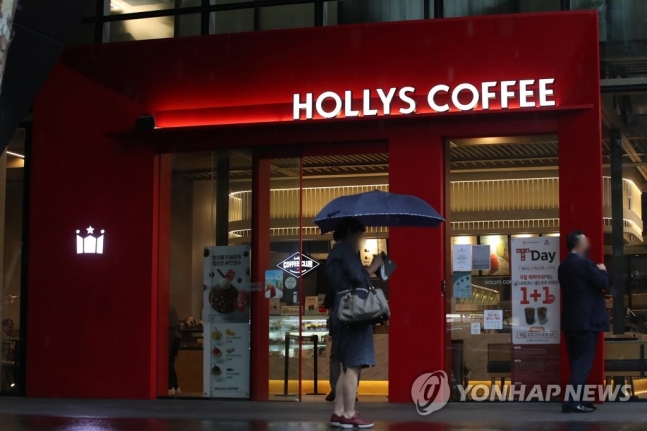 The Central Disease Control Headquarters identified the Hollys Coffee Seolleung Station branch in Gangnam-gu, Seoul, as a location visited by a confirmed case.
 Photo by Yonhap News
[Asia Economy Reporter Kim Ga-yeon] Recently, a cluster infection of the novel coronavirus disease (COVID-19) occurred at a coffee specialty shop in Gangnam-gu, Seoul, raising concerns among citizens. Although health authorities urged compliance with preventive measures such as wearing masks and social distancing inside cafes, many consumers violate these rules due to the nature of the place where food is consumed and conversations take place.
As a result, voices among citizens range from demanding the complete closure of operating coffee specialty shops to arguing that simple closure is unrealistic and that supplementary measures such as strengthening quarantine rules should be prepared, leading to ongoing debates.
According to the Central Disease Control Headquarters (CDCH) on the 5th, as of 12 p.m. on the 4th, the cumulative confirmed cases related to 'Hollys Coffee Seolleung Station Branch' in Gangnam-gu, Seoul, and 'Yangjae Jokbal Bossam' in Yangjae-dong, Seocho-gu, were confirmed to be 12. Accordingly, the confirmed cases at Hollys Coffee Seolleung Station Branch and Yangjae Jokbal Bossam were 5 and 7, respectively. It was confirmed that the first confirmed case at Hollys Coffee Seolleung Station Branch visited Yangjae Jokbal Bossam and transmitted COVID-19, so the two cases were classified as Gangnam coffee shop cases.
According to the CDCH, some of the initial confirmed cases at Hollys Coffee Seolleung Station Branch and the first confirmed case of the cluster outbreak at a camping site in Hongcheon, Gangwon-do, were found to have stayed in the same space on the 22nd of last month. CCTV footage from Hollys Coffee Seolleung Station Branch confirmed that they were seated about 3 meters apart and stayed together for about 30 minutes. However, there was no evidence of direct contact between them.
This has raised concerns about the level of quarantine in cafes and restaurants. Given the characteristics of COVID-19 spreading through droplets and close contact, the possibility of transmission is high in the enclosed space of cafes, and infection can occur through touching shared utensils contaminated with droplets even without direct contact.
Some citizens have raised their voices demanding the complete closure of cafes for the time being. While high-risk facilities such as clubs and emotional pubs have systems like QR code electronic entry logs for quarantine management, there are no regulations for cafes. It is also pointed out that the lack of systematic regulations fails to instill awareness among citizens.
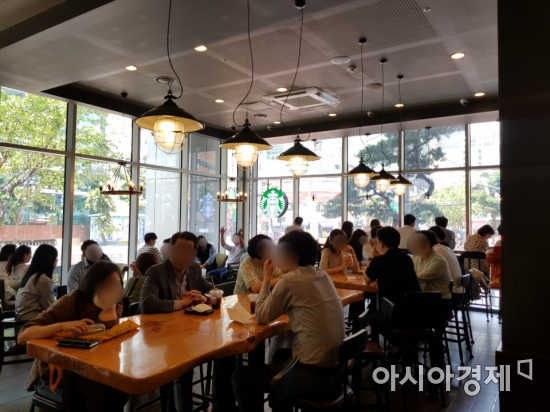 On June 3rd, at a large franchise cafe located in Jung-gu, Seoul, citizens are sitting face-to-face without masks, engaging in conversation. Photo by Gayun Kim katekim221@asiae.co.kr
On the other hand, criticism has been raised against such claims, saying they are "unrealistic considering the livelihoods of store owners and self-employed people." As the COVID-19 situation is prolonged, it is argued that measures should be prepared to prevent spread without hindering livelihood maintenance.
A university student A (24), who works part-time at a cafe, said, "Since it is a space where you can drink beverages or eat food, the awareness of wearing masks does not seem to be high," adding, "I ask customers to wear masks when ordering or moving outside the table area, and my throat gets hoarse from asking all day, but it does not have much effect."
A added, "It is practically difficult because it is not something that can be enforced like not allowing public transportation use without a mask," and "I think the most effective way to ensure compliance with quarantine rules is for the government to establish systematic monitoring measures."
An office worker B (29) said, "I saw a claim in the comments of a portal site article saying 'Since confirmed cases appeared in cafes, they should be completely shut down,' but I thought it was really a simplistic and unrealistic statement," adding, "If that is the case, then places classified as high-risk facilities should be closed first, and workplaces, public transportation, and restaurants should all be closed."
B emphasized, "In the situation where COVID-19 has lasted for more than seven months, many business owners have already suffered significant damage," and said, "If you are anxious, you can simply avoid going to cafes. The government should prepare supplementary measures to minimize economic damage while preventing the spread of COVID-19."
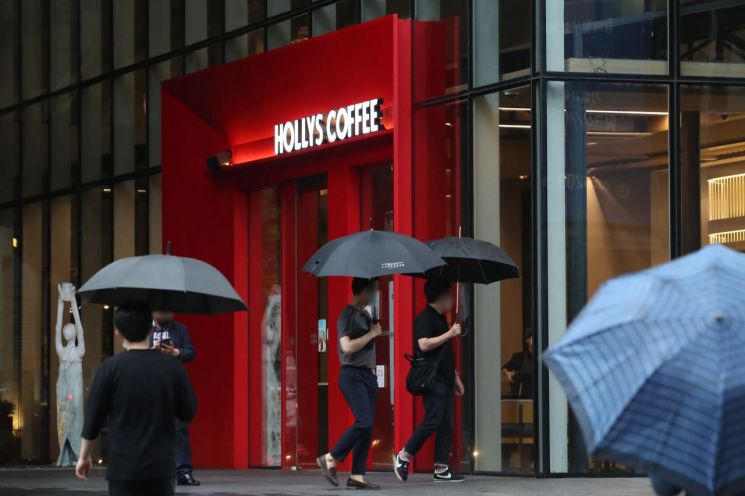 The Central Disease Control Headquarters identified the Hollys Coffee Seolleung Station branch in Gangnam-gu, Seoul, as a location visited by a confirmed case.
 Photo by Yonhap News
Experts believe that considering the prolonged COVID-19 situation, it is important for the government to establish measures to ensure thorough compliance with quarantine rules.
Professor Lee Eun-hee of the Department of Consumer Studies at Inha University said in a phone interview with Asia Economy, "If it were possible to completely close cafes and thoroughly quarantine to end COVID-19 in a short period, it would be better to do so, but that is not necessarily the case," adding, "I think it is more desirable to operate cafes while following quarantine rules."
Professor Lee explained, "Consumers are very exhausted from the COVID-19 situation that has lasted more than six months. There are fewer places to go out properly, and there is unmet desire because of that," and added, "We need to operate cafes but seek ways to strictly follow quarantine rules."
Meanwhile, on the 4th, health authorities announced updated quarantine rules for cafes and restaurants to address shortcomings.
The CDCH urged maximizing the use of delivery and takeout orders, mandatory mask-wearing when visiting, avoiding crowded times, and minimizing the time spent at the venue. They also emphasized disinfecting hands with water or sanitizer before eating, and using hand sanitizer or disposable gloves before and after using shared tongs, plates, and spoons.
In particular, they recommended wearing masks except when eating or drinking and refraining from talking while consuming food as much as possible.
Deputy Director Kwon Jun-wook of the CDCH said, "Health authorities and local governments are receiving reports of risk factors and working hard to prevent explosive outbreaks through on-site inspections and contact tracing. We repeatedly urge all members of society to routinely comply with social distancing, mask-wearing, and quarantine rules."
© The Asia Business Daily(www.asiae.co.kr). All rights reserved.
![User Who Sold Erroneously Deposited Bitcoins to Repay Debt and Fund Entertainment... What Did the Supreme Court Decide in 2021? [Legal Issue Check]](https://cwcontent.asiae.co.kr/asiaresize/183/2026020910431234020_1770601391.png)

















