UNIST and Domestic and International Joint Research Establish Standard Genome of Whale Shark Caught Near Coast
Provides Clues to Biological Aging and Evolution... Published in Proceedings of the US National Academy of Sciences
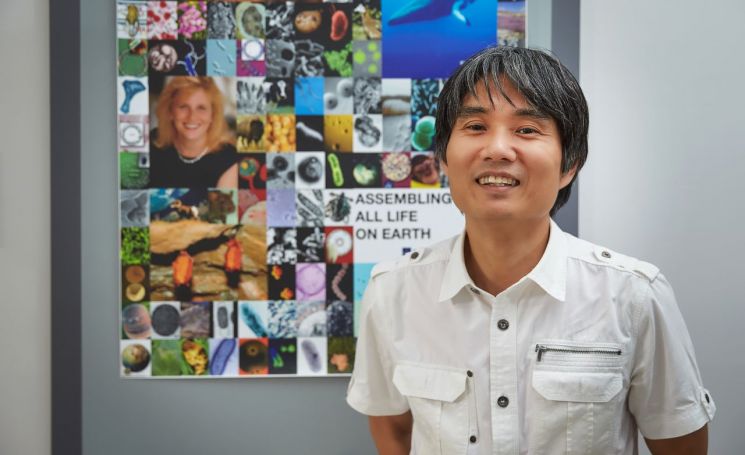
[Asia Economy Yeongnam Reporting Headquarters Reporter Kim Yong-woo] Could this be a clue to unraveling the secrets of aging and evolution? The genome analysis information of the whale shark, the largest fish in the world, has been released.
The Genome Industry Technology Center (KOGIC) at Ulsan National Institute of Science and Technology (UNIST), in collaboration with Harvard University, Seoul National University, Jeju National University, and Clinomics Co., Ltd., decoded, assembled, and analyzed the genome information of the endangered whale shark species and published the results in the prestigious scientific journal Proceedings of the National Academy of Sciences (PNAS).
The analysis revealed a correlation between gene length and lifespan. The research team completed the standard genome of the whale shark using samples provided by Aqua Planet Jeju in Korea and compared it with the whole genome information of 84 species, confirming that the whale shark’s introns are longer than those of other organisms.
Introns are parts of genes that do not participate in protein synthesis and are related to basal metabolic rate (BMR), which is associated with lifespan.
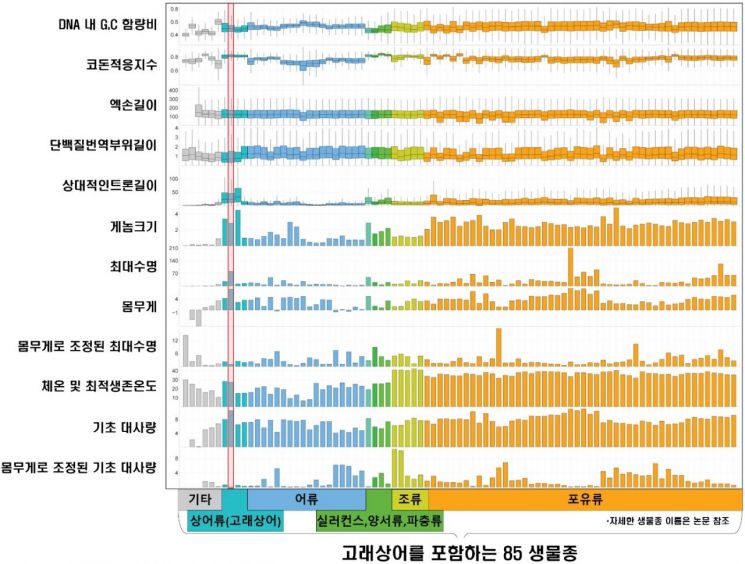 Illustration of various interrelationships analyzed through comparative research of 85 species, including the whale shark.
The whale shark reaches an average length of 20 meters and a weight of 42 tons. The longest-living whale sharks have lifespans of about 100 years, making their longevity remarkable.
Generally, large-bodied organisms are known to have longer lifespans because they can minimize heat loss, but the exact reasons for the whale shark’s longevity had not been revealed.
The UNIST Genome Industry Technology Center research team constructed the standard genome of the whale shark and, by comparing it with the genomes of 84 species, discovered that the whale shark has relatively long introns.
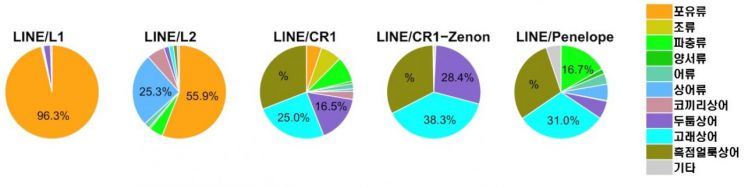
The whale shark was found to have many repetitive sequences in its nucleotide sequences compared to other organisms. Regular repetitive sequences were frequently found in the intron regions, suggesting that introns may have additional functions.
The research team believes that some of these new functions of introns are related to aging.
Seung-koo Park, Ph.D., the first author from UNIST, said, “The whale shark genome contains significantly more repetitive sequences such as ‘CR-1’ and ‘Penelope,’ whose functions are not clearly understood, compared to other species.”
The research team hypothesizes that among the unknown functions of whale shark introns, there may be functions that affect aging.
The team obtained these results by comparing and analyzing various factors known to be related to lifespan?such as body size, basal metabolic rate, and genome size?with the genomic characteristics of the whale shark across 84 species.
In this process, the standard genome of the whale shark was also constructed. By assembling billions of short nucleotide sequences obtained through genome decoding, the team built a whale shark standard genome map consisting of 3.2 billion base pairs.
The research team was the first to reveal that whale shark neural-related genes have long introns. This study also demonstrated that genes associated with neural connectivity in whale sharks are longer than other genes.
Neural-related genes play a very important role in biological evolution, and generally, the longer the neural-related genes, the better they are expressed and regulated.
Jong-hwa Park, Ph.D., a corresponding author and professor at UNIST, evaluated, “This whale shark genome analysis result can provide a very important clue not only for whale shark evolution research but also for aging research in various species including humans.”
This study involved corresponding authors George M. Church from Harvard University and Jeremy S. Edwards from the University of New Mexico.
© The Asia Business Daily(www.asiae.co.kr). All rights reserved.
![From Hostess to Organ Seller to High Society... The Grotesque Scam of a "Human Counterfeit" Shaking the Korean Psyche [Slate]](https://cwcontent.asiae.co.kr/asiaresize/183/2026021902243444107_1771435474.jpg)


















