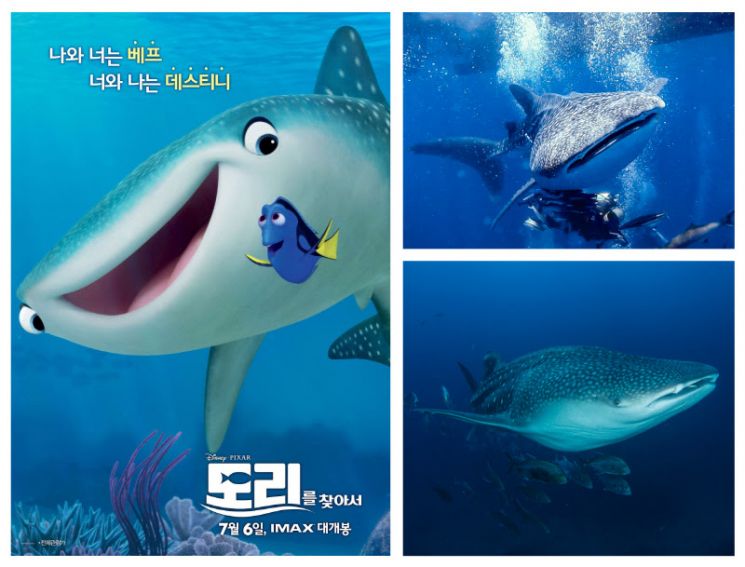
[Asia Economy Reporter Junho Hwang] What is the reason that the whale shark, the largest existing fish species, can live for nearly 100 years on average?
The Genome Industry Technology Center at Ulsan National Institute of Science and Technology (UNIST), Harvard University, Seoul National University, Jeju National University, and others announced on the 5th that through a joint study analyzing the genome of the endangered whale shark, they found a correlation between gene length and lifespan. The research results were published in the Proceedings of the National Academy of Sciences of the United States of America.
Gene Length Related to Lifespan
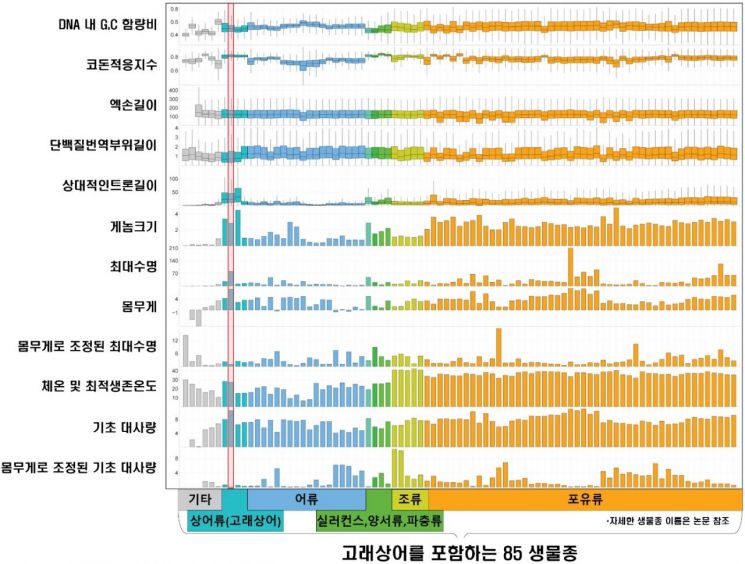
The research team completed a reference genome of the whale shark using samples provided by Aqua Planet Jeju in Korea. By decoding the genome, they newly assembled billions of short nucleotide sequences (de novo assembly) to construct a whale shark reference genome map consisting of 3.2 billion base pairs.
The team then compared various factors known to be related to lifespan, such as body size (organism weight), basal metabolic rate (BMR), and genome size, with the genomic characteristics of the whale shark against the whole genomes of 84 other species.
As a result, they confirmed that the length of the whale shark's 'introns' is longer compared to other organisms. Introns are parts of genes that do not participate in protein synthesis but are related to basal metabolic rate (BMR), which is associated with lifespan.
In particular, the researchers discovered that the intron regions are arranged repeatedly with a certain pattern, unlike in other organisms. This is a feature not found in other species.
Contributing to Aging Research Across Various Species
 Professor Jonghwa Park, Department of Life Sciences, Ulsan National Institute of Science and Technology
The research team anticipated that these intron regions might be related to aging. First author Seunggu Park of UNIST explained, "The whale shark genome contains significantly more repetitive sequences such as CR-1 and Penelope, whose functions are not yet clear, compared to other species," adding, "We expect that among the unknown functions of introns, there may be functions affecting aging."
Additionally, the researchers confirmed that whale shark neural-related genes have long introns. They demonstrated that genes associated with neural connectivity in whale sharks have longer lengths than other genes. Neural-related genes play a very important role in biological evolution. The longer the neural-related genes, the better their expression and regulation.
Professor Jonghwa Park evaluated, "This whale shark genome analysis result can be a very important study not only for whale shark evolutionary research but also for aging research across various species, including humans."
© The Asia Business Daily(www.asiae.co.kr). All rights reserved.
!["I'd Rather Live as a Glamorous Fake Than as a Poor Real Me"...A Grotesque Success Story Shaking the Korean Psyche [Slate]](https://cwcontent.asiae.co.kr/asiaresize/183/2026021902243444107_1771435474.jpg)


















