Seoul City States Initial Opposition to Government's Public Reconstruction Plan
Explains 50-Story 'Apartment' Also Not Allowed... "35-Story Rule Still Valid"
Highlights Issues in Current Public Sale System and Emphasizes Equity Accumulation Type Sale
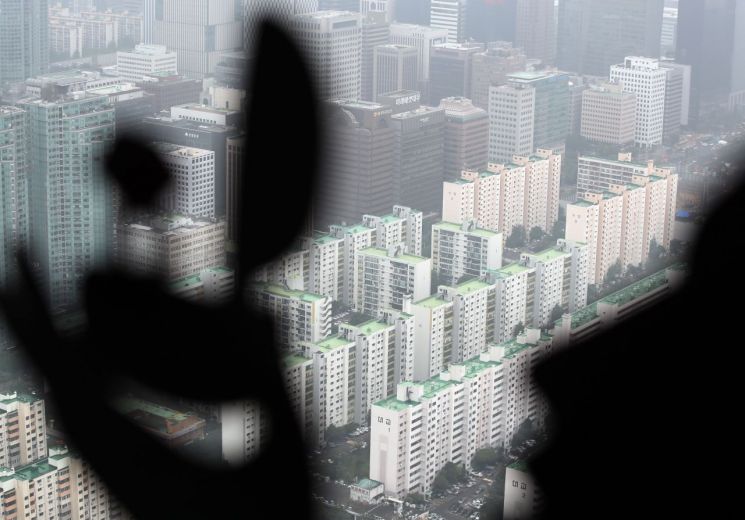
[Asia Economy Reporter Onyu Lim] On the 4th, the government proposed 'public participation high-density reconstruction' as a major housing supply plan for the Seoul metropolitan area, but it turned out that Seoul City, a key local government, has a passive stance on this. Conflicting statements also emerged regarding the '50-story reconstruction apartments' through floor regulation relaxation, continuing the discord between the government and Seoul City on real estate measures.
"Seoul City does not particularly support public reconstruction"
Kim Seong-bo, head of the Seoul City Housing and Architecture Headquarters, held a separate briefing at Seoul City Hall in the afternoon and said, "Public redevelopment and public reconstruction are not exempt from the application of the price ceiling system, so there is a practical question of whether the private sector can participate," adding, "Seoul City originally did not particularly support this method."
Public reconstruction is a new type of maintenance project led jointly by public institutions such as Korea Land and Housing Corporation (LH) and Seoul Housing and Communities Corporation (SH). It relaxes the floor area ratio to 300-500%, supplying more than twice the number of existing households, and recovers 50-70% of the increased floor area ratio through donation. The government announced that it plans to supply more than 50,000 households over the next five years through public reconstruction.
However, while Seoul City agrees with strengthening the public nature of reconstruction projects, it explains that private sector involvement is not an appropriate measure. Director Kim added, "Basically, the position is that the public nature of reconstruction should be strengthened through rental housing, but it is unbalanced for the public sector to participate and lead private reconstruction projects due to the nature of the business."
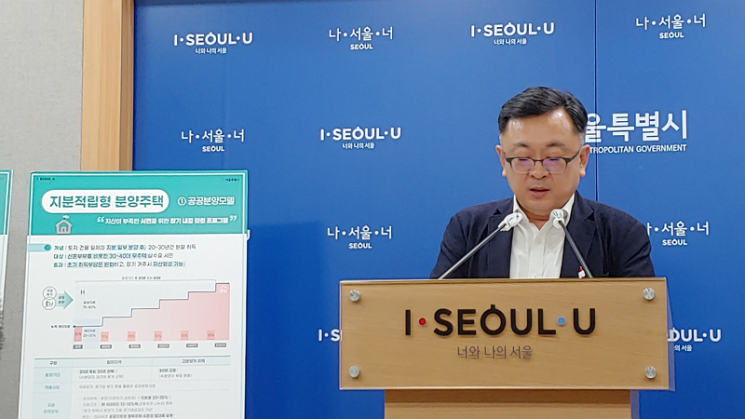 On the 4th, Kim Seong-bo, Director of the Housing and Architecture Headquarters of Seoul City, is giving a briefing on housing supply measures.
Regarding the 50,000 households estimated by the government, Director Kim said bluntly, "Seoul City does not have a separate estimate for the volume set by the government." He also said about the government's estimation method, "The government ran simulations, but Seoul City does not know about it." This is interpreted as opposition to the public reconstruction discussion and little involvement in the drafting process. When asked if there are any associations that have expressed willingness to participate in public reconstruction, he briefly answered, "None."
Is the government's 50-story reconstruction apartment plan off the table? Seoul City: "Currently impossible to build 50-story apartments that are not mixed-use"
Seoul City also showed disagreement with the government's relaxation of floor area ratio and floor regulations for public reconstruction. The government announced that "when promoting public reconstruction, it is possible to build apartments up to 50 stories with a maximum floor area ratio of 500% through zoning upgrades." However, Seoul City holds the position that 50-story apartments are impossible under current regulations.
Lee Jeong-hwa, director of Seoul City Urban Planning Bureau, said, "The height issue has been finally decided within the framework of the 2030 Seoul Basic Urban Plan (Seoul Plan)," adding, "Whether general residential or semi-residential, pure residential apartments can only be built up to 35 stories." However, she explained, "In semi-residential areas, if it is a mixed-use building including non-residential uses, it can be built over 40 stories depending on the hierarchy of the central area."
Kim Seong-bo, head of the Seoul City Housing and Architecture Headquarters, also said in the same vein, "As per Seoul City's basic stance, residential areas can have up to 35 stories, and semi-residential areas can have up to 50 stories."
Since Seoul City, which holds the authority for urban maintenance planning and permits, has firmly stated that "residential apartments can be up to 35 stories," '50-story reconstruction apartments' seem practically impossible. Accordingly, the government's goal of 50,000 households is inevitably facing setbacks.
The 35-story limit reflects the strong will of the late former Mayor Park Won-soon, who passed away last month. It is reported that Seoul City plans to maintain this limit at least until a new mayor takes office after the by-election in April next year.
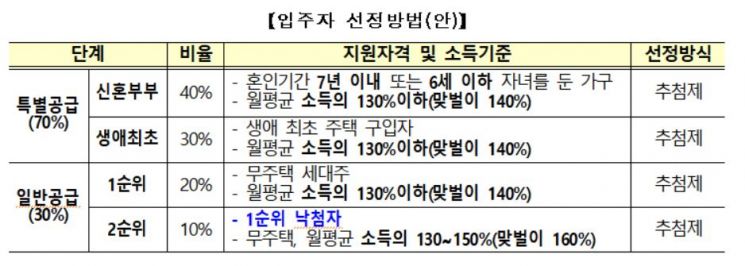
Seoul City increases public sale units with equity accumulation type: "Helps 30s and 40s secure their own homes"
Meanwhile, Seoul City seems to focus on equity accumulation type public sales instead of public reconstruction. A significant portion of the briefing was devoted to explaining the equity accumulation type. Equity accumulation type sale housing refers to housing where non-homeowners with insufficient funds pay a certain equity portion of the sale price at move-in and acquire the remaining equity gradually over a long period while residing. For example, paying 40% of the sale price upfront and the remaining 60% in installments over 20 or 30 years. The 60% equity is held by the supplier, Korea Land and Housing Corporation (LH) or Seoul Housing and Communities Corporation (SH), but the contract holder gradually increases their equity according to the amount paid.
Seoul City plans to apply equity accumulation type sale housing to as many public sale units supplied by the city as possible. A Seoul City official said, "It is expected that up to 17,000 households can be supplied through equity accumulation type sales by 2028," adding, "More than half of the sites owned by Seoul City will be supplied in this equity accumulation type." The plan is also to gradually increase equity accumulation type sales on land owned by SH.
Equity accumulation type housing is allocated by lottery. This decision aims to solve the current problem where 30s and 40s households are excluded from public sales. A Seoul City official explained, "A person who won a 59㎡ public sale in Magok District has a subscription payment of 23 million KRW, which requires about 20 years paying 100,000 KRW monthly. People in their mid-30s cannot afford that amount. Because of the payment, young people find it difficult to win." He continued, "The equity accumulation type we designed uses a lottery system to benefit as many people as possible," adding, "For those who qualify, the equity accumulation type is allocated by lottery, with 70% special supply and 30% general supply."
Director Kim said, "Unlike the current method, which is evaluated as a lottery, this model can help the 30s and 40s generation, who face various difficulties such as small asset size, low subscription points, and loan regulations, to secure their own homes."
© The Asia Business Daily(www.asiae.co.kr). All rights reserved.



















