Tesla, Amazon, and Others Bought 1.6 Trillion Won This Month
Net Buying in Semiconductor, Healthcare, and New Materials Stocks
Increased Hong Kong and China Stock Holdings Compared to First Half
[Asia Economy Reporter Minji Lee] As domestic investors increasingly invest in overseas stocks, it has been revealed that they are actively purchasing representative growth stocks in the United States. Individual investors have net bought 1.6 trillion KRW worth of stocks in major growth stocks such as Tesla, Amazon, Apple, and Microsoft (MS) just this month. In particular, since the second half of the year, they have increased net purchases of companies related to semiconductors, healthcare, and new materials, while also raising their proportion of Hong Kong and China stocks.
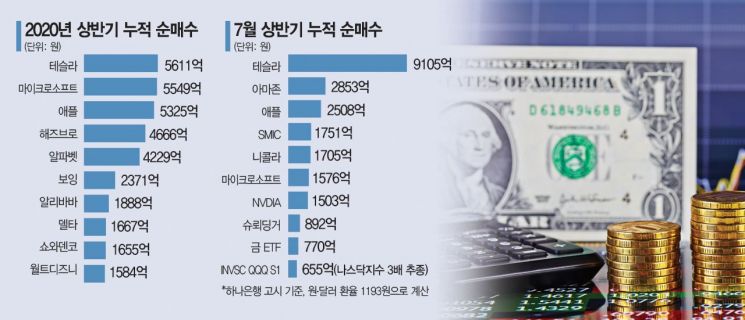
◆ Retail investors buying growth stocks with earnings growth = According to the Korea Securities Depository’s SaveRo on the 4th, the stock most purchased by domestic investors in July was Tesla, with about 910.5 billion KRW worth of shares bought. This is a 60% increase compared to Tesla’s net purchase amount in the first half of the year.
The reason for the heightened interest in Tesla among individuals is the expectation that the stock price will rise further if it is included in the S&P 500 index. Lee Sang-hyun, a researcher at IBK Investment & Securities, said, "Tesla has increased its chances of inclusion by posting profits for four consecutive quarters," adding, "If included in the index, the buying momentum from funds and individuals will grow even more."
The biggest difference compared to the first half of the year is that stocks without supported earnings have disappeared from the rankings. Hasbro, a favorite stock of domestic investors in the first half, recorded an operating profit 29% lower year-on-year in the second quarter, causing its stock price to fall about 13% from the June peak. Walt Disney also saw a significant drop in offline sales such as theme parks due to the impact of COVID-19, making recovery uncertain in the second half. Its stock price fell about 9% from the June peak. Delta Air Lines and Boeing, which were hit hard by COVID-19, also dropped out of the rankings. Instead, individual investors bought semiconductor-related manufacturing companies SMIC (Shenzhen Microelectronics International Corporation) and NVIDIA stocks worth 175.1 billion KRW and 150.3 billion KRW, respectively.
Retail investors boldly invested in healthcare and new materials companies, dreaming of a "second Tesla." Nikola, a hydrogen truck manufacturer, was the fifth most purchased stock by individuals with 170.5 billion KRW. Hydrogen trucks are expected to begin production in the second half of 2023, with sales from 2020 to 2022 projected to be minimal. The company’s future value and government policies on eco-friendly materials appear to be stimulating investment sentiment. Schr?dinger, which provides platforms related to new drug development, also attracted future-oriented investments worth 89.2 billion KRW. Although the new drug development sector mostly operates at a loss, clinical expectations for the pipeline and anticipated sales growth in the software sector are believed to be driving buying momentum.
◆ Proportion of net purchases in Hong Kong and China stocks rises from 8% to 30% = Retail investors have also expanded their interest to Hong Kong and China stocks this month. Among the top 50 stocks purchased by domestic investors in July, 15 were Hong Kong and China-listed stocks, accounting for 30%. This contrasts with the first half of the year, when only 4 stocks (8%) were from these markets, with most purchases being U.S. stocks.
Overseas direct buyers focused on BBIG (Bio, Battery, Internet, Game) stocks. Growth stocks have emerged as new leaders in this year’s market due to the spread of untact culture caused by COVID-19. Recently, as U.S. tech stocks posted solid earnings, individual interest in BBIG has further expanded.
In particular, the scale of purchases in biotech was large. Excluding SMIC, the most purchased Hong Kong and China stock by individuals was Ping An Good Doctor (57.8 billion KRW). This stock is China’s largest online remote medical platform, actively expanding telemedicine services by leveraging its parent company Ping An Insurance. Ping An Insurance ranks just behind Alibaba and Tencent Group in terms of market capitalization among Chinese companies. Additionally, money flowed into Mirae Asset Horizon China Biotech ETF (22.5 billion KRW), which invests in Chinese biotech companies with high potential, as well as into Hansoh Pharmaceutical (23.8 billion KRW), Alibaba Health (21.8 billion KRW), and Wuxi Biologics (19.4 billion KRW).
Following the acceleration of China’s delivery market growth after COVID-19, Meituan Dianping also attracted 22 billion KRW. Known as the "Amazon of China," this company’s stock price rose about 94% from 103.50 HKD at the beginning of the year to 200.60 HKD. The market expects Meituan Dianping’s profitability to improve if it successfully builds lifestyle service platforms such as tourism, dining, and leisure. Additionally, 20.8 billion KRW and 19.9 billion KRW flowed into Ganfeng Lithium and related stocks held by Mirae Asset GBL IN GLOBAL X C ELC VHC ETF, which benefit from secondary batteries. Stocks related to 5G, such as Sun Nan Circuit, attracted 16 billion KRW in funds.
© The Asia Business Daily(www.asiae.co.kr). All rights reserved.

















