Export of E-Government Systems Halved
Mid-sized Companies Engage in Price-Cutting Competition
Ministry of Education's 'NEIS' Construction Project
Inter-Ministerial Conflict Over Large Corporation Participation
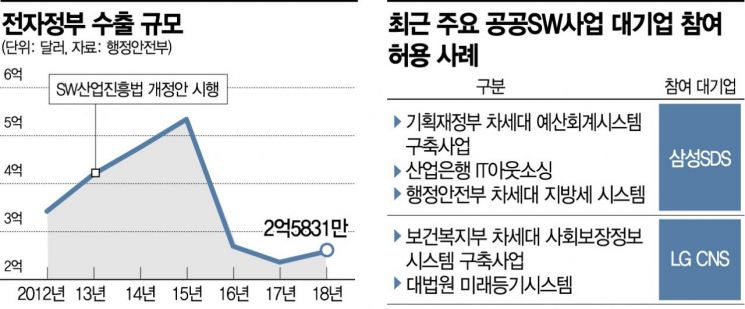
[Asia Economy Reporter Jin-gyu Lee] The government’s effective restriction on large corporations’ participation in public software (SW) projects for eight years has led to numerous side effects. Exports of e-government systems have been halved, and mid-sized companies that filled the void left by large corporations face a crisis of deteriorating profitability due to cutthroat low-price competition. Criticism has also arisen that public inconvenience has only increased as service quality has declined in large-scale public projects, such as connection errors during the unprecedented online school openings. Far from fulfilling the legal intent of fostering small and medium-sized enterprises (SMEs) and mid-sized companies, this policy runs counter to the digital transformation spreading throughout the industry.
This is also why conflicts have intensified even within government ministries over whether to allow large corporations to participate in the Ministry of Education’s recent '4th Generation Education Administration Information System (NEIS)' development project. Voices are growing that large corporations should not be arbitrarily blocked from participating, especially to apply new technologies such as cloud computing in public IT services and to ensure stable service in line with the 'Digital New Deal.'
E-Government Export Shaken as Large Corporations Withdraw
According to the Ministry of the Interior and Safety and the system integration (SI) industry on the 4th, the scale of e-government system exports has been halved in recent years and has struggled to recover. Before the ban on large corporations’ participation in public SW projects, e-government exports peaked at $534.04 million in 2015, up from $342.12 million in 2012. However, from 2016 onward, foreign companies began to dominate, cutting exports in half. A Ministry of the Interior and Safety official analyzed, “As large corporations withdrew from e-government export bids, the competitiveness of e-government exports sharply declined.”
Although opportunities for mid-sized and small companies to participate in public projects increased, there is controversy over whether their self-sustainability has grown in line with the law’s intent. Profitability deterioration has been confirmed mainly among mid-sized companies that took the place of large corporations, as small companies lack the ability to bid alone. ITCEN, which had sales of around 130 billion KRW before the large corporation participation restriction, saw its sales surge to 1.5424 trillion KRW last year. However, its operating profit was only 24.1 billion KRW, with an operating profit margin of just 1.5%. Metanet Daewoo Information (formerly Daewoo Information System) had an operating profit margin below 1%. An industry insider said, “Public SW projects themselves have low profitability, and as mid-sized companies engage in cutthroat low-price competition, profitability is not improving.”
Discord Among Ministries... System Construction Delays
The Ministry of Education’s NEIS project, originally scheduled to launch in 2022, is facing delays in system construction orders due to discord among ministries over whether to allow large corporations to participate. Currently, the Ministry of Science and ICT is conducting its fourth review on whether to permit large corporations’ participation in the NEIS project. NEIS is the Ministry of Education’s core IT system managing student grades, attendance, and academic schedules. According to the revised Software Industry Promotion Act of 2013, an exception review must be conducted to allow large corporations’ participation, but the Ministry of Science and ICT has rejected it three times since December last year. Meanwhile, the Ministry of Education argues that amid the COVID-19 pandemic, introducing the latest IT technologies such as cloud computing for non-face-to-face education makes large corporations’ participation essential in the 'IT new technology' field.
Concerns about system stability also underlie this issue. Blocking large corporations from participating in large-scale public SW projects like NEIS has led to confirmed cases of declining quality. A representative example was the failure of the online public education site during the online school opening in the first half of the year, when hundreds of thousands of students accessed it simultaneously. At that time, the problem was barely resolved with the help of LG CNS. Recently, exceptions allowing large corporations’ participation were granted for the Ministry of Health and Welfare’s next-generation social security information system (LG CNS), the Supreme Court’s future registration system (LG CNS), and the Ministry of Strategy and Finance’s next-generation digital budget accounting system (Samsung SDS), which is not unrelated to this issue.
Additionally, the lack of consistent standards regarding exceptions for large corporations’ participation in public SW projects has been pointed out as a problem. The Ministry of Science and ICT’s 'Operation Guidelines for Large Corporation Participation in Public SW Projects in New Industry Fields' only states, “Even in new industry fields, decisions are made comprehensively considering project scale, technological and industrial ripple effects.” In June last year, the Ministry of Science and ICT pledged to analyze the policy effects of the large corporation participation restriction system and prepare improvement measures within the year but has yet to present any alternatives.
Lim Dong-won, a senior researcher at the Korea Economic Research Institute, emphasized, “Instead of excluding large corporations from public SW projects, improvement measures should be devised to enable coexistence, such as forming consortia including large, mid-sized, and small companies.”
© The Asia Business Daily(www.asiae.co.kr). All rights reserved.

















