
[Asia Economy Reporter Junho Hwang] A next-generation NVMe (Non Volatile Memory express) controller developed to maximize the performance of SSDs that store data using semiconductors has been created by a domestic research team. In particular, the researchers are releasing the NVMe intellectual property (IP) required to build this controller free of charge. This is expected to open a new chapter in NVMe research, which previously cost tens of millions to hundreds of millions of Korean won.
Development of Korean-made NVMe Controller

Professor Myungsoo Jung’s research team from the Department of Electrical Engineering at the Korea Advanced Institute of Science and Technology (KAIST) announced on the 4th that they have developed a next-generation NVMe controller called 'OpenExpress,' which implements hardware for parallel data input/output processing of SSDs.
The NVMe controller is a device that controls data exchange between the SSD’s memory and interface. It was developed as a replacement for the existing standard (SATA), which was designed for hard disk drives (HDDs) and could not fully realize performance on SSDs. SSDs are storage devices developed due to the slow speed of auxiliary storage devices (hard disks, HDDs), which are one of the core components of computers.
This device has performance suitable for NVMe research. The FPGA storage card prototype developed using OpenExpress supports bandwidths of up to 7GB/s. In tests comparing various storage server workloads, it showed 76% higher bandwidth and 68% lower input/output latency than Intel’s new high-performance storage device, the Optane SSD. It is expected that synthesizing silicon devices according to user needs will yield much higher performance. Additionally, this device can be freely used and modified within the 'OpenExpress' open-source protocol by universities and research institutes for non-profit purposes.
Free Release for Research Purposes
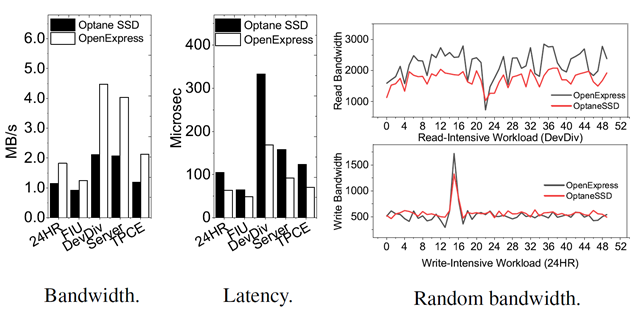
OpenExpress is significant as a technology that opens a new chapter in NVMe research. The research team is releasing OpenExpress free of charge. This open-source controller consists of more than dozens of basic hardware IPs and several core NVMe IP cores. For actual performance evaluation, the team produced a prototype NVMe hardware controller using OpenExpress, and all logic provided by OpenExpress was designed to operate at high frequencies.
Global ICT companies invest enormous amounts in NVMe development. However, since each company does not disclose their IP externally, universities and research institutes have been unable to conduct research. Although a company in Silicon Valley, USA, has released its self-developed IP, the usage fee is as high as 40 million won per month. To receive a single-use source code for IP modification, about 100 million won per copy must be paid.
Professor Myungsoo Jung emphasized, "By releasing this research achievement, controllers that were previously only held by a few world-leading companies in SSD technology can now be used free of charge by universities and research institutes," adding, "It is meaningful as it lays the foundation for research on ultra-high-speed next-generation memory and storage systems."
Meanwhile, this research achievement was presented at ATC2020 (The USENIX Annual Technical Conference 2020), the top academic conference in the systems field, held on the 18th of last month. It is the first time in the conference’s history (since 1993) that a paper authored by a single Asian author has been accepted.
© The Asia Business Daily(www.asiae.co.kr). All rights reserved.



















