[Asia Economy Reporter Jeong Hyunjin] More than eight out of ten Japanese citizens perceive that Japan has already apologized to neighboring countries that suffered damage due to the Pacific War and other aggressive wars initiated by Imperial Japan.
On the 3rd, the "Japan Public Opinion Survey Group," composed of Kyodo News and its affiliated agencies, conducted a nationwide postal survey in June and July targeting 2,059 voters (valid respondents) regarding the 75th anniversary of the end of the Pacific War. The results showed that 84% of respondents answered that Japan had apologized to the neighboring countries harmed by the war. Specifically, 31% said Japan had "apologized sufficiently," and 53% said "to some extent," greatly surpassing the 14% who chose opposing opinions.
Since 1994, Japanese Prime Ministers have attended memorial services for war dead every August 15, the anniversary of Japan's defeat, and have expressed reflection as the aggressor nation through speeches, starting with then-Prime Minister Tomiichi Murayama. However, this practice has been broken since December 2012, when Prime Minister Shinzo Abe began his second term. Abe has not expressed remorse for past aggressive wars.
About 46% of respondents identified the Second Sino-Japanese War and the Pacific War as aggressive wars by Imperial Japan. In contrast, 13% viewed them as wars of self-defense, and 3% responded that they were "Asian liberation wars." A significant 32% answered "don't know." Regarding whether the Japanese Prime Minister should "mention reflection and also apologize" as the aggressor nation, 38% agreed, while 44% said "mention reflection but no need to apologize."
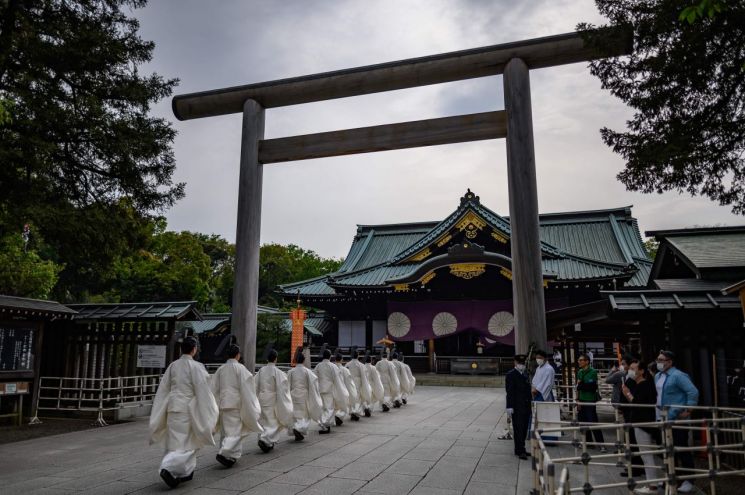
When asked whether Japanese citizens should continue to hold a sense of reflection and apology for past aggressive wars against neighboring countries, 50% said "necessary," and 46% said "not necessary." Regarding the issue of the Japanese Prime Minister visiting Yasukuni Shrine, 58% said "should visit," greatly exceeding the 37% who said "should not visit."
Regarding the reason Japan has not been involved in any wars since the end of World War II in 1945, 47% cited Article 9 of the Peace Constitution. Article 9 renounces war as a means of settling international disputes and prohibits maintaining military forces. As for the possibility of Japan engaging in war in the future, 66% predicted "no," while 31% saw a "possibility." Concerning the future status of the Self-Defense Forces, 76% responded that "based on the pacifist principle of the Constitution, Japan must strictly maintain defense of the homeland."
© The Asia Business Daily(www.asiae.co.kr). All rights reserved.

















