
[Asia Economy Reporter Junho Hwang] Domestic researchers have found clues to the causes of dementia through Generative Adversarial Networks (GAN). GAN is an artificial intelligence (AI) that creates fake data through competition between datasets, and it is well known as the algorithm recently used by the University of Washington in the United States to create videos of former President Barack Obama actually giving speeches. The research team expects that GAN can overcome the limitations of brain disease and aging-related analyses.
Dr. Mu-Kyung Cheon’s research team at the Korea Brain Research Institute announced on the 4th that they proved, by analyzing omics data using GAN, that an increase in amyloid beta in the brain induces cholesterol synthesis. Omics is a field of study that analyzes important information related to life phenomena, such as the activity of proteins that make up genetic material within living organisms.
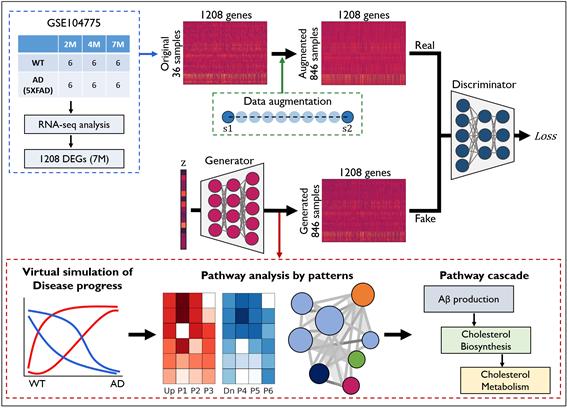
The research team analyzed cerebral cortex tissue data from mice induced with Alzheimer’s disease using GAN and discovered that as amyloid beta increases, it initially induces cholesterol synthesis. They also confirmed this correlation in human postmortem brain tissue.
Amyloid beta is a protein that causes dementia and is a substance removed by microglia (immune-related neural cells) when excessively accumulated in a normal brain. Cholesterol is a substance that composes cell membranes, regulates membrane fluidity, and must be maintained at a certain level to preserve homeostasis in the body.
The researchers evaluated that the increase in amyloid beta acts as a signal for cholesterol synthesis, and the interaction between these two processes may be involved in synapse formation and synaptic plasticity.
The research team expects this study to be a new approach to predicting in vivo changes occurring in the early stages of disease, as it is an example of a unique research method that integrates AI with RNA transcriptome analysis.
Dr. Mu-Kyung Cheon stated, "By utilizing GAN, it is possible to explain molecular mechanisms by going beyond analyzing differences in gene expression caused by diseases to uncovering the causes of phenomena. If this methodology continues to expand and omics data accumulates, it is expected to overcome the limitations of existing brain disease and aging-related analyses, which required a lot of time to obtain samples."
© The Asia Business Daily(www.asiae.co.kr). All rights reserved.


















