Supreme Court Orders Compensation for Forced Labor by Japanese Companies
Asset Seizure Procedures Begin at Midnight on 4th for Japanese Forced Labor Firms in Korea
Japanese Government Considers Tariff Hikes, Remittance Suspension, Visa Restrictions
Civic Groups: "Japanese Government, Fundamentally Responsible Perpetrator, Pretends to Be Victim"
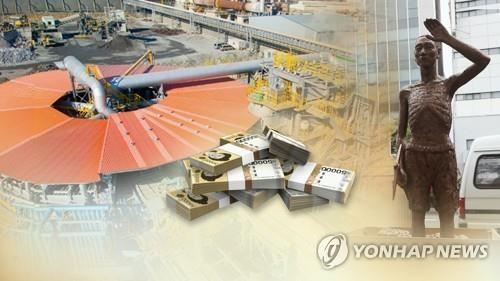
[Asia Economy Reporter Kim Suwan] As the procedures by our courts to seize domestic assets of Japanese forced labor companies begin tomorrow (the 4th), the Japanese government has hinted at additional retaliatory measures should their companies suffer damage from this sale, sparking controversy. The Japanese government claims that the issue of forced labor victims was fully resolved by the 1965 Korea-Japan Claims Agreement, intensifying the conflict surrounding this matter. Citizens, in particular, are outraged by Japan's response, saying retaliatory measures are unacceptable.
In October 2018, the Korean Supreme Court ordered the Japanese company Shin Nippon Steel (Shin Nihon Ch?kin) to compensate four forced labor victims, including Lee Chunsik, with 100 million won each in a final appeal lawsuit.
They were forcibly conscripted to work under harsh conditions without pay at Nippon Steel, the predecessor of Shin Nippon Steel, between 1941 and 1943.
Shin Nippon Steel argued that even if claims remained, they should be considered expired, but this was not accepted.
In December of the same year, the plaintiffs applied to the court to seize shares of PNR, a Korean joint venture between Nippon Steel and POSCO, to secure their compensation claims.
The Pohang branch of the Daegu District Court decided in January last year to seize 81,075 shares (equivalent to about 400 million won based on a face value of 5,000 won), and the plaintiffs applied for the sale of these assets in May last year.
However, the Japanese government refused to deliver the Korean court's asset seizure decision to the defendant Nippon Steel. Ultimately, the Pohang branch initiated a public notice delivery procedure on June 1, with its effect taking place on the 4th.
Accordingly, after midnight on the 4th, the documents will be considered delivered, allowing the court to order the liquidation of Shin Nihon Ch?kin's domestic assets under seizure.
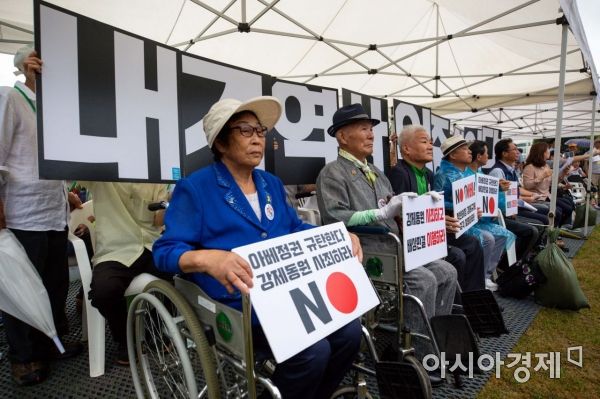 Victims and bereaved families of forced mobilization under Japanese rule participating in the 'Citizen Rally for the Resolution of Forced Mobilization Issues on the 74th Anniversary of Liberation' held at Seoul Plaza, Jung-gu, Seoul on August 15 last year, are holding a picket protest.
 /Photo by Kang Jin-hyung aymsdream@
Meanwhile, it has been confirmed that the Japanese government is currently considering retaliatory measures in preparation for the possible liquidation of its companies' assets in Korea.
Foreign media such as Yomiuri Shimbun reported on the 2nd that "If the assets of Shin Nihon Ch?kin (currently Nippon Steel) are liquidated, the Japanese government plans to take countermeasures," and "various options are being discussed."
Japanese government spokesperson Chief Cabinet Secretary Yoshihide Suga appeared on Yomiuri TV on the 1st (local time) and stated regarding the forced sale of Nippon Steel's assets, "The government is reviewing all possible responses. The direction is clear."
Relatedly, Kyodo News reported that "stricter visa issuance requirements or the temporary recall of the Japanese ambassador to Korea are emerging as options."
According to these reports, various countermeasures such as visa restrictions, financial sanctions, and export controls are being considered in Japan.
Previously, the Japanese government retaliated against the Supreme Court's forced labor compensation ruling by imposing export restrictions, intensifying the controversy. On August 15 last year, marking the 74th Liberation Day, a "Citizens' Rally for the Resolution of the Japanese Forced Labor Issue" was held in downtown Seoul. Citizens gathered at the protest shouted slogans such as "Apologize for forced labor" and "Abe must apologize," urging the Japanese government to compensate forced labor victims.
Given this situation, citizens expressed their opposition to the Japanese government's actions, saying, "There is absolutely no remorse," "Retaliatory measures are absurd. How long must we keep watching Japan?" and "There was no sincere apology for forced labor victims, yet they retaliate against asset seizures. We cannot tolerate this anymore. We will continue the boycott movement to the end." The Japanese government's attitude, lacking apology or remorse, is causing further suffering to forced labor victims.
A 27-year-old office worker A said, "Being swayed by the Japanese government like this is unacceptable now," adding, "Considering the victims who have suffered for a long time, Japan should offer a sincere apology and compensation as soon as possible. But the fact that the Japanese government is thinking about retaliation makes me very angry. I hope our government takes strong measures."
Another office worker B (31) said, "Japan has played the retaliation card, but I don't think we should compromise because of this. If we give in now, only the victims will suffer," and insisted, "Even if it takes a long time, we must seize the assets until the victims are compensated." He added, "I also feel that we should continue the boycott movement diligently."
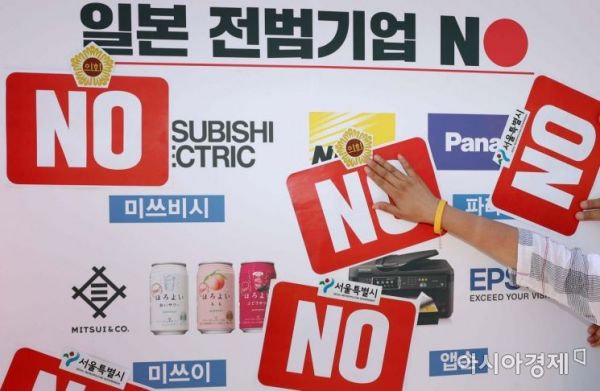
Meanwhile, civic groups raised their voices criticizing the Japanese government, which bears fundamental responsibility for Japan's forced labor. The Institute for Research in Collaborationist Activities, which investigates and researches the resolution of forced labor issues and the clearing of Japan's past, told Asia Economy in a phone interview, "The effect of the public notice delivery procedure takes place at midnight on the 4th, but this does not mean immediate forced sale or conversion to cash. The Japanese government's consideration of retaliatory measures is illegal under international law and unjustifiable in principle. It is irrational."
They continued, "If Nippon Steel does not intend to comply with the Korean court's ruling, why did they come to Korea and undergo a long trial?" and explained, "When our organization visited Japan directly, they responded that since the trial was ongoing, they would abide by the ruling. However, when the ruling came out, they are refusing to compensate."
The Lawyers for a Democratic Society also stated in a press release, "Since the 2018 Supreme Court ruling, the expectations of victims who have long awaited human rights restoration and justice after more than 70 years since liberation have been brutally trampled," and "We cannot contain our anger at the Japanese government, which bears fundamental responsibility for forced labor, pretending to be victims."
They added, "The defendant Japanese companies Nippon Steel, Mitsubishi, and Fujikoshi should acknowledge their responsibility and take the lead in compensation according to the ruling, but instead, they refuse dialogue and hide behind the government, making no effort," emphasizing, "We strongly condemn the cowardly behavior of these so-called global companies and declare that we will hold the perpetrator companies accountable to the end."
© The Asia Business Daily(www.asiae.co.kr). All rights reserved.
![Clutching a Stolen Dior Bag, Saying "I Hate Being Poor but Real"... The Grotesque Con of a "Human Knockoff" [Slate]](https://cwcontent.asiae.co.kr/asiaresize/183/2026021902243444107_1771435474.jpg)













