Rainy Season During Vacation, Offline Sales Down
Convenience Store Sales at Tourist Spots Halved
Department Stores See Decline in Miscellaneous Goods and Apparel
Online Shows Stable Growth
SSG.com SSG Delivery Up 10%
Dehumidifiers and Dryers Benefit from Rainy Season Demand
Vegetable Prices Rise Amid Reduced Shipments
[Asia Economy Reporter Seungjin Lee] The prolonged rainy season over the past few weeks has brought mixed fortunes to distribution companies. The government attempted to revitalize consumption, which had stagnated due to the COVID-19 pandemic, by providing emergency disaster relief funds, but offline retailers are struggling as the rainy season coincides with the vacation period. On the other hand, online shopping malls have seen increased sales as people spend more time at home.
◆ Convenience stores and department stores see a sharp drop in customers due to the rainy season = According to the distribution industry on the 3rd, sales at convenience stores in major tourist areas have been halved recently. Normally, convenience stores would be bustling with customers looking for beer, ice cream, and other items, but continuous heavy rain has caused customer visits to plummet.
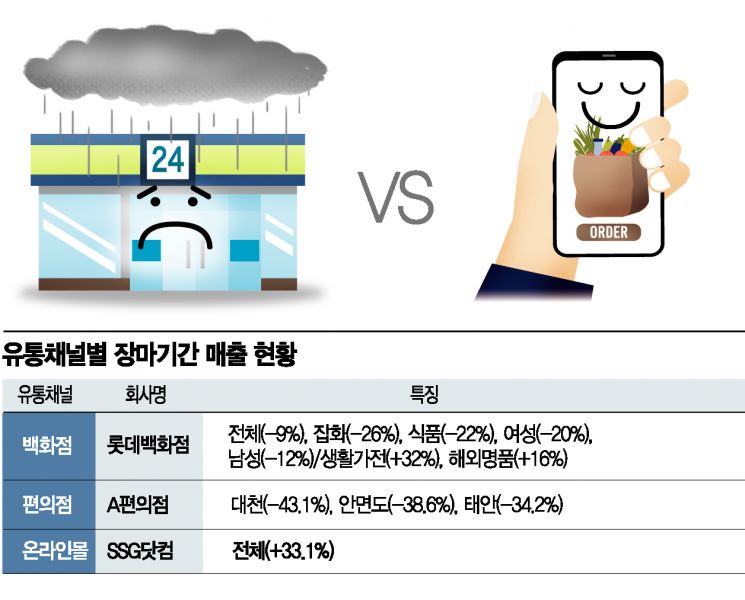
In fact, for brand A convenience stores, sales at stores located on the west coast during last week (July 27 to August 2) all decreased compared to the previous year. Sales at convenience stores in Daecheon, Anmyeondo, and Taean areas dropped by 43.1%, 38.6%, and 34.2%, respectively. Brand B convenience stores showed a similar trend. Sales at representative stores in the west coast region fell by 30% compared to the same period last year. By product category, sales of summer items such as ice, carbonated drinks, and ice cream sharply declined by 41%, 31.2%, and 35.6%, respectively.
Sales at major offline stores are also sluggish. Consumers are reluctant to go shopping outdoors, and the continuous bad weather has suppressed spending on clothing and other items. Lotte Department Store's sales last week (July 27 to August 2) decreased by 9% compared to the same period last year (July 29 to August 4), when there was no rain. By category, miscellaneous goods, including sunglasses and bags, saw the largest drop at 26% compared to last year. Food, women's clothing, and men's clothing also declined by 22%, 20%, and 12%, respectively.
◆ Online sales hold steady despite consumption slump = Amid the overall decline in consumer sentiment due to the rainy season, online sales maintained a stable growth trend. According to SSG.com, sales from SSG Delivery last week increased by 10% compared to the same period last month (June 22 to 28). It appears that consumers preferred online grocery shopping over visiting marts in bad weather. For dawn delivery, there was little difference before and after the rainy season due to limited capacity at logistics centers, but the operation rate remained around 85%.
Some products benefited from the rainy season. At Lotte Department Store, sales of home appliances increased significantly by 32% compared to the previous year. This is because more consumers sought dehumidifiers and dryers due to the humid weather. At Electronic Land, air conditioner sales in July decreased by 30% compared to last year, but sales of dryers and dehumidifiers rose by 48% and 20%, respectively, during the same period. Clothing care appliances increased by as much as 388%.
◆ Decrease in vegetable and fruit shipments causes dining table prices to soar = Vegetable prices have been rising daily. According to the Korea Agro-Fisheries & Food Trade Corporation (aT), as of the 31st of last month, the consumer price for one head of cabbage was 5,708 won. It was 4,323 won a month earlier, but frequent rainfall in the Gangwon (Pyeongchang) region delayed shipments, reducing supply and causing a 15% increase. The same applies to other vegetables. During the same period, the price of 1 kg of spinach rose 14% to 10,549 won, and prices of radishes, carrots, cucumbers, and others also shifted to an upward trend.
Watermelon farmers, who should be making strong sales, are distressed. Due to early heatwaves followed by continuous rain, watermelon growth has been poor, and the price for one watermelon approaches 20,000 won. However, consumption has slowed as the rainy season overlaps with the vacation period. In response, Jinan County in Jeonbuk, a major production area, launched a "Watermelon Selling Campaign." Most summer fruits are in a similar situation. Grapes and peaches saw shipment reductions due to cold damage in April, causing prices to rise nearly 30% compared to last year, and prices are expected to increase further due to decreased shipments caused by the rainy season.
© The Asia Business Daily(www.asiae.co.kr). All rights reserved.

















