"Securing Cash Liquidity Is More Urgent Than Profit"
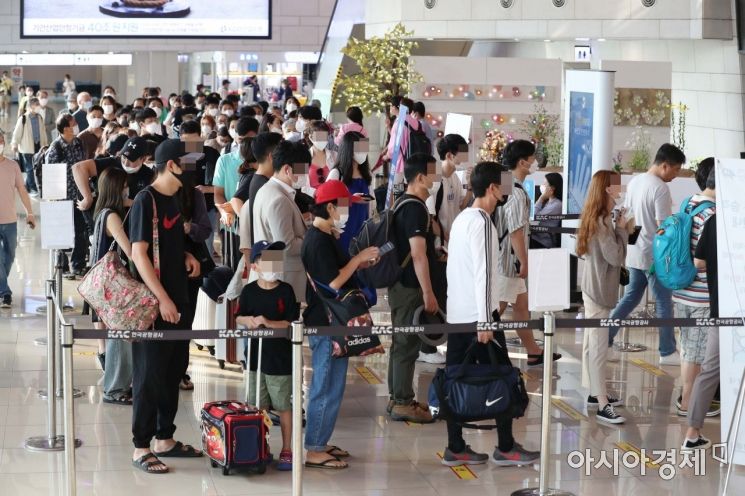 On the 31st, the domestic terminal of Gimpo Airport in Gangseo-gu, Seoul, was bustling with travelers during the holiday season. Photo by Moon Honam munonam@
[Asia Economy Reporter Yoo Je-hoon] The domestic airline market is experiencing intensified overheating competition due to the impact of the novel coronavirus infection (COVID-19). Low-cost carriers (LCCs), which have lost their way in international routes, are focusing on expanding domestic routes.
According to the Ministry of Land, Infrastructure and Transport's Aviation Information Portal System on the 1st, the number of domestic flights and passengers last month were tentatively counted at 33,678 flights and 4,944,351 passengers, respectively. This represents a recovery to 99% and 90% of the previous year's levels, respectively.
Although overall air travel demand decreased due to COVID-19, the increase in passengers choosing domestic travel instead of overseas trips during the summer vacation season has partially offset this decline.
In fact, recently, new domestic route launches, mainly by LCCs, have been accelerating. Jin Air simultaneously launched five routes starting yesterday: Gimpo~Pohang, Pohang~Jeju, Gimpo~Daegu, Gimpo~Ulsan, and Ulsan~Jeju. T'way Air (Busan, Gwangju) and Jeju Air (Busan) have also started operating at Yangyang Airport, which had been stigmatized as a "ghost airport."
Recently, cases of team kill have even appeared. Air Seoul plans to newly operate the Gimpo~Busan route four times daily starting on the 21st, but this route is already operated 11 times daily by Air Busan, a subsidiary and "sister company" of the same Asiana Airlines. Korean Air and Jin Air, sister companies under the Hanjin Group, also operate the same route eight and four times daily, respectively.
An industry insider said, "Generally, except for routes with very high demand, companies within the same group usually coordinate route operations, but this is an unusual situation now," adding, "Since each company is pushed to the brink of collapse due to COVID-19, there is a large aspect of inevitability."
Despite this situation, the industry evaluates that there is little real benefit in each company's domestic operations. The supply increase is steep compared to the demand growth, causing fares to fall below the published rates. An LCC insider said, "Domestic fares have hit rock bottom, and recently, customers seem to feel that even 40,000 to 50,000 won for a ticket is expensive," adding, "Rather than making a profit, the focus is more on securing cash liquidity."
This situation is likely to continue in the future. All companies urgently need to secure cash liquidity due to the prolonged COVID-19 situation. With the paid leave employment maintenance subsidy set to expire at the end of August, Jeju Air is now pushing for unpaid leave following T'way Air.
© The Asia Business Daily(www.asiae.co.kr). All rights reserved.

















