Offline Struggles as Online Dominates
Increased Purchases of Appliances Ahead of Summer... Consumer Economy Recovery Still Pending
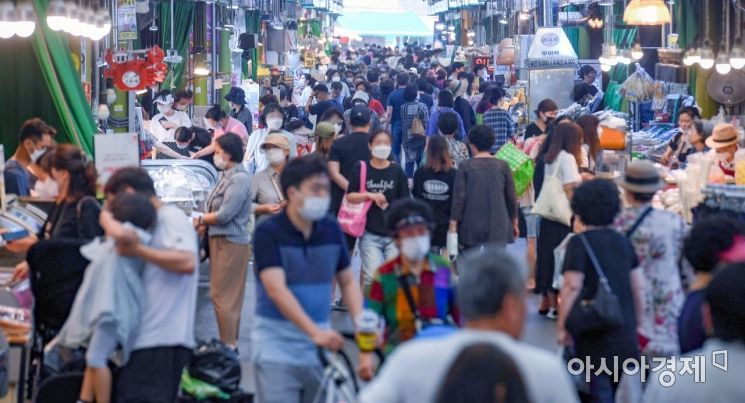 On the 26th, when the discount event "Korea Together Sale," planned to overcome the economic crisis caused by COVID-19 and promote consumption, began, Mangwon Market in Seoul was bustling with citizens. This Together Sale, in which all economic entities including traditional markets, neighborhood supermarkets, department stores, and large marts participate with gift certificate giveaways and discount events, will be held for 17 days until the 12th of next month. Photo by Kim Hyun-min kimhyun81@
[Asia Economy Reporter Minwoo Lee] The combined sales of major retailers grew compared to the same month last year. This is seen as a partial resolution of the stagnation in growth rates caused by the impact of the novel coronavirus infection (COVID-19). However, offline sales are still struggling, and since purchases of high-priced items such as home appliances increased ahead of summer, it is difficult to interpret this as a recovery in consumer spending.
According to Hanwha Securities on the 1st, sales of major retailers in June increased by 4.6% compared to the same month last year. Offline retailer sales decreased by 3.0%, while online retailer sales increased by 15.9%. Despite the relative increase in social activities, offline retailers have not seen a recovery in sales. Consumption through online channels is becoming entrenched.
In the case of offline sales, considering the simple decrease rate, it improved compared to the previous month’s -6.1%. However, given that sales increased only in some categories such as home appliances, overseas famous brands, and household goods, the negative trend is still continuing. Nam Seong-hyun, a researcher at Hanwha Investment & Securities, explained, "Despite the increase in social activities, the avoidance of multi-use facilities continues, and the growth of major items by offline channels remains sluggish. In the case of corporate supermarkets (SSM) with a high proportion of food, the decline rate actually widened compared to the previous month."
There is some room to interpret the June performance positively. This is because the number of business days during holidays in June was three days fewer than the same month last year. Nevertheless, convenience stores and SSM, which are relatively less affected by weekend effects, showed sales growth rates of +2.4% and -14.7%, respectively, indicating sluggishness. It is highly likely that the income increase effect due to disaster relief funds was partially reflected, and the sluggishness of essential non-food items such as food is clearly evident. It is pointed out that it is difficult to interpret this simply as an effect of the decrease in holiday business days.
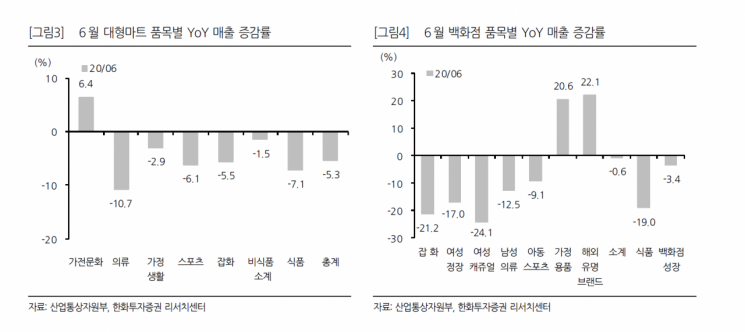
The reason why June’s performance held up relatively well is analyzed to be due to the strong sales of durable goods such as home appliances and furniture. The online growth rate increased by 2.4 percentage points (P) compared to the previous month, which is also attributed to the growth in sales of home appliances and electronics, with a year-on-year increase of 26.6% and a month-on-month increase of 7.8%P. Researcher Nam interpreted, "Rather than a recovery in consumer spending, it was influenced by increased sales of home appliances, especially air conditioners, due to early heat, and the rise in household goods."
There is a forecast that the profitability of major retailers in the second quarter is likely to deteriorate compared to the same period last year. In the case of department stores, the proportion of overseas famous brands increased by +6.5%P compared to the same period last year, and the non-food proportion of convenience stores rose to 47.8% from 45.7% in the same period last year, an increase of about 2.1%P. Researcher Nam pointed out, "Although the food proportion in large marts increased by 2.4%P to 62.1% compared to the same period last year, considering that major companies have reduced the number of SKUs in the non-food sector and the deterioration of existing store growth rates, it is difficult to judge that profitability will improve."
© The Asia Business Daily(www.asiae.co.kr). All rights reserved.
![Clutching a Stolen Dior Bag, Saying "I Hate Being Poor but Real"... The Grotesque Con of a "Human Knockoff" [Slate]](https://cwcontent.asiae.co.kr/asiaresize/183/2026021902243444107_1771435474.jpg)












