78.1% of Intermediate Goods Exports Are for the Chinese Domestic Market... Supply Chain Diversification Needed for Re-exports
[Asia Economy Reporter Hwang Yoon-joo] As China's role as the world's factory gradually diminishes, there are calls for Korean companies to diversify their global supply chain structures according to whether products are for the Chinese domestic market or for re-export to third countries.
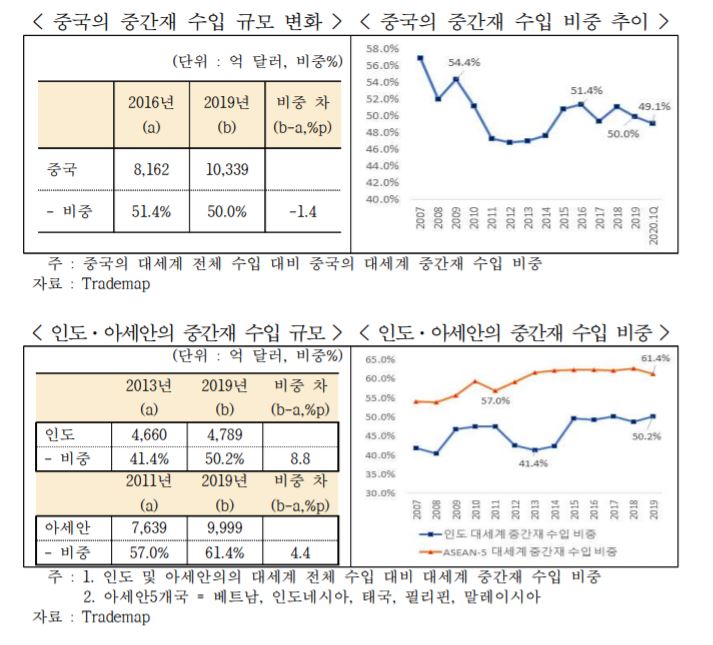
According to the "Our Response to the Reorganization of Global Supply Chains in the Post-COVID Era" report released on the 3rd by the Korea International Trade Association's Institute for International Trade and Commerce, China's share as a processing hub for intermediate goods in the global supply chain?where intermediate goods are imported, assembled or processed, and then final products are exported worldwide?declined from 11.8% in 2013 to 11.5% in 2018. Even when limiting the final product demand to Asia, the share of intermediate goods processed in China slightly decreased from 34.5% in 2013 to 34.2% in 2018.
Meanwhile, the roles of India and ASEAN are gradually expanding. The share of final products assembled and processed from intermediate goods imported from ASEAN and supplied worldwide rose from 4.2% in 2015 to 4.5% in 2018, and India's share also showed a moderate increase from 2.5% in 2015 to 2.9% in 2018. When considering final product demand in Asia, ASEAN's share increased from 11.1% in 2011 and India’s from 7.9% in 2013, reaching 12.4% and 9% respectively in 2018.
Meanwhile, the share of intermediate goods in Korea's exports to China reached 77.4% (105.4 billion USD) based on customs clearance data in 2019. Analyzing this again on a value-added basis, 78.1% of intermediate goods exported to China in 2018 were used for the local domestic market, which is 3.5 times higher than the share for re-export to third countries (21.9%).
The report stated, "This is because Korea's exports to China are rapidly shifting from low-wage processing trade to a domestic market-oriented parts supply system," adding, "Intermediate goods are mainly used for domestic consumption in industries such as electrical equipment (25.2%), chemicals (10.4%), and basic and processed metals (4.9%)."
Kang Nae-young, senior researcher at the Korea International Trade Association, said, "Although China's role in the global value chain is gradually shrinking compared to the past, it is realistically difficult for the China-centered supply chain to change drastically in the short term," emphasizing, "Especially since Korea's trade dependence on China is high, a two-track strategy is needed to maintain the existing supply chain targeting the Chinese domestic market while diversifying the re-export supply chain to third countries such as India and ASEAN."
© The Asia Business Daily(www.asiae.co.kr). All rights reserved.

















