Estimated Nationwide Pigeon Population at About 1 Million
Many Suffer from 'Pigeon Phobia' Due to Large Numbers
Emergence of 'Pigeon Extermination Specialists'

[Asia Economy Reporter Heo Midam] "I walk avoiding pigeons."
Recently, more and more citizens are complaining about discomfort caused by pigeons roaming around various parts of the city. Due to the large number of pigeons, there are severe complaints about damage such as corrosion of structures caused by droppings and foul odors. Some even express what is called 'pigeon phobia,' saying that pigeons that do not avoid people are rather scary.
The pigeon, once a 'symbol of peace,' has recently fallen into being an 'object of disgust.' In 2009, the Ministry of Environment designated pigeons as harmful animals, stating that pigeons cause damage to citizens and buildings due to odors and droppings.
However, the pigeon population continues to increase. According to the Korean Association for Bird Studies, the estimated number of pigeons nationwide is about 1 million, with half of them, 500,000, distributed in the Seoul metropolitan area.
As a result, complaints about inconvenience caused by pigeons are ongoing. Office worker Kim (28) said, "The large number of pigeons is a problem, but when walking, there are many pigeon droppings on the streets," adding, "Not only is it unsightly, but as the weather gets warmer, the droppings also emit a foul odor."
Complaints are also on the rise. According to the Ministry of Environment's data on pigeon-related complaints nationwide, the number of complaints rapidly increased from 645 cases (18,496 pigeons) in 2016, to 714 cases (25,788 pigeons) in 2017, and 1,073 cases (47,331 pigeons) in 2018.
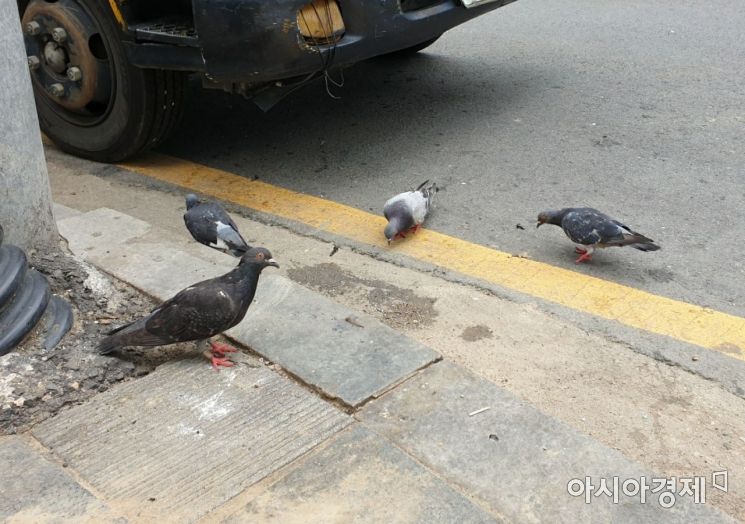
The problem is that despite these inconveniences, there is no proper measure to exterminate pigeons. Under current law, pigeons can be captured with a capture permit, but in urban areas, it is practically impossible to use guns or traps, making it difficult to reduce the pigeon population.
Meanwhile, some people are expressing 'pigeon phobia.' Office worker Park (28) said, "When a flock of pigeons appears while walking, I deliberately take a detour," adding, "I developed trauma after seeing a pigeon hit by a car a few years ago. Now, I am very scared of pigeons, and my heart races whenever a pigeon appears while walking."
The majority of citizens support controlling the pigeon population. In a 2015 survey on 'pigeon population control,' 77.2% of respondents agreed that "the Ministry of Environment should actively take action." This was more than three times higher than the percentage who opposed it.
Therefore, some local governments are making various efforts to reduce the pigeon population. Seoul City has put up banners saying 'No Feeding' in areas densely populated by pigeons and is spraying repellents that pigeons dislike, but the population is so large that it remains a headache.
Due to the difficulty in reducing the pigeon population, 'extermination specialist companies' have even appeared. These companies conduct pigeon extermination work according to complaints received, producing eco-friendly bird repellents and other measures.
The situation in other countries is similar to ours. Especially, various efforts are being made to reduce the pigeon population.
In Los Angeles, USA, a drug containing sterilizing ingredients was mixed into the feed and spread, significantly reducing the population. In the UK, fines are imposed for feeding pigeons, and street vendors who provide feed face business suspension. In Switzerland, pigeon populations are controlled by collecting eggs and replacing them with fake eggs.
In Paris, France, to control the pigeon population, large pigeon houses are installed in parks. Nests capable of housing more than 200 pigeons are made in dozens of places, and whenever eggs are laid, they are removed or the nests are shaken to prevent hatching, thereby controlling the population.
In Korea as well, legislation to impose fines on people who feed pigeons was proposed to the Ministry of Environment, but it was scrapped due to opposition from environmental and animal protection groups.
© The Asia Business Daily(www.asiae.co.kr). All rights reserved.


















