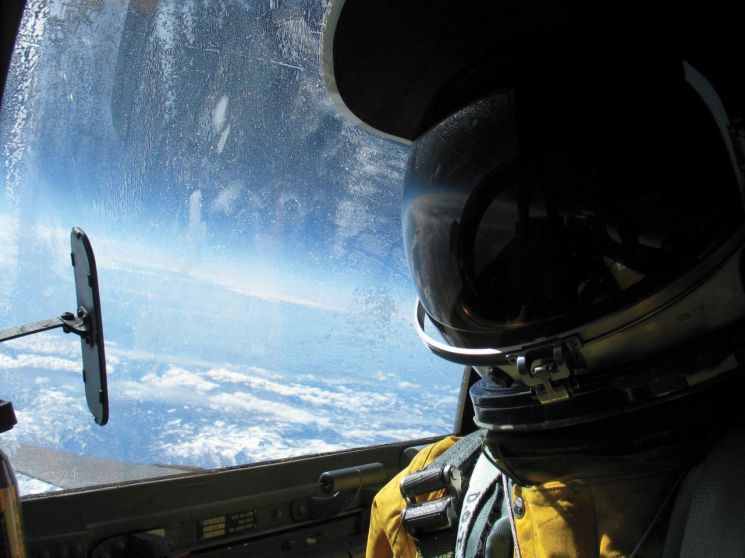
[Monthly Aviation Editor-in-Chief Kim Jae-han] The Black Cat of the U.S. Air Force’s 5th Reconnaissance Squadron, operating the high-altitude reconnaissance aircraft U-2S, stands at the forefront of intelligence gathering on North Korea. This unit, under the 9th Reconnaissance Wing, was reactivated on October 1, 1994. Although its home base is Beale Air Force Base in California, USA, it is currently deployed at Osan Air Base, continuously monitoring and collecting intelligence on developments in the North Korean region. In short, it is a core force maintaining deterrence against North Korea. As such, it remains shrouded in secrecy to this day.
▲The challenging ‘Dragon Lady’= The reporting began with firsthand experience of the mission site. To this end, the vehicle boarded was the so-called chase car, a unique vehicle performing a special mission only seen in the U-2 unit. Fortunately, there was an actual U-2 flight training on that day, allowing the reporter to ride along in the chase car.
The main training content was takeoff and landing practice. The U-2 approaches the runway maintaining about 0.6 meters above the ground and lands by gently dropping the aircraft. If it lands at a higher altitude than this, it can cause aircraft damage or accidents. The takeoff and landing training involves repeating this process to master it.
The chase car’s role is to closely follow behind the U-2 to help the pilot land safely by counting down the landing moment. Because U-2 landings require very sensitive aircraft control, a U-2 pilot also rides in the chase car to assist.
Due to the difficulty of landing, training time is longer than for other pilots. According to unit officials, to pilot the U-2S, one must pass a qualification test. This test requires hundreds of hours of training and a two-week evaluation period. However, pilots are given only three landing attempts to qualify. Failure to land safely within these three attempts disqualifies them from flying the U-2.
▲U-2’s usefulness remains= Although the U-2 is difficult to handle and is an outdated aircraft that has been in operation for over 50 years, its high utility as a reconnaissance aircraft remains intact. The current model operated by the 5th Reconnaissance Squadron is the U-2S, an upgraded version of the earlier U-2R. The U-2R, which was about 40% larger than the original U-2 when it first appeared, was delivered to the U.S. Air Force until 1989. Starting in 1994, the Air Force invested $1.7 billion to upgrade the U-2R’s airframe and sensors and install a new engine, renaming it the U-2S.
The upgrade from U-2R to U-2S also improved performance. The U-2S is equipped with various mission systems, including an electro-optical sensor with a built-in CCD camera, radar capable of collecting high-resolution images day and night regardless of weather conditions at high altitude, and signal intelligence collection equipment. Among these, the radar can detect both stationary and moving ground targets, with an imaging range reportedly exceeding 160 km.
The information collected is diverse. A single U-2 can gather imagery from electro-optical, infrared, and synthetic aperture radar (SAR) equipment, signal intelligence through radar and communications interception, and measurement and signature intelligence (MASINT) that collects signals before and after missile launches. Notably, this information is transmitted almost in real-time anywhere on Earth via ground and satellite data links.
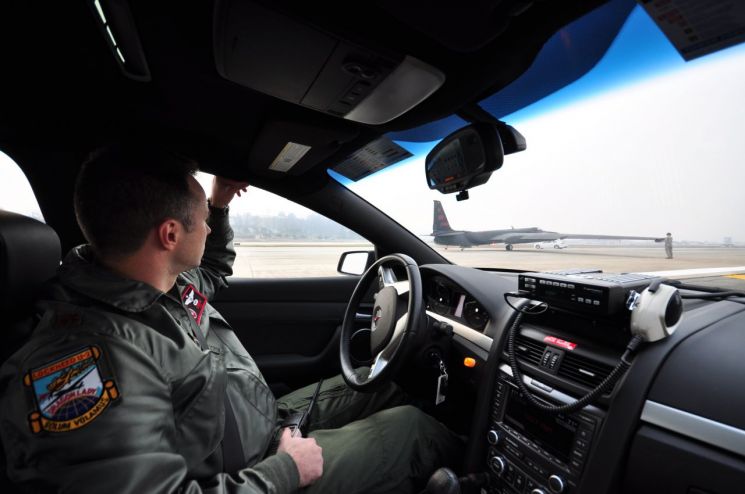 The role of the escort is to closely follow behind the U-2 and count down the landing time so that the pilot can land safely.
▲U-2 pilots battling decompression sickness= The unique mission environment dictated by the special mission is also distinctive. As is well known, the U-2 reconnaissance aircraft operates at an altitude of about 70,000 feet, or over 20 km. Considering that commercial airliners typically fly at altitudes of 8 to 13 km, this is truly a dizzying height. The range is also considerable. According to the U.S. Air Force, the U-2’s range exceeds 11,200 km, comparable to that of the long-range jumbo jet Boeing 747, meaning pilots’ mission durations are equally long.
Due to this unique mission environment, pilots face significant physical burdens. One pilot said, “Imagine sitting in a cramped cockpit wearing a spacesuit for 8 to 10 hours without being able to use the restroom,” adding, “Fatigue increases greatly as time passes.” He especially cited decompression sickness caused by pressure differences as a major challenge.
Decompression sickness occurs when nitrogen dissolved in body fluids expands like bubbles during ascent to high altitude. It results from the difference between internal body pressure and external atmospheric pressure, similar to the sudden bubbling when opening a carbonated drink. It is akin to the bends experienced by deep-sea divers who ascend too quickly. One pilot said, “Exposure to decompression sickness can be so severe that you forget what you are supposed to do.”
U-2 pilots must also adjust their diet a day before the mission to avoid needing to defecate during flight. Additionally, to prevent decompression sickness, they must breathe 100% oxygen for one hour before takeoff. During this time, they also exercise to remove as much nitrogen from the body as possible. One pilot explained, “Although we breathe 100% oxygen during the mission, operating at high altitude is like staying at the summit of Mount Everest,” adding, “Prolonged exposure to high altitude causes joint numbness and pain.”
U-2 pilots’ high-altitude missions are akin to staying at the summit of Mount Everest
If the pressure suit is damaged by defecation during the mission, a new suit costing about 150 million KRW must be purchased
▲Meals and physiological needs handled in the cockpit= To reduce the physical burden on pilots during these high-altitude missions, special flight suits are used. These are a curiosity to the general public and look unmistakably like spacesuits. However, rather than spacesuits, they are pressure suits specially developed for high-altitude missions. According to unit officials, although U-2 pilots actually fly above 20 km, the pressure inside the flight suit is maintained at the equivalent of 10 km altitude.
While the U-2 flight suit has excellent pressure-maintaining capabilities, pilots must endure some inconveniences, notably physiological needs such as urination and defecation. Fortunately, urination is possible. Pilots install a device called a UCD (Urine Collection Device) inside their underwear before donning the flight suit, allowing them to urinate during the mission. Although there are no actual cases, if defecation damages the pressure suit, a new one costing about 150 million KRW must be procured.
Consuming food and water is also not simple. Maintaining pressure inside the suit requires eating in a sealed environment. If the pilot removes the helmet to eat or drink, it immediately becomes a dangerous situation. Therefore, U-2 pilots eat “tube food,” which is food in tube form connected to an intake port on the helmet.
Interestingly, although tube food seems simple, all these foods are developed by professional nutritionists considering nutritional content. The menu is diverse, including hash browns, beef, gravy, chicken, Manhattan clam chowder, and even vegetarian options. To avoid the feeling of eating baby food, hash browns contain small pieces of actual potatoes, and the bistro meals include small meat chunks.
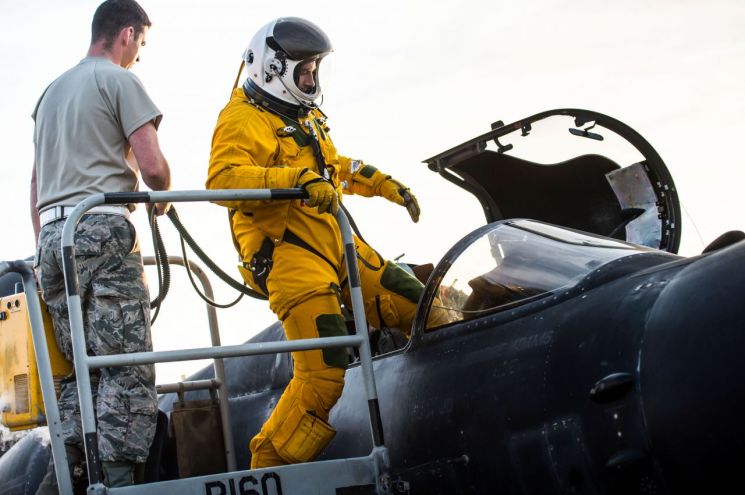 To maintain the internal pressure of the decompression chamber, food must be consumed in a sealed environment isolated from the outside.
▲Core of deterrence power against North Korea= The 5th Reconnaissance Squadron is unique in every aspect?from its high-altitude long-endurance mission environment and the special U-2 aircraft to its special mission of gathering intelligence on North Korea. But the most critical mission is surveillance and reconnaissance of North Korea. Typically, three aircraft take turns flying once a day, meticulously reconnoitering North Korean territory from high altitude near the Demilitarized Zone. The intelligence collected by the U-2 is provided to the U.S. Pacific Air Forces (PACOM), Air Combat Command (ACC), Korea Combat Operations Information Center (KCOIC), and the Combined Analysis and Control Center (CACC) of the ROK-U.S. alliance, serving as vital data for assessing the North Korean situation.
Because the U-2 plays a key role in deterrence against North Korea, it has always been excluded from U.S. Forces Korea reduction plans. Regarding this, a unit official said, “Our mission’s top priority is to deter North Korea’s willingness to provoke,” adding, “Continuous surveillance, reconnaissance, and intelligence provision necessary for this are our main tasks.” He further explained, “North Korea is extremely closed off, so there are few ways to discern their intentions. The U-2 is one method to understand their intentions and monitor where their assets are located.”
As the aircraft ages, special attention is paid to maintenance. Especially since it performs high-altitude missions, specific maintenance is required. According to maintenance personnel, the most critical factor in maintaining the U-2 is icing caused by high-altitude operations. Icing causes metal parts to expand and contract repeatedly, shortening their lifespan. Also, many parts require continuous replacement, making parts procurement an important task.
Above all, whenever military tensions between the South and North rise, the determination of the 5th Reconnaissance Squadron members is exceptional. A unit official emphasized, “Deterring North Korean provocations is most important,” adding, “By making the North Korean military aware that we are up there, their willingness to provoke is suppressed.” He continued, “The mission is tough, but we carry it out with a sense of duty to secure the information necessary to reduce military tensions on the Korean Peninsula.”
© The Asia Business Daily(www.asiae.co.kr). All rights reserved.
![Clutching a Stolen Dior Bag, Saying "I Hate Being Poor but Real"... The Grotesque Con of a "Human Knockoff" [Slate]](https://cwcontent.asiae.co.kr/asiaresize/183/2026021902243444107_1771435474.jpg)


















