Party-Government-Blue House National Intelligence Service Reform Plan
Rename and Completely Block Domestic Political Interference
Abolish Counterintelligence Investigation... Focus on Overseas and Advanced Crimes
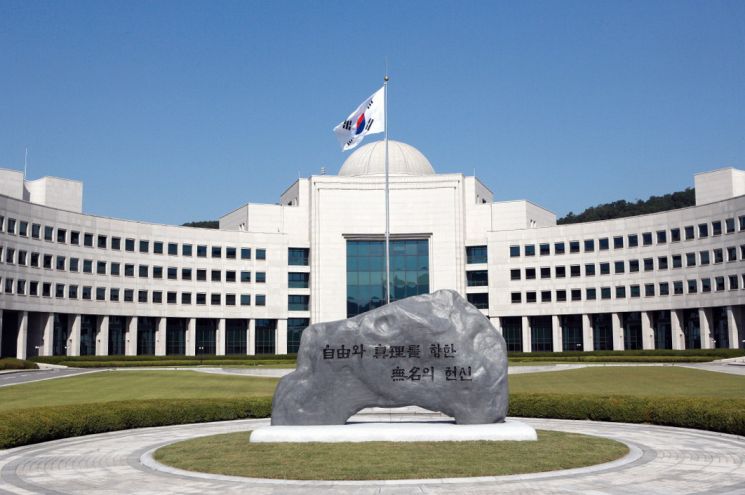 The National Intelligence Service will be renamed the Foreign Security Intelligence Service, and domestic political involvement will be strictly limited.
 On the 30th, Cho Jung-sik, the Policy Committee Chair of the Democratic Party of Korea, announced this decision during a high-level party-government-office meeting held at the National Assembly that morning to discuss follow-up tasks for intelligence agency reform.
The photo shows the National Intelligence Service building.
The reform plan for the National Intelligence Service (NIS) by the ruling party, government, and presidential office focuses on completely blocking the NIS's involvement in domestic politics. The renaming of the NIS to the "External Security Intelligence Service" reflects the intention to limit the agency's activities strictly to "external intelligence."
The reform plan includes not only the name change but also the removal of counterintelligence investigative authority, strengthening external oversight such as by the National Assembly, and tougher criminal penalties for illegal acts like political involvement by employees. It clearly defines "political neutrality" as the operational principle of the agency and aims to strictly prohibit the collection and use of information beyond the purposes stipulated by law.
The plan also intends to establish a legal basis for abolishing the Domestic Intelligence Officer (IO) position. Currently, the NIS has abolished the IO role on its own. However, with changes in administration, there remains a possibility that the position could be reinstated at the discretion of the highest authority. To prevent this, a related provision will be newly added to the NIS Act to fundamentally block any chance of political interference.
On the 27th, NIS Director Park Jie-won reiterated his commitment to completely blocking political interference by the NIS during his confirmation hearing. He stated, "We will ensure that the NIS never intervenes in domestic politics or elections." In his opening remarks at the ruling party-government-presidential office meeting that day, Director Park said, "The core of the NIS reform is to block domestic political involvement, transfer counterintelligence investigative authority, and strengthen democratic oversight by the National Assembly." He added, "Since the inauguration of the Moon Jae-in administration, we have taken bold actions to block domestic political interference, but for these reforms to be irreversibly completed, it is essential to amend the NIS Act."
Counterintelligence investigative authority and domestic intelligence collection functions will be transferred to the police. At the hearing, Director Park disclosed that regarding counterintelligence investigative authority, "We have agreed with the Blue House to ensure that the NIS collects information and hands it over to the police for investigation."
To enhance transparency in budget execution and internal control, a "Execution Control Deliberation Committee" will be established within the External Security Intelligence Service, and internal control functions of the agency will be strengthened. External oversight through the National Assembly Intelligence Committee and the Board of Audit and Inspection will also be reinforced.
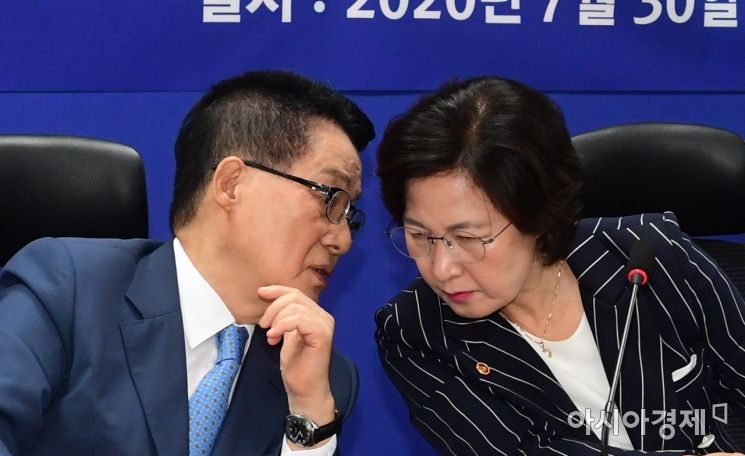 Minister of Justice Choo Mi-ae and Director of the National Intelligence Service Park Jie-won are attending the 'Power Agency Reform Party-Government-Civil Service Council for the People' held at the National Assembly on the 30th, talking during the meeting. Photo by Yoon Dong-joo doso7@
The NIS is responsible for overseeing domestic and foreign information security tasks but has been criticized for abusing its excessive and concentrated power, repeatedly engaging in illegal and illicit acts as well as political deviations.
Under current law, the NIS can collect not only overseas and North Korea-related intelligence for national security but also domestic security information. Article 3, Paragraph 1 of the NIS Act limits domestic security information to intelligence related to counterintelligence, anti-government subversion, counter-espionage, counterterrorism, and international criminal organizations. This has provided a direct basis for the extensive collection of information on its own citizens and involvement in domestic politics, causing serious political side effects. Representative cases include civilian surveillance and manipulation of public opinion using comment squads during the Lee Myung-bak and Park Geun-hye administrations, as well as the "Yoo Woo-sung spy fabrication incident." One of President Moon Jae-in's key pledges was to completely abolish domestic intelligence collection duties to block the NIS's involvement in domestic politics.
The NIS has changed its name several times depending on the political situation and the roles required of the organization. Until 1980, it was called the "Central Intelligence Agency," from 1981 to 1998 the "Agency for National Security Planning," and since 1999 it has been known as the "National Intelligence Service."
Meanwhile, this is not the first attempt to rename the NIS. The 2017 proposed amendment to the NIS Act also included renaming it to the External Security Intelligence Service to shed its negative image, but the effort stalled and is now being pursued again.
© The Asia Business Daily(www.asiae.co.kr). All rights reserved.


















