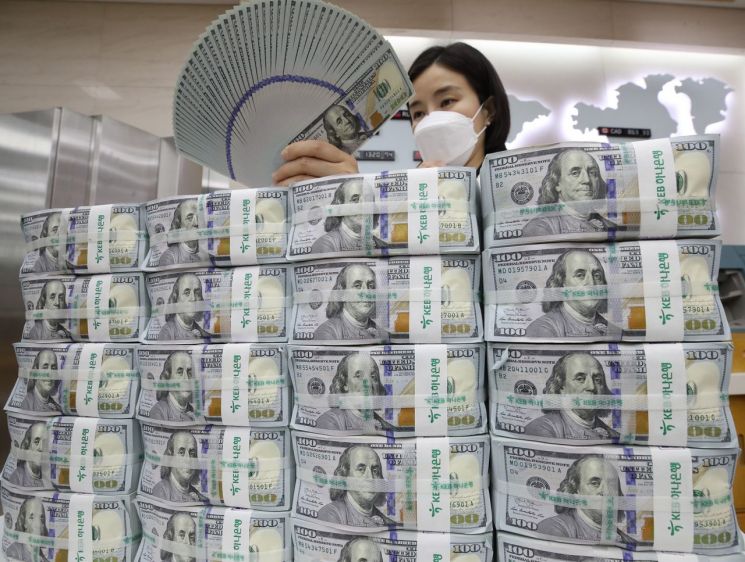
[Asia Economy Reporter Eunbyeol Kim] The Bank of Korea has decided to extend the currency swap agreement with the United States, which was signed in March, by an additional six months. Although the domestic foreign exchange market has shown signs of stabilization compared to the early days of the COVID-19 outbreak, uncertainties related to the pandemic persist, leading to the judgment that it is necessary to extend the Korea-US currency swap, regarded as a 'foreign currency safety net.'
The Bank of Korea announced on the 30th at 3 a.m. (2 p.m. on the 29th Eastern Time in the U.S.) that it would extend the expiration date of the Korea-US currency swap agreement worth $60 billion by six months. Accordingly, the original expiration date of September 30 this year has been postponed to March 31 next year.
A Bank of Korea official stated, "Although the dollar market and the domestic foreign exchange market have recently shown stability, uncertainties due to COVID-19 still persist," adding, "The scale and conditions of the currency swap remain the same as before, and only the contract period has been extended by six months."
He continued, "We expect that the extension of the Korea-US currency swap will contribute to maintaining stability in the domestic foreign exchange and financial markets." The Bank of Korea plans to supply dollars through foreign currency loans conducted via a competitive bidding method, depending on trends in the foreign currency funding market.
The effectiveness of the Korea-US currency swap was also proven when it was signed in March. In fact, just announcing the signing of the Korea-US currency swap agreement on the night of March 19 eased concerns about dollar funding.
At that time, as COVID-19 became a pandemic in the U.S. and Europe in early March, the domestic stock market rebounded and the won-dollar exchange rate fell, leading to an immediate recovery in the financial market. However, as soon as news of the Korea-US currency swap agreement was announced, the KOSPI index rose by 7.4%, and the won-dollar exchange rate dropped by 3.1%.
Ten days after signing the Korea-US currency swap, the Bank of Korea announced plans and schedules for foreign currency loans using the swap funds with the U.S. Federal Reserve (Fed) through a competitive bidding method and supplied funds. From March 31, a total of $19.872 billion was supplied over six rounds. After the Korea-US currency swap funds were supplied, exchange rate volatility decreased, and domestic foreign currency liquidity conditions improved, leading to rapid stabilization of the domestic foreign exchange sector.
The decision to extend the Korea-US currency swap maturity on this day was made at the Federal Open Market Committee (FOMC) of the U.S. Federal Reserve (Fed). The regular FOMC meeting after July is scheduled for September 15-16. Since the September FOMC will be held just fifteen days before the Korea-US currency swap expires, the preemptive response was also intended to avoid unnecessary controversy.
The Fed decided at the FOMC to extend currency swap agreements with a total of nine central banks, including those of Australia, New Zealand, Brazil, Mexico, Denmark, Norway, Singapore, Sweden, as well as Korea. All these countries signed currency swap agreements with the Fed in March. During the financial crisis, Korea also signed a six-month contract and extended it twice, maintaining the swap agreement for a total of 15 months.
This currency swap extension is expected to maintain stability in the domestic foreign exchange market for the time being. It is reported that the Bank of Korea and other foreign exchange authorities in Korea have expressed to the Fed the necessity of extending the Korea-US currency swap while monitoring the situation weekly after signing the swap in March. Although the current market situation is not problematic, uncertainties remain in the future. A foreign exchange official said, "The more foreign currency reserves you have, the better," adding, "Even if you don't use a single cent after the currency swap, just having it acts as a safety net."
© The Asia Business Daily(www.asiae.co.kr). All rights reserved.

















