"Capital Erosion State... Bearing Debt Burden"
Political Circles Urged to Expedite Integration Process
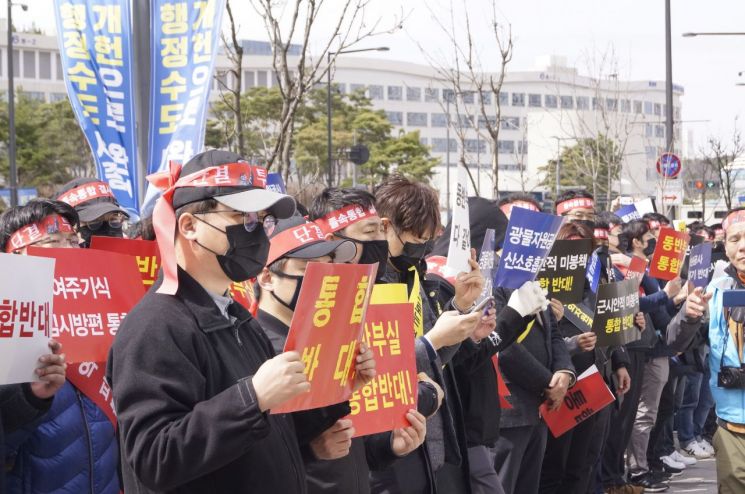 On the 27th, in front of the Government Sejong Complex in Sejong Special Self-Governing City, the Korea Mine Reclamation Corporation Labor Union and social organizations from the abandoned mine areas in Gangwon Province jointly issued a solidarity statement opposing the attempt to resubmit the Korea Mining Corporation Act. (Photo by Korea Mine Reclamation Corporation Labor Union)
[Asia Economy Reporter Moon Chaeseok] The conflict surrounding the integration of Korea Resources Corporation and Korea Mine Reclamation Corporation is intensifying. The Mine Reclamation Corporation is raising concerns about the deteriorating financial structure of the Resources Corporation. Although the Resources Corporation has transferred its stakes in two Australian coal mines, its main cash cows, overseas, the political sphere is pushing to expedite the integration of the Resources Corporation and the Mine Reclamation Corporation.
On the 27th, Woori Union, the negotiating representative labor union of the Mine Reclamation Corporation, along with social organizations from the closed mine areas in Gangwon Province such as the Jeongseon Joint Promotion Committee, held a protest in front of the Government Sejong Complex opposing the merger. They expressed dissatisfaction, stating that if the 'Korea Mining Corporation Act,' which was primarily proposed by Lee Jangseop, a member of the Democratic Party of Korea, on the 26th of last month, passes, the Mine Reclamation Corporation will have to take on the Resources Corporation, which is in a state of capital erosion.
According to industry sources, the Resources Corporation unconditionally transferred its 25% stakes in the Australian overseas mines Springvale and Angus Place to Centennial Asset Management last month. The remaining mining periods for the two mines acquired by the corporation were 18 years and 6 years, respectively. The price of thermal coal dropped from $90 per ton in early 2018 to $40 this year, reducing profitability and increasing the burden of mine operation costs and exploration expenses.
The debt of the Resources Corporation is increasing, and the government is ordering high-intensity restructuring. The corporation's debt rose more than threefold from 800 billion won in 2016 to 2.5 trillion won last year. On the 21st, the government announced the formation of the 'Second Task Force (TF) for Overseas Resource Development Innovation,' which will monitor the corporation and its financial management and restructuring over the next six months.
The Ministry of Trade, Industry and Energy diagnosed that the corporation's restructuring following the recommendations of the first TF (active from November 2017 to July 2018) failed to produce results due to the combined effects of COVID-19, low oil prices, and investment contraction in the global energy market. The second TF will conduct an objective reevaluation of major overseas resource development projects and public enterprise financial conditions and discuss the promotion system for public enterprises and private resource development.
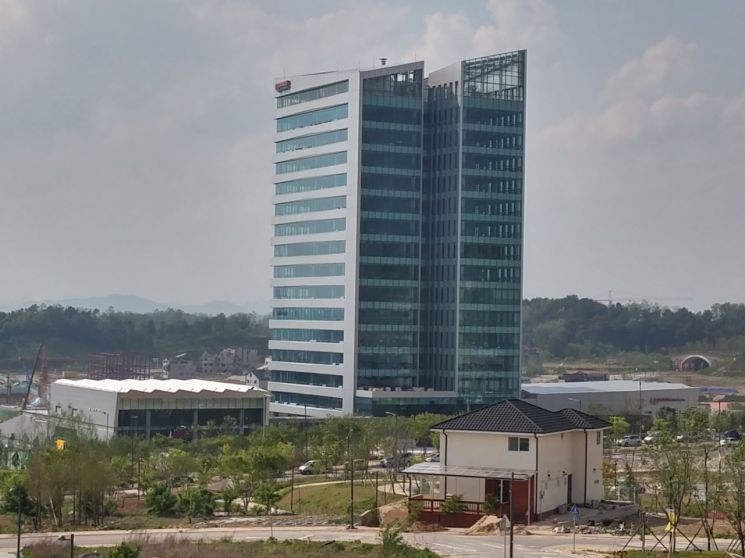 Exterior view of the Korea Resources Corporation headquarters. (Photo by Korea Resources Corporation)
The positions of the Resources Corporation and the Mine Reclamation Corporation regarding the merger are polar opposites. The Resources Corporation emphasizes the positive aspects, stating that ▲ functions other than overseas resource development will be preserved, ▲ resource development assets held will be sold strategically rather than as a whole, and ▲ the integrated corporation will be able to perform the entire resource development cycle of 'exploration-development-reclamation.'
A representative of the Resources Corporation said, "It is true that the corporation's new overseas resource development projects have been halted since 2016 according to government policy," but added, "If integrated with the Mine Reclamation Corporation, it will open the way to negotiate strategically rather than selling all overseas assets at a low price, which will also help improve finances."
The Mine Reclamation Corporation points out that ▲ dividends from Kangwon Land flow into repaying the Resources Corporation's debt rather than the corporation's main business of reclaiming closed mine areas, and ▲ synergy effects between closed mine area restoration (corporation) and mine development (Resources Corporation) work are expected to be limited.
Hong Gipo, chairman of the Woori Union at the Mine Reclamation Corporation, said, "It is difficult to find positive effects from integration with the corporation, and there are many anticipated side effects such as local community opposition and concerns that the corporation's dividends will be used to repay the Resources Corporation's debts," adding, "Some domestic operations like mine safety management and loan support for mining rights holders are similar to the Resources Corporation, but 90% of the corporation's work is closed mine area restoration, so how can synergy be created with the Resources Corporation staff who develop new mines?"
© The Asia Business Daily(www.asiae.co.kr). All rights reserved.


















