Pukyong National University Holds First Domestic Exhibition of 'Pyohaerok,' a Record of Drifting History
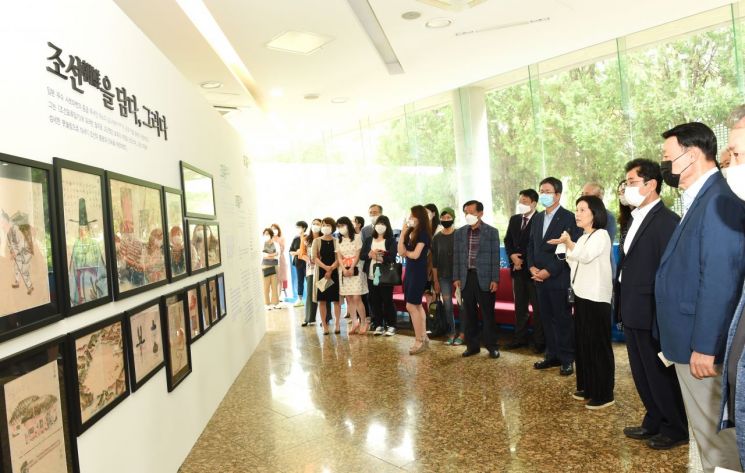 On the 27th, visitors at Pukyong National University, where the exhibition "Asian Maritime Records - Sea Routes Connecting Asia" opened, are viewing the exhibits.
[Asia Economy Yeongnam Reporting Headquarters Reporter Kim Yong-woo] An exhibition showcasing historical records of humans drifting across the Asian seas is being held at Pukyong National University in Busan. This rare exhibition is the first of its kind in Korea.
The Pukyong National University Humanities Korea Plus (HK+) Project Group (Director Son Dong-joo) opened the exhibition titled “Asian Drift Records ? Sea Routes Connecting Asia” on the afternoon of the 27th at the Global Lounge on the first floor of Dongwon Jang Bogo Hall.
Running until August 14, this exhibition was organized to explore the history of exchanges within the East Asian region through records of people drifting at sea in East Asia before the modern era.
This exhibition is composed of key contents from the maritime humanities series “Asian Drift Records” and “Joseon Drift Diary,” jointly published through two years of collaborative research by the Pukyong National University HK+ Project Group and the Asia Culture Institute (Director Lee Ki-pyo).
Seven drift records from Korea, China, Japan, and Vietnam included in “Asian Drift Records” are displayed alongside East Asian maps and images of old books. Among these, five drift records from China, Japan, and Vietnam, excluding two Korean drift records, are materials introduced for the first time in Korea.
The two Korean drift records are Lee Ji-hang’s “Pyojurok” (1696), who drifted from Busan to Hokkaido, mainland Japan, Tsushima Island, and back to Busan, and Kim Dae-hwang’s “Pyohaeilrok” (1687), who drifted from Jeju Island to Vietnam and returned.
China’s drift records include Chae Jeong-ran’s “Hainan Japjeo” (1836), who drifted from Taiwan to Vietnam; Ban Jeong-gyu’s “Annam Giyu” (1688), who departed from China and landed in Vietnam; and Jeong Gwang-jo’s “Pyobagi-yeok” (1842), who drifted to Japan.
Japan’s drift record is Ishii Bon’s “Daldan Drift Record” (1644), which documents oral accounts of drift victims who arrived in Vladivostok, then traveled through Manchuria and Joseon before returning. Vietnam’s drift record is Jang Deung-gye’s “Japan Observation Record” (1815), which recounts stories of soldiers drifting to Japan.
Additionally, the exhibition provides a detailed introduction to the “Joseon Drift Diary” left by Yasuda Yoshikata (安田義方), a mid-level samurai from Satsuma Domain in southern Kyushu, Japan, who drifted to Joseon, including illustrations and ship models from the book.
This material vividly depicts early 19th-century Joseon, detailing the drifting experience and repatriation process, and is highly valued as a precious resource in drift research history.
The Pukyong National University HK+ Project Group has produced some exhibition content in braille and provides braille leaflets for visually impaired visitors. The main contents of this exhibition will also be introduced at the 14th World Ocean Forum to be held in Busan on October 27.
© The Asia Business Daily(www.asiae.co.kr). All rights reserved.
![User Who Sold Erroneously Deposited Bitcoins to Repay Debt and Fund Entertainment... What Did the Supreme Court Decide in 2021? [Legal Issue Check]](https://cwcontent.asiae.co.kr/asiaresize/183/2026020910431234020_1770601391.png)
















