Caliber refers to the bore diameter: 20mm or less is a gun, more than 20mm is a cannon.
Cannons are classified as direct-fire guns, howitzers, or mortars based on projectile trajectory.
[Agency for Defense Development] Guns and cannons have a long history with humanity alongside swords. The greatest advantage of guns and cannons over spears or swords is that they allow attacking the enemy from a certain distance. Around the 12th to 13th centuries, China had firearms similar to cannons, such as the Bihwa-chang and Hwaryong-chang, and later, metal tube-shaped firearms were developed by improving these.
These were transmitted to Europe through Arabs in the 14th century, leading to the invention of primitive small firearms called "portable cannons carried by people," and as firearms became smaller, the first rifle, which can be considered the earliest gun, was developed. Before the 15th century, cannons were very incomplete. Their range was only a few hundred meters, and they used round stones as ammunition; after firing about ten shots, the cannon barrel would break. At that time, wooden barrels were mainly used, and even metal barrels were constructed by attaching iron plates like wooden staves with hoops. Moreover, they had no wheels, so mobility was nonexistent.
Later, with the advancement of metal smelting technology, bronze barrels were used, and cast specialized cannonballs replaced stones. As a result, cannons became more accurate and powerful. The term "guns and cannons" commonly refers to both guns and cannons, and there is little difference in the firing and launching principles between them.
In times of limited technology, the origin of the cannon was to enable striking distant enemies with simple devices and methods. Later, by controlling and regulating the combustion state of the propellant, smaller, lighter, and easier-to-use firearms were created. There are three criteria to distinguish guns from cannons. However, these are not absolute, and exceptions have continuously appeared over time. Therefore, it is necessary to understand the exceptions and limitations of guns and cannons through various classification methods rather than relying on a single condition.
If the projectile explodes on the target, it is a cannon; if it does not explode, it is a gun
Anti-aircraft cannons use proximity-fuzed shells that explode near the target
First, if the caliber is 20 mm or less, it is classified as a gun; if more, it is classified as a cannon. Caliber refers to the size of the muzzle. Broadly speaking, the caliber determines the size of the bullet that can be fired, and the larger the caliber, the larger the projectile that can be fired. For example, .44 caliber means the muzzle is 0.44 inches, and .22 caliber means 0.22 inches. Since force is proportional to mass, larger calibers can fire bigger projectiles, resulting in greater destructive power.
Second, classification is based on whether the trajectory is straight or curved?that is, whether it is a direct-fire weapon or an indirect-fire weapon. Cannons are divided into direct-fire cannons, howitzers, and mortars depending on the firing method and trajectory angle. The required impact angle varies depending on the relative position, shape, and nature of the target, so selective firing is necessary. For example, direct-fire cannons use low trajectories, while howitzers use relatively low muzzle velocities with high trajectories. Direct-fire cannons have muzzle velocities over 650 m/s and barrel lengths at least 75 times the caliber, allowing precise long-range targeting.
Because they are fired with strong propellant force, their trajectory is close to horizontal, enabling long-range fire. Naval guns and anti-aircraft guns fall into this category. Howitzers have a relatively gentle curved trajectory and barrel lengths about 20 times the caliber. They use less powerful propellant than direct-fire cannons and are relatively lighter, so they are mainly used by ground artillery units requiring mobility. Mortars have barrel lengths about 10 times the caliber and fire shells in a gentle curve over 45°, causing the projectile to fall almost vertically from above. Mortars are usually loaded from the muzzle, have simple and lightweight structures, and are mainly used by infantry special forces.
Third, if the projectile explodes on the target, it is classified as a cannon; if not, it is classified as a gun. Guns fundamentally use kinetic energy from velocity to penetrate targets, so their calibers tend to be relatively small. In contrast, cannons have explosive material inside the projectile, which detonates upon impact or proximity to the target via fuzes. This classification is evident from the types and names of actual guns and cannons.
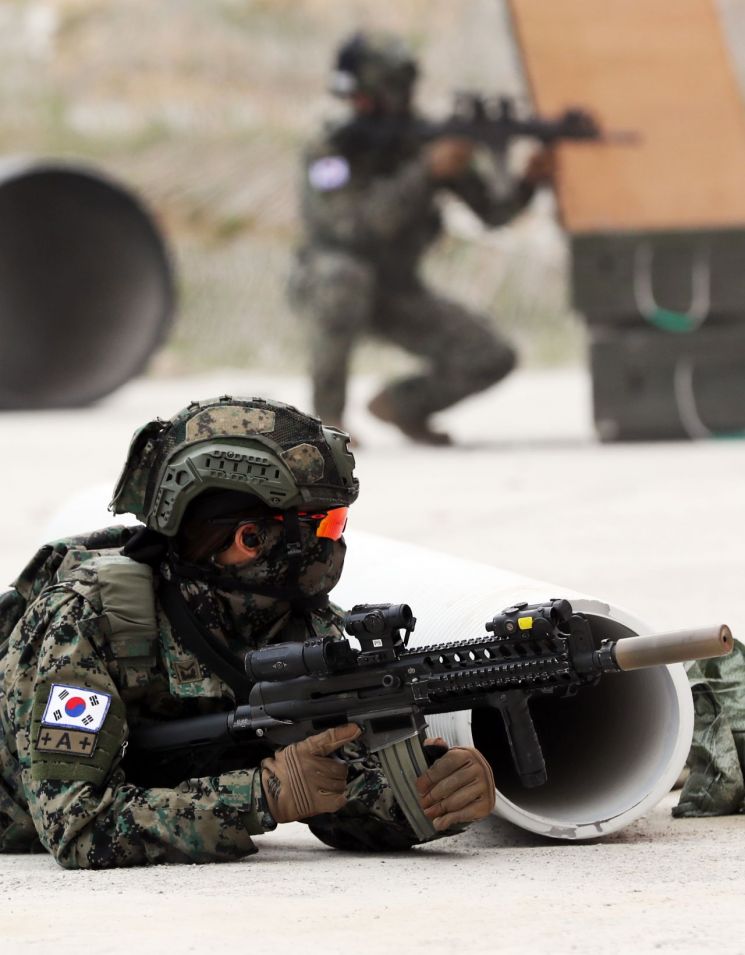
For example, mortars and howitzers have relatively large calibers, and anti-aircraft cannons use proximity-fuzed shells that explode at a certain altitude or near the target. Conversely, guns have relatively small calibers and very high muzzle velocities. Examples include pistols, rifles, and machine guns.
© The Asia Business Daily(www.asiae.co.kr). All rights reserved.
![User Who Sold Erroneously Deposited Bitcoins to Repay Debt and Fund Entertainment... What Did the Supreme Court Decide in 2021? [Legal Issue Check]](https://cwcontent.asiae.co.kr/asiaresize/183/2026020910431234020_1770601391.png)
















