Utilized as Devices Including Sensor Memory Elements ... Paper Published in Nature Communications

[Asia Economy Yeongnam Reporting Headquarters Reporter Kim Yong-woo] Professor Lee Seung-hoon of Pukyong National University has attracted academic attention by identifying the characteristic shape change of vanadium dioxide (VO2), a next-generation material used in sensors and memory devices.
Professor Lee Seung-hoon of the Department of Physics at Pukyong National University recently published research results on the ‘phase transition’ characteristics of vanadium dioxide (VO2), an emerging next-generation material, in the international journal Nature Communications.
Professor Lee viewed the crystal structure of the material as playing a key role in the phase transition of vanadium dioxide.
Vanadium dioxide is a material in which the ‘metal-insulator phase transition’ phenomenon occurs very rapidly, drawing attention as a core next-generation material for sensors, memory devices, smart windows, and high-speed switching devices.
A phase transition refers to the phenomenon where the phase of a material changes under certain conditions. For the commercialization of materials like vanadium dioxide, it is crucial that their properties switch rapidly according to external condition changes and that they possess strong durability against repeated phase transitions.
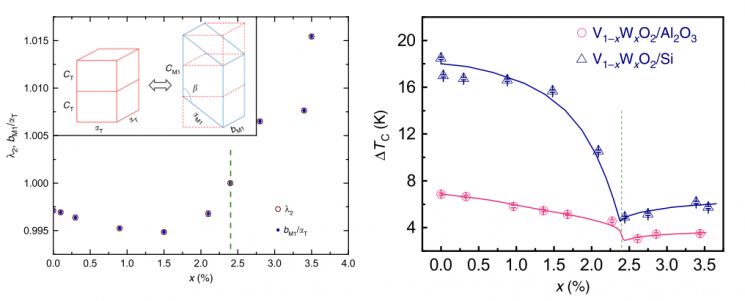
During the phase transition process, materials exhibit thermal hysteresis, where past states affect the current state. Various studies have been conducted to reduce the thermal hysteresis in vanadium dioxide, which adversely affects reversibility and durability.
Professor Lee fabricated vanadium dioxide thin films doped with various concentrations of tungsten and analyzed the lattice constants (crystal structure parameters) at high and low temperatures. As a result, he revealed that when the lattice constants in specific directions of two different phases have similar values, the hysteresis characteristic of the metal-insulator phase transition significantly decreases.
Professor Lee said, “Through this research, by understanding and controlling the characteristics of phase transition materials, we expect to accelerate the practical application of various devices in energy, bio fields, and more that utilize phase transition materials.”
Professor Lee Seung-hoon of Pukyong National University published a paper titled ‘Tuning the hysteresis of a metal-insulator transition via lattice compatibility’ as a co-first author on the 15th in the international journal Nature Communications. The paper reports joint research conducted with the University of Maryland, the National Institute of Standards and Technology (NIST), the Hong Kong University of Science and Technology, and the University of Minnesota.
© The Asia Business Daily(www.asiae.co.kr). All rights reserved.


















