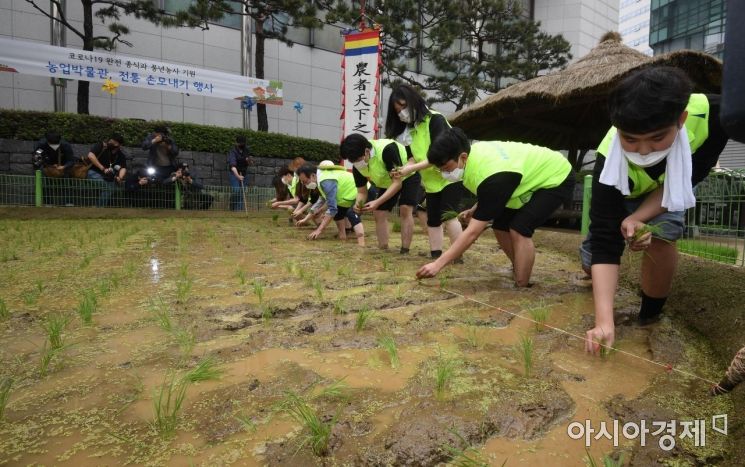
 On the 18th, two days before Soman, the solar term when sunlight is abundant and all things are full, Lee Seong-hee, Chairman of the National Agricultural Cooperative Federation, and university student volunteers are experiencing rice planting at the "Traditional Hand Rice Planting in the City" event held at the Agricultural Museum Experience Farm in Jung-gu, Seoul. Photo by Kim Hyun-min kimhyun81@
[Asia Economy Reporter Kim Hyunjung] The Ministry of Agriculture, Food and Rural Affairs announced on the 22nd that 11 national tax special cases in the agricultural sector, which were set to expire at the end of this year, have been extended through the '2020 Tax Law Amendment' announced by the Ministry of Economy and Finance.
The special cases under the Restriction of Special Taxation Act, which will be extended for two years until the end of 2022, include six direct support special cases for farmers such as zero VAT rate on agricultural machinery and equipment, and tax exemption on interest income from savings for farmers and fishermen, as well as five indirect support special cases for agricultural cooperatives and agricultural corporations such as tax exemption on deposits and capital contributions to agricultural cooperatives.
First, the income tax exemption benefits on interest income from savings for farmers and fishermen, interest income on cooperative deposits (up to 30 million KRW), and dividend income on capital contributions (up to 10 million KRW) will be extended.
To reduce the burden of farming costs on farms, the zero VAT rate on domestically produced agricultural machinery and equipment will continue to be applied, and VAT on imported agricultural machinery and equipment will also be exempted. Agricultural and livestock equipment subject to the zero rate includes 33 types of agricultural machinery (power tillers, tractors, combines, etc.), 39 types of livestock equipment (feed bins, feed mixers, etc.), fertilizers, pesticides, feed, and 50 types of eco-friendly agricultural materials (chitosan, wood vinegar, etc.).
Furthermore, low-rate taxation on cooperative corporations such as agricultural cooperatives will continue, and special tax reductions for small and medium-sized enterprises engaged in crop cultivation and livestock farming will lower the tax burden on agricultural-related corporations.
In addition, other tax support measures to revitalize agriculture and rural areas will be maintained, such as gift tax reductions on farmland for farming children (support for agricultural succession), capital gains tax reductions on general housing for rural housing acquirers (support for rural settlement), and capital gains tax reductions on livestock farm land upon closure of livestock farms (livestock industry restructuring).
In particular, under the current law, capital gains tax reductions apply only to rural housing acquirers with properties of 660㎡ or less when transferring general housing, but according to the amendment, benefits will be available regardless of size.
The 2020 Tax Law Amendment will be finalized by the National Assembly after going through the Vice Ministerial Meeting and the Cabinet Meeting next month following the legislative notice period. During the legislative notice period, the Ministry of Agriculture, Food and Rural Affairs plans to collect opinions from related organizations and the agricultural sector and submit the ministry’s opinions to the Ministry of Economy and Finance.
© The Asia Business Daily(www.asiae.co.kr). All rights reserved.

















