[Asia Economy Reporter Kim Eunbyeol] Due to the characteristic of South Korea where most household assets are concentrated in real estate, the proportion of non-financial assets in total assets is noticeably higher compared to major countries.
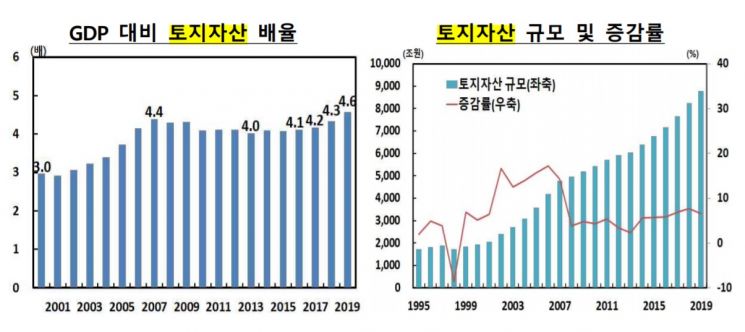
According to the national balance sheet released by the Bank of Korea and Statistics Korea on the 25th, as of the end of last year, the ratio of land assets to Gross Domestic Product (GDP) in South Korea reached a record high of 4.6 times.
At the end of last year, the total value of land assets was 876.7 trillion won, an increase of 54.14 trillion won (6.6%) compared to the previous year. While nominal GDP increased by only 1.1% last year, land assets grew by 6.6%, which had an impact. The increase was significant in cultural and recreational land such as parks and sports grounds (8.8%). Among land assets, the asset growth rate of land attached to buildings reached 7.3%. The ratio of land assets to GDP has steadily risen from 4.0 times in 2013 to 4.2 times in 2017 and 4.3 times in 2018.
South Korea's ratio of land assets to GDP is also high compared to other countries. According to calculations based on data published by various countries as of 2018 by the Bank of Korea, Australia's land assets to GDP ratio was 2.91 times, and South Korea's land asset ratio was higher than that of the UK (2.82 times) and France (2.80 times).
In addition, Japan (2.24 times), Canada (1.88 times), and Germany (1.49 times) had land asset ratios to GDP about half that of South Korea. Compared to the average of the six major countries (2.4 times), South Korea's land asset ratio to GDP is about twice as high.
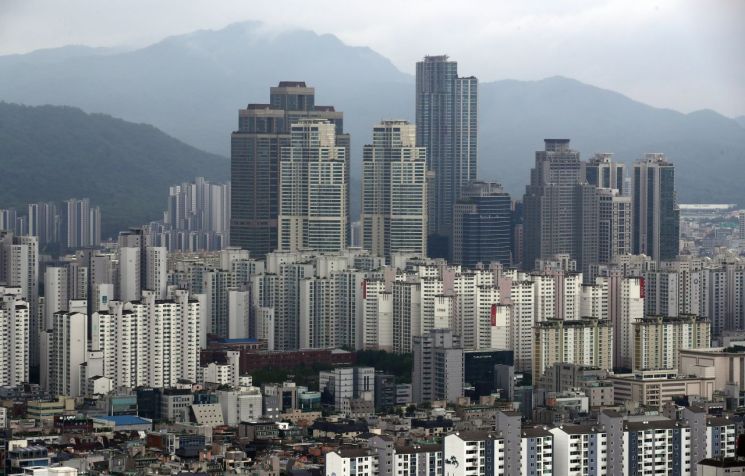
One reason for South Korea's high ratio of land assets to GDP is its geographical characteristics. Compared to the United States or Europe, which have many plains and wide land areas, South Korea physically has less habitable land area, which inevitably leads to higher valuation of land assets. The tendency to concentrate personal assets in land, buildings, and houses is also cited as a reason for the high ratio of land assets to GDP.
The rapid increase in land asset prices concentrated in the Seoul metropolitan area in South Korea has also had an impact. The proportion of land assets in the metropolitan area decreased from 61.7% in 2010 to 56.6% in 2017 but rose again to 56.9% in 2018. After 2011, the growth rate of land assets in non-metropolitan areas was higher than in the metropolitan area, but this reversed after seven years. In 2018, the growth rate of land assets in the metropolitan area (8.1%) surpassed that of non-metropolitan areas (7.1%), resulting in this phenomenon.
An official from the Bank of Korea explained, "Traditionally, in South Korea, most assets tend to be concentrated in land or buildings, so the ratio of land assets to GDP is relatively high."
© The Asia Business Daily(www.asiae.co.kr). All rights reserved.


















