"Human Rights Issues Can No Longer Be Postponed"
Poll Shows General Support for 'Anti-Discrimination Law'
International Community Continues to Recommend Legislation
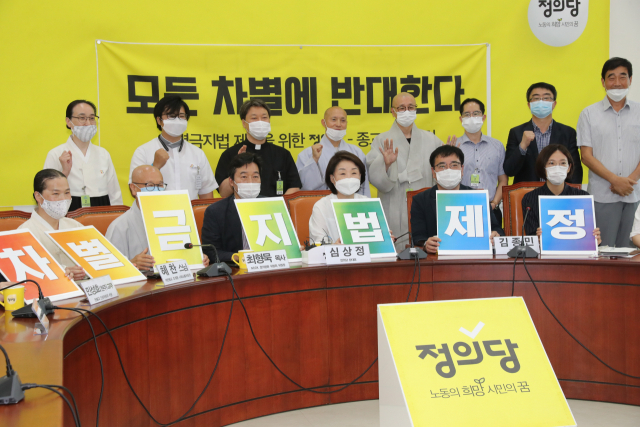 On the 8th, Sim Sang-jung, leader of the Justice Party, is taking a commemorative photo with attendees at the Justice Party-Religious Community meeting for the enactment of the Anti-Discrimination Act held at the National Assembly in Yeouido, Seoul. Photo by Yonhap News
[Asia Economy Reporter Han Seung-gon, Intern Reporter Kang Joo-hee] The Justice Party proposed the 'Comprehensive Anti-Discrimination Act' on the 29th of last month, sparking ongoing debates over its pros and cons. While some oppose it, calling it a 'law protecting homosexuals,' the Justice Party is determined to enact the anti-discrimination law during the 21st National Assembly.
On the 20th, the Justice Party reiterated the necessity of the anti-discrimination law at a forum held in the main conference room of the National Assembly Members' Office Building.
The types of discrimination specified include 23 categories such as gender, disability status, age, country of origin, educational background, sexual orientation, and gender identity, and based on these categories, the law states that no discrimination should be tolerated in 'public spheres' such as ▲employment, supply or use of goods and services ▲education and vocational training in educational institutions ▲provision or use of administrative services.
Sim Sang-jung, leader of the Justice Party, emphasized, "The Comprehensive Anti-Discrimination Act is a law to strengthen the human rights foundation of our democracy," adding, "In the post-COVID-19 era, to move toward a society of cooperation and solidarity based on individual dignity and safety, this is a law that cannot be postponed any longer and must be enacted immediately."
Meanwhile, public opinion regarding the enactment of the anti-discrimination law appears generally positive.
According to a public perception survey released by the National Human Rights Commission on the 23rd of last month, 88.5% of respondents said the enactment of the anti-discrimination law is necessary. Regarding the 'sexual orientation and identity' category, 73.6% of respondents stated that sexual minorities such as homosexuals and transgender people should be treated equally like others.
In a survey titled 'Legislative Tasks for Gender Equality Desired by the People in the 21st National Assembly' released by the Korean Women's Development Institute on the 15th of last month, 87.7% of respondents also answered that the enactment of the anti-discrimination law is necessary.
Office worker Kim (27) said, "As discussions about social fairness and justice become more active, people's awareness of discrimination is naturally beginning to change," adding, "Existing laws do not adequately protect socially vulnerable groups. A minimum law to protect these vulnerable groups must be established as soon as possible."
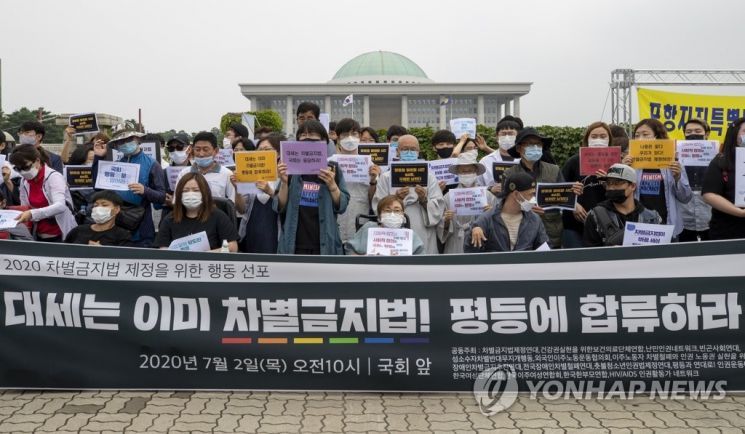 At the press conference for the "2020 Action Declaration for the Enactment of the Anti-Discrimination Act" held in front of the National Assembly on the 2nd, participants including the Coalition for the Enactment of the Anti-Discrimination Act are holding hand placards with related content. Photo by Yonhap News
Another office worker Lee (28) stated, "I believe that no one should question an individual's identity for any reason. It is not a matter for others to agree or disagree on in the first place," and argued, "I think the enactment of the anti-discrimination law is the starting point to eliminate prejudice and discrimination against minorities and to bring about a change in such perceptions."
International recommendations for the enactment of anti-discrimination laws have been ongoing for over a decade.
The United Nations (UN) repeatedly urged the Korean government to enact an anti-discrimination law from 2007 to 2017. Among the 34 member countries of the Organisation for Economic Co-operation and Development (OECD), most countries except Korea and Japan already have similar laws such as anti-discrimination laws and equality laws.
However, some still argue that the enactment of the anti-discrimination law is unnecessary. Members of the Future United Party's Christian group held a press conference at the National Assembly Communication Hall in Yeouido, Seoul, on the 17th, opposing the anti-discrimination law, calling it a "law protecting homosexuals" and "immoral sexual behavior."
They claimed, "The Comprehensive Anti-Discrimination Act is based on an anti-democratic and dictatorial idea that seeks to prohibit and punish personal judgment and expression under the name of anti-discrimination."
On the other hand, some Protestant organizations have expressed support for the anti-discrimination law. On the 20th, 81 Christian organizations including the Human Rights Center of the National Council of Churches in Korea, the Catholic Human Rights Committee, and the Justice and Peace Priests Group of the Anglican Church issued a statement titled 'Christians Support the Anti-Discrimination and Equality Laws for All People ? Welcoming the Political Efforts to Enact Equality Laws,' urging the 21st National Assembly to enact the anti-discrimination law.
They stated, "Christianity is a religion of love, not hate," and pointed out, "Some fundamentalist Christians are opposing the anti-discrimination clauses concerning 'sexual orientation' and 'gender identity.' Unfortunately, their opposition is based on fake news such as 'preaching that homosexuality is a sin will lead to arrest.'"
Meanwhile, Representative Jang Hye-young, who spearheaded the proposal of the anti-discrimination law, emphasized on the 20th, "The Comprehensive Anti-Discrimination Act is an agenda that can no longer be postponed with the phrase that social consensus is needed," adding, "Because our human rights can never be postponed."
She continued, "The anti-discrimination law has been proposed in the National Assembly after seven years. Now, the big goal of 'enactment' remains," adding, "We will continue to raise awareness that the anti-discrimination law is closely related to our daily lives."
© The Asia Business Daily(www.asiae.co.kr). All rights reserved.
!["The Woman Who Threw Herself into the Water Clutching a Stolen Dior Bag"...A Grotesque Success Story That Shakes the Korean Psyche [Slate]](https://cwcontent.asiae.co.kr/asiaresize/183/2026021902243444107_1771435474.jpg)

















