[Asia Economy Reporter Jang Hyowon] Samkang M&T, a manufacturer of offshore wind turbine substructures, is buzzing with the government's Green New Deal announcement. This is because the company has been securing large-scale offshore wind-related contracts overseas since last year. However, attention is focused on whether it can overcome the overhang (potential pending volume) issue due to outstanding convertible bonds (CB) equivalent to 13% of the total shares.
◆ Surging Orders... Continued Profitability
Samkang M&T specializes in manufacturing steel pipes, shipbuilding equipment, ship modifications, and plant structures. It grew by being the first to successfully localize thick-walled steel pipes, which were entirely imported until 2000. Thick-walled steel pipes are basic materials mainly used for crude oil extraction and oil pipelines.
In 2009, the company established a ship block and onshore/offshore plant factory in Goseong, Gyeongnam, entering the plant business. As of 2018, sales from ship blocks and offshore plants accounted for 63.1% of Samkang M&T's total revenue.
Samkang M&T's performance declined starting in 2016. In 2017, its sales dropped 29.6% year-on-year to 121.8 billion KRW, and it recorded an operating loss of 14.1 billion KRW, turning to a deficit. This was attributed to the poor performance of Samkang S&C, acquired in 2017. Samkang S&C, engaged in ship modification, recorded net losses annually until last year but achieved a net profit of 1 billion KRW in Q1 this year through cost management.
Samkang M&T's full-scale turnaround was driven by the offshore wind turbine substructure business. Early last year, Samkang M&T signed a 56.7 billion KRW offshore wind turbine substructure supply contract with Belgium's JDN. JDN, a Belgian company specializing in seabed dredging and reclamation, is a supplier for Taiwan's offshore wind farm.
Subsequently, offshore wind turbine substructure orders continued. On the 15th, Samkang M&T announced a 27.3 billion KRW supply contract with a Singaporean client. Earlier on the 9th, it secured a 57.6 billion KRW contract from Lamprell in the United Arab Emirates (UAE). Samkang M&T's new orders this year amount to about 203 billion KRW, with an order backlog of approximately 320 billion KRW remaining.
As orders are reflected in performance, Samkang M&T recorded an operating profit of 8.8 billion KRW on a consolidated basis in Q1 this year, successfully turning profitable from an operating loss of 3.9 billion KRW in the same period last year. Sales also increased 143% year-on-year to 138.7 billion KRW.
Outlook for Samkang M&T's Q2 performance is also positive. According to financial information provider FnGuide, the consensus for Samkang M&T's Q2 sales is 131.8 billion KRW, a 49% increase year-on-year. Operating profit and net profit are expected to continue the profit trend at 9.1 billion KRW and 4.6 billion KRW, respectively.
Researcher Kim Youngjun of KTB Investment & Securities analyzed, "The offshore wind power market is expected to grow at an average annual rate of 18.1% until 2025, growing faster than the onshore wind power market. Samkang M&T is expected to improve performance as offshore wind turbine substructure sales begin in earnest this year and its subsidiary Samkang S&C normalizes operations."
◆ Potential Shares 13%... Will Performance Offset?
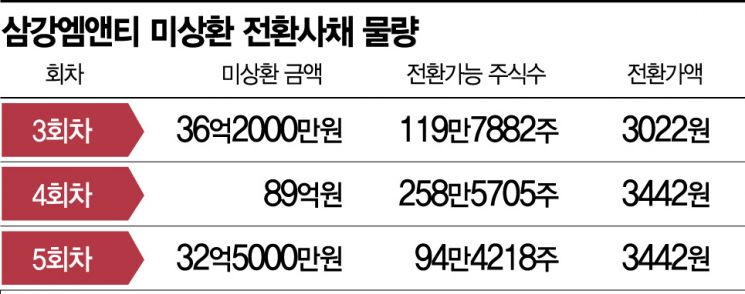
Although performance is improving, the CB volume is somewhat burdensome. As of the 15th, Samkang M&T's outstanding CB amount is 15.77 billion KRW. The number of convertible shares is 4,727,805 shares, which would account for 13% of total equity if fully converted.
The conversion price per share for these CBs ranges from 3,022 to 3,442 KRW. It was around 4,300 KRW at issuance but was refixed (conversion price adjusted) as the stock price fell in March. The refixing increased the number of convertible shares.
Among these CBs, the third tranche worth 3.62 billion KRW has been convertible since September last year, and the fourth and fifth tranches worth 12.15 billion KRW became convertible on the 9th and 12th, respectively. Given the recent stock price hovering around 6,000 KRW, it is advantageous for CB investors to convert.
In fact, these CBs were worth 28.7 billion KRW at the end of Q1, but about 13 billion KRW has been converted into shares since May. This means 3,751,519 shares (11.9%) have already been released into the market.
Researcher Eom Kyunga of Shin Young Securities analyzed, "The potential issuance volume relative to existing shares was large, causing a prolonged period of supply-demand impact on the stock price. However, the unconverted CB balance has decreased to 13% of total shares, reaching a level where stock price increases can be expected based on improving performance."
© The Asia Business Daily(www.asiae.co.kr). All rights reserved.

















