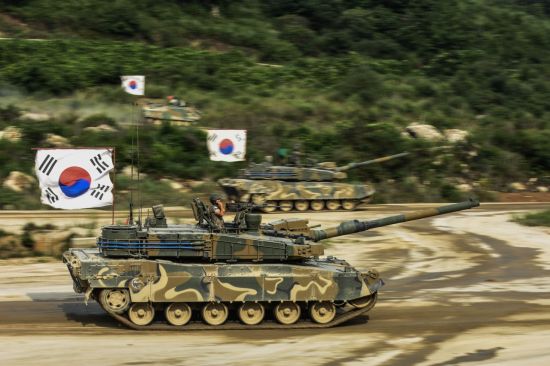
[Agency for Defense Development] A tank refers to any combat vehicle equipped with a hull capable of protecting against enemy bullets or shrapnel on the battlefield. However, in principle, the term ‘tank’ specifically means a main battle tank. Tanks, armored vehicles, and self-propelled artillery all share similar appearances but are distinct weapon systems designed for different missions and situations.
First, tanks equipped with powerful guns are intended for direct combat against enemy armored forces. Their primary mission is to advance to the front lines, destroy enemy tanks, break through defensive obstacles, and facilitate the mobility of following armored vehicles and self-propelled anti-aircraft guns.
Tanks first appeared during World War I. At that time, battles involved digging trenches and setting up fortified defensive lines with barbed wire, suppressing advancing enemy infantry with machine guns. No matter how many infantry charged into enemy trenches, they were inevitably annihilated by machine-gun fire from within the trenches. This created the need to develop combat vehicles equipped with weapons capable of attacking enemy machine guns and infantry.
The British Army was the first to create and deploy tanks in warfare. To maintain secrecy, tanks were called ‘water tanks’ (vehicles for carrying water), which was later shortened to ‘tank.’ The first tank, the Mark 1, was deployed in the 1916 Battle of the Somme in France, playing a pivotal role in neutralizing enemy positions and contributing significantly to the Allied victory.
Tanks and armored vehicles, which fight closest to the enemy, penetrate enemy lines and attack strong defensive points, infantry, and opposing tanks with guns and machine guns. Because they must be capable of both offense and defense, they feature thick armor capable of withstanding enemy tank shells, resulting in weights exceeding 50 tons. They carry a minimum crew of 3 to 4 personnel, are designed for close combat, and are equipped with direct-fire systems.
However, even tanks, known as the ‘king of ground warfare,’ cannot handle everything alone on the battlefield. Due to their limited visibility, tanks require infantry to accompany them to detect hidden anti-tank guns or infantry armed with anti-tank weapons, protect friendly forces, and attack enemies. Infantry running alongside tanks face limitations, and riding in regular vehicles does not guarantee their safety.
Accordingly, armored vehicles with sturdy armor were developed to accompany tanks and protect infantry from enemy machine-gun fire. These armored vehicles move quickly across the battlefield, shielding infantry from bullets and shrapnel and ensuring safe movement. They also perform reconnaissance and provide fire support to friendly infantry. While not primarily designed for combat, they can be equipped with relatively light armaments such as anti-tank missiles. Armored vehicles are classified according to their roles into personnel carrier armored vehicles (APC), infantry fighting vehicles (IFV), and multipurpose tracked support armored vehicles.
Self-propelled artillery, as the name suggests, are ‘autonomous’ cannons that support friendly forces from the rear through artillery fire. They evolved from traditional towed artillery. Conventional artillery, commonly called cannons or howitzers, can fire shells over long distances with great destructive power but cannot move on their own and must be towed by vehicles. Until the early stages of World War II, horses were often used to tow artillery due to a shortage of trucks.
When tanks advance into enemy territory, artillery pieces that strike enemy batteries ahead of the tanks must naturally accompany and support them. However, in the fast-paced environment of the battlefield, towing artillery by vehicle, having soldiers dismount to prepare firing, load ammunition, and fire is a lengthy process. Therefore, self-propelled artillery was developed by mounting the gun on a tracked vehicle, enabling it to move independently without towing. Tank guns are direct-fire weapons with short range, designed to engage enemy tanks or infantry with high accuracy and rapid fire.
In contrast, self-propelled artillery uses indirect fire to bombard enemy positions or obstacles far beyond the tank’s line of sight. While tanks are mobile weapons for close and mid-range combat, self-propelled artillery are fixed-position, long-range weapons. They establish a firing position, adjust the barrel, and attack targets from a stationary location. Additionally, tanks carry ammunition internally, whereas self-propelled artillery are accompanied by separate ammunition vehicles.
Recently, ammunition is also stored inside the turret. The Agency for Defense Development has developed the K1 and K1A1 tanks and the world-class K2 tank. It has also developed armored vehicles such as the Korean-type armored vehicle K200 and the next-generation infantry fighting vehicle K21. For howitzers, it developed the KH179 towed howitzer and, following the production of the KM109A2 (K55), developed the K9 self-propelled howitzer with a firing range of 40 km, which currently contributes to overseas defense exports.
© The Asia Business Daily(www.asiae.co.kr). All rights reserved.
![User Who Sold Erroneously Deposited Bitcoins to Repay Debt and Fund Entertainment... What Did the Supreme Court Decide in 2021? [Legal Issue Check]](https://cwcontent.asiae.co.kr/asiaresize/183/2026020910431234020_1770601391.png)
















