Job Insecurity Due to Reduced Work for Internal Combustion Engine Vehicles
Concerns Over Conflict Between Ulsan Hyundai Mobis Branch and Hyundai Motor Union
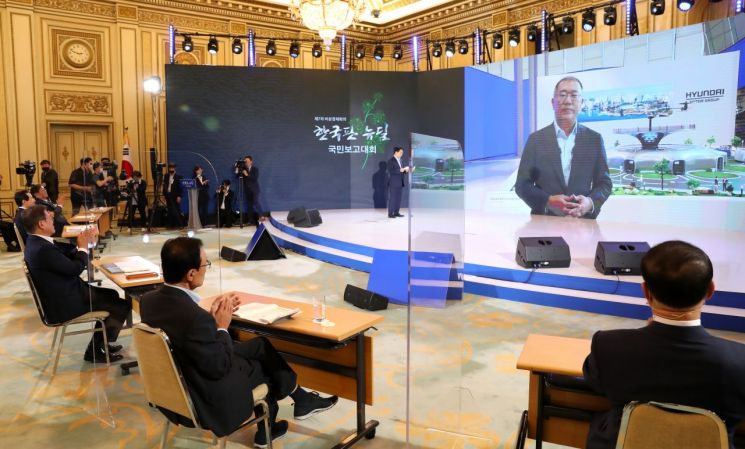 On the 14th, at the Blue House State Guesthouse during the 'Korean New Deal National Report Conference,' President Moon Jae-in is listening in real-time to the presentation by Chung Eui-sun, Executive Vice Chairman of Hyundai Motor Group. (Photo by Yonhap News)
[Asia Economy Reporter Kim Ji-hee] As Hyundai Motor Group accelerates its focus on future vehicles centered on electric and hydrogen electric cars, competition among labor unions to secure related work is emerging. Amid employment insecurity voiced not only by parts suppliers related to the future vehicle transition but also by the finished car unions, concerns are rising that 'union-to-union conflicts' over work allocation may intensify.
According to the industry on the 16th, on the 14th, the Ulsan Hyundai Mobis branch of the Metal Workers' Union Ulsan branch posted a large notice inside the factory revealing that the Hyundai Motor union executive recently conducted an on-site inspection of the PE (Power Electronics) module production line, criticizing it as "an attempt to find prey to resolve employment insecurity due to the reduction of internal combustion engine vehicle work caused by the 4th Industrial Revolution." They stated, "The Hyundai Motor branch, which calls for employment stability and fair distribution, is currently acting in a way that appears to be trying to take away our work," and added, "We are repeatedly contemplating employment stability and are exploring ways to move forward."
The reason for such strong opposition from the Ulsan Hyundai Mobis branch is that recently the Hyundai Motor and Kia Motor unions have repeatedly mentioned the PE module as an alternative to protect employment. At the end of last month, the Hyundai Motor union stated through a newsletter, "We should bring an external battery module factory inside the Ulsan plant," and "As internal combustion engine vehicles decrease, we plan to assign surplus personnel to the battery module factory to maintain employment stability." Recently, the Kia Motor union also expressed its intention to "make efforts to expand the PE module factory," which has heightened anxiety at the Hyundai Mobis plant that produces these modules.
Since the beginning of this year, the Hyundai-Kia Motor unions have been responding more actively than ever to adapt to changes in the future vehicle era. They have formed a Future Change Response Task Force (TF) consisting of union members, company representatives, and civilian committee members to discuss employment issues and quality improvements. Last week, they attracted attention by organizing a test drive of Tesla models, recognized as leaders in electric and autonomous vehicle technology, during a union delegates' retreat. However, as the union executives show a cooperative approach with management on future vehicles, some on-site organizations express opposing views, such as "We need to strike to increase bargaining power in the upcoming wage negotiations."
Although future vehicle-related parts are limitless, domestic technological capabilities remain limited, leading to an analysis that competition over limited work will intensify. Lee Hang-gu, senior research fellow at the Korea Institute for Industrial Economics and Trade, said, "Broadly speaking, the union's claim means to engage in electric vehicle-related businesses, and the PE module is one of the various alternatives being considered," adding, "Hyundai Motor receives a significant portion of electronic components supply through Hyundai Mobis, which has caused clashes between the two sides."
Recently, Hyundai Motor Group Vice Chairman Chung Eui-sun unveiled a blueprint to achieve "1 million electric vehicles and a 10% global electric vehicle market share by 2025," signaling the group's company-wide efforts to dominate the future vehicle market, which has increased conflict factors not only between labor and management but also among unions. The research fellow explained, "The unions have begun to recognize that transitioning to future vehicles is inevitable, but since there is not yet much work, competition to secure it is occurring," adding, "However, as electric vehicle volumes continue to expand, profitability will improve and the quantity of parts to be supplied will increase, which may reduce competition."
© The Asia Business Daily(www.asiae.co.kr). All rights reserved.

















