Results of the Bank of Korea's Monetary Policy Committee Meeting
Bank of Korea Appears Concerned About Asset Market Overheating Including Real Estate Price Increases
[Asia Economy Reporter Jang Sehee] The Bank of Korea has kept the base interest rate steady at 0.50% per annum. This is interpreted as a decision to maintain a low interest rate stance for the time being and monitor the situation amid delayed economic recovery in the second half of the year due to the novel coronavirus disease (COVID-19) and increasing uncertainties in external factors. Criticisms that excessive liquidity only inflates asset prices such as real estate, and the effective lower bound are cited as reasons for not lowering the base rate further.
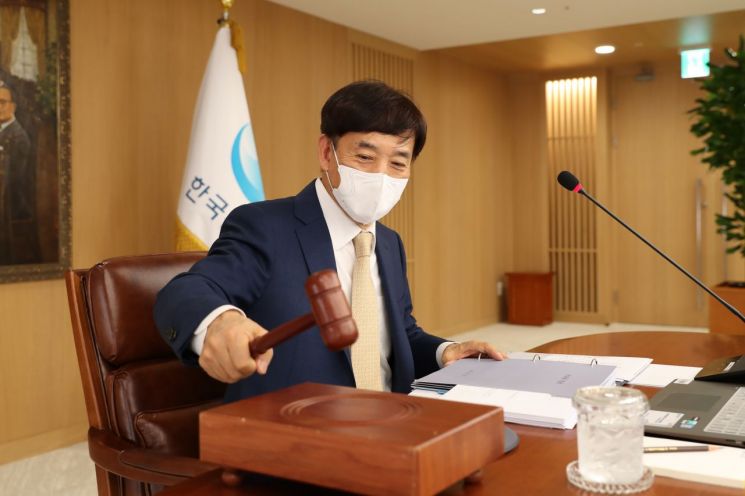
The Monetary Policy Board of the Bank of Korea held a meeting on the 16th, chaired by Governor Lee Ju-yeol, and decided to keep the base interest rate at 0.50% per annum. Previously, at the Monetary Policy Board meeting on May 28, the Bank of Korea lowered the base rate from 0.75% to the historic low of 0.5%.
The fact that the shock caused by COVID-19 has not yet fully recovered is part of the reason the Monetary Policy Board maintains the low interest rate stance. Governor Lee Ju-yeol stated in the Bank of Korea’s 70th anniversary speech last month, "Monetary policy needs to be operated accommodatively until our economy shows signs of recovery."
The Federal Reserve (Fed) of the United States announcing it will maintain zero interest rates until 2022 is also analyzed as influencing the decision to keep rates steady. When major countries like the U.S. maintain rates at the lowest levels, it reduces the burden on the Bank of Korea to continue the low interest rate stance. Narrowing the interest rate gap with the currency-issuing countries could cause issues such as foreign currency outflows.
There is also a policy mix aspect related to the government’s real estate stabilization policy. Deputy Prime Minister and Minister of Economy and Finance Hong Nam-ki indirectly stated during the real estate measures announcement on the 10th that the Bank of Korea’s rate cuts had influenced the rapid rise in real estate prices and that rates should not be lowered further. Deputy Prime Minister Hong said, "Various economic conditions and factors determining interest rates are intertwined, so the Bank of Korea has made an appropriate judgment, but interest rates might be considered in connection with the real estate market." Governor Lee also responded to questions about the relationship between low interest rates and housing prices by saying, "There are various factors besides interest rates that determine housing prices," but added, "Accommodative financial conditions lower household costs, which can act as a factor increasing housing demand."
Another reason for keeping the rate steady is to observe the effects of policies such as the execution of the third supplementary budget (supplementary budget). However, the Bank of Korea is closely monitoring the possibility that the issuance of deficit government bonds due to the supplementary budget could raise government bond yields. Governor Lee stated after the May Monetary Policy Board meeting, "We are closely watching the possibility of market instability if a large amount of government bonds is issued," and "If long-term interest rates fluctuate, we will actively purchase government bonds to stabilize the market."
Experts view the global economic trends amid the large-scale resurgence of COVID-19 as a variable but analyze that additional rate cuts within the year are unlikely.
Oh Chang-seop, a researcher at Hyundai Motor Securities, said, "Additional rate cuts in the U.S. seem to be a prerequisite, but under the current circumstances, the capacity for further rate cuts is very low." Professor Lee In-ho of Seoul National University’s Department of Economics said, "This economic crisis was caused by COVID-19," and added, "I do not think lowering interest rates will stimulate the economy."
Meanwhile, the Monetary Policy Board, which decides the base interest rate within the year, has three remaining meetings scheduled for August 27, October 14, and November 26.
© The Asia Business Daily(www.asiae.co.kr). All rights reserved.
![User Who Sold Erroneously Deposited Bitcoins to Repay Debt and Fund Entertainment... What Did the Supreme Court Decide in 2021? [Legal Issue Check]](https://cwcontent.asiae.co.kr/asiaresize/183/2026020910431234020_1770601391.png)