Recycling Green MoaMoa Project Fully Implemented in All Neighborhoods of Eunpyeong-gu
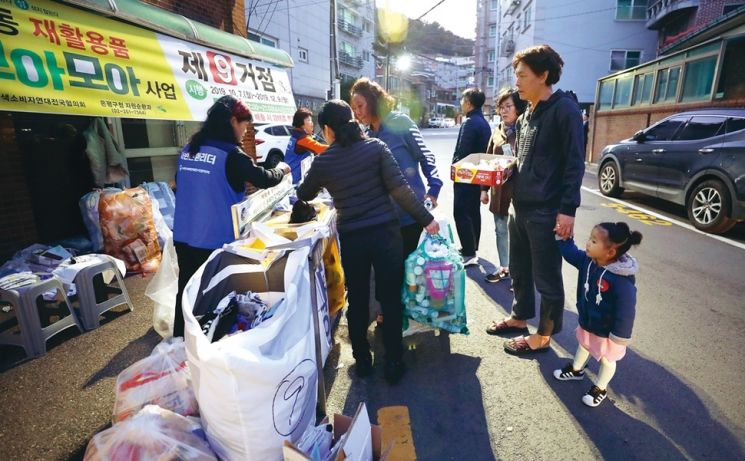
[Asia Economy Reporter Jongil Park] In a corner of the village park, people gather holding familiar recyclables such as PET bottles, waste paper, and bottles.
The scene is diverse, ranging from young children carrying bundles of recyclables following their mothers to elderly people bringing recyclables on silver carts. This is the ‘Recyclables Green MoaMoa Project’ being implemented in Eunpyeong-gu.
Eunpyeong-gu (Mayor Kim Mikyung) has expanded the project, which was piloted in one neighborhood since last October, to all 16 neighborhoods starting from the 16th.
According to the ‘Direct Landfill Household Waste Import Quota System’ implemented since January, the amount of household waste sent to the metropolitan landfill must be reduced by 10% compared to 2018. Failure to comply results in a five-day suspension of household waste acceptance throughout the year, making a ‘garbage crisis’ inevitable.
To prevent this ‘garbage crisis,’ Eunpyeong-gu is making every effort to reduce household waste, and one such effort is the ‘Recyclables Green MoaMoa Project.’
This project aims to increase the sorting rate of marketable recyclables to 70% by putting special effort into the recycling stage.
With residents’ consent, at 10 designated collection points in each village, residents separate and dispose of recyclables into eight categories such as clear PET bottles, milk cartons, and cans every Thursday or Friday (Thursday for Ilhwamok collection areas, Friday for Monday-Wednesday-Friday collection areas) for four hours (5 PM to 9 PM).
By disposing of recyclables in a ‘Bihaengbunseok’ manner?emptying, rinsing, separating, and not mixing?the project reduces recycling processing costs and the total amount of household waste.
Another fundamental factor enabling this effect is the role of ‘Resource Managers’ who work actively on-site. A designated ‘Resource Manager’ is assigned at each MoaMoa location to promote ‘Bihaengbunseok’ to residents and manage the site.
While the previous doorstep disposal method often resulted in contamination of recyclables by food waste or general trash, making only about 20-30% of collected recyclables marketable, the sorting rate at MoaMoa sites exceeds 90%, allowing recyclables to be sold immediately without additional sorting.
At the Susaek-dong recycling collection center operated by Eunpyeong-gu, about 50 tons of recyclables are processed daily. Since the implementation of the MoaMoa project, the amount of recyclables sold in the first half of this year increased by 1,535 tons compared to the same period last year, a 19.6% increase.
Eunpyeong-gu’s analysis shows that by expanding the MoaMoa project to all neighborhoods, the amount of high-value recyclables collected at the source increases, reducing the volume of recyclables brought to the collection center and enhancing sorting efficiency.
Reducing waste and preparing for the closure of the metropolitan landfill cannot be achieved by public sector efforts alone; active participation and practice by residents are essential.
Mayor Kim Mikyung explained, “Through the MoaMoa project, we can protect the environment and revitalize the community by practicing recyclable separation in daily life, achieve sustainable growth, and also enjoy the effect of creating community-based jobs through the employment of resource managers.”
The Eunpyeong-style Green New Deal ‘Recyclables Green MoaMoa Project’ is expected to function as a stable public waste processing system alongside the upcoming ‘Eunpyeong Metropolitan Resource Circulation Center,’ serving as a good model for realizing a resource-circulating society.
© The Asia Business Daily(www.asiae.co.kr). All rights reserved.
![User Who Sold Erroneously Deposited Bitcoins to Repay Debt and Fund Entertainment... What Did the Supreme Court Decide in 2021? [Legal Issue Check]](https://cwcontent.asiae.co.kr/asiaresize/183/2026020910431234020_1770601391.png)















