Mobile Base for Surface Travel After 2024 Lunar Exploration
Supports 2 People for Up to 14 Days... Uses Solar Panels and Hydrogen Fuel Cells
NASA Engineer: "Essentially a Camping Car for Moon Exploration"
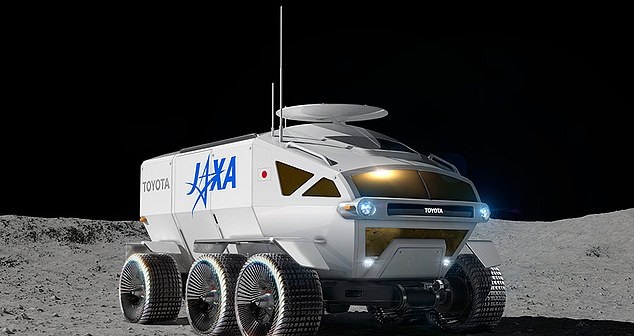 A 6-wheeled lunar exploration vehicle jointly developed by the Japan Aerospace Exploration Agency (JAXA) and the automobile company Toyota. / Photo by JAXA
[Asia Economy Intern Reporter Lim Juhyung] NASA, preparing for a lunar exploration mission in 2024, has begun creating the first lunar base where astronauts will reside. The lunar base currently envisioned by NASA is a so-called 'camper' made by the Japanese automobile company Toyota.
According to the British media outlet 'Daily Mail' on the 15th (local time), NASA is currently developing an autonomous six-wheeled vehicle together with the Japan Aerospace Exploration Agency (JAXA) and Toyota.
This vehicle will be used as a lunar base for astronauts following NASA's 2024 lunar exploration plan, the 'Artemis Program.'
The vehicle can carry various supplies for two astronauts to survive for 14 days and supports daily life, various experiments and tasks, as well as lunar surface travel. It can also supply power through solar panels and hydrogen fuel cells.
Mark Krasich, NASA's Exploration Systems Development Manager, said in a video interview, "I have worked on many spacecraft, but this vehicle is the coolest because people can actually work and live inside it."
He added, "It can practically be considered a habitat similar to a space facility. Two people can live in it for 14 days, and they can drive the vehicle anywhere on the moon. It's like a lunar exploration 'camper.'"
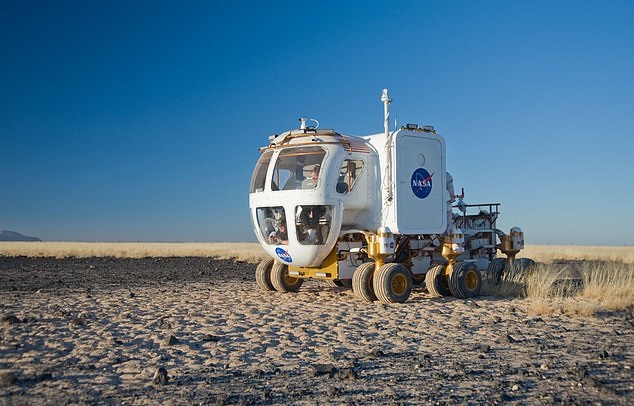 The U.S. National Aeronautics and Space Administration (NASA) is developing a mobile base to be used for traveling on the lunar surface and conducting experiments after the 2024 moon exploration. / Photo by NASA
Koichi Wakata, JAXA Deputy Director who has been in charge of designing the vehicle with Toyota since 2018, said, "The moon's gravity is only one-sixth of Earth's, and the lunar terrain is much more complex and rugged than Earth's. It is exposed to radiation and the temperature is much harsher than on Earth. We are developing a vehicle that can meet these conditions and travel 10,000 km."
The necessity of a lunar base was raised in March last year during a NASA speech by U.S. Vice President Mike Pence. At that time, Vice President Pence emphasized, "NASA must not only send humans back to the moon but also establish a permanent base there. From that base, new technologies should be developed to send American astronauts to Mars and beyond the solar system."
NASA initially researched methods to build lunar bases such as inflatable tents and digging underground holes but eventually discarded these ideas and adopted the plan to use a vehicle as a mobile base.
Meanwhile, NASA is preparing a series of lunar exploration missions from 2021 to 2024.
First, in next year's 'Artemis 1' mission, an unmanned spacecraft will be launched, followed by a manned spacecraft orbiting the moon in 2022. The final 'Artemis 3' mission in 2024 will achieve the actual manned lunar landing.
After the lunar landing, NASA plans to establish a lunar base using vehicles and other means, aiming to build facilities where humans can reside on the lunar surface by 2028.
© The Asia Business Daily(www.asiae.co.kr). All rights reserved.


















