Legal Community Largely Expects 'Acquittal-Oriented Remand for Retrial'
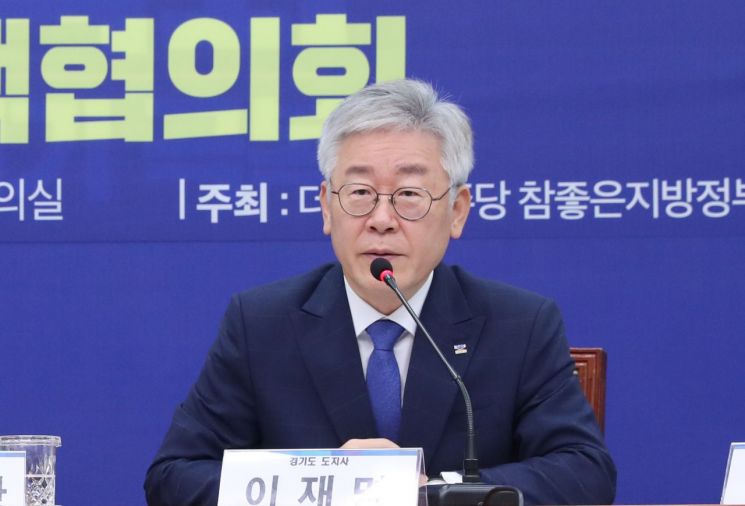 Governor Lee Jae-myung of Gyeonggi Province, facing a Supreme Court verdict on the afternoon of the 16th regarding charges including violation of the Public Official Election Act. [Image source=Yonhap News]
[Asia Economy Reporter Choi Seok-jin] The Supreme Court ruling on the appeal of Gyeonggi Province Governor Lee Jae-myung, who was sentenced to a fine of 3 million won in the second trial?a penalty equivalent to disqualification from election?for publicly disseminating false information related to the ‘forced hospitalization of his elder brother’ during a candidate TV debate ahead of the 2018 nationwide local elections, will be delivered on the 16th.
This trial, which will determine the political fate of Governor Lee, one of the leading presidential candidates from the ruling party, has focused on whether his ‘non-disclosure’?not specifically stating facts that his debate opponent did not ask about?can be regarded as ‘publicizing’ facts contrary to the truth.
The Supreme Court is expected to clarify its position on the scope of the establishment of the ‘crime of publicizing false facts’ under Article 250, Paragraph 1 of the Public Official Election Act during the sentencing trial, which will be broadcast live nationwide via TV and YouTube.
The Supreme Court’s full bench (presiding Justice Noh Jeong-hee) will deliver the ruling on Governor Lee’s appeal trial, who was indicted for violating the Public Official Election Act, at 2 p.m. on the day.
Governor Lee was indicted on charges of abuse of authority and obstruction of the exercise of rights for allegedly ordering the head of the health center and a psychiatrist to forcibly hospitalize his elder brother in a psychiatric hospital in June 2012 during his tenure as mayor of Seongnam, and for making false statements during a TV debate held ahead of the 2018 local elections, claiming that he ‘never tried to forcibly hospitalize his elder brother’ (publicizing false facts under the Public Official Election Act).
The charge of publicizing false facts, on which the first and second trials differed in verdict, concerned statements Governor Lee made during two TV debates.
On May 29, 2018, at the KBS Gyeonggi Province governor candidate debate, when asked by candidate Kim Young-hwan, “You tried to hospitalize your elder brother in a psychiatric hospital, right? You tried to hospitalize him through the head of the health center, right?” Lee responded, “That never happened.”
Also, on June 5 of the same year, at the MBC Gyeonggi Province governor candidate debate, he said, “It seems that candidate Kim Young-hwan wants to claim that I tried to hospitalize my elder brother in a psychiatric hospital, but that is not true.”
The Suwon District Court Seongnam Branch, which handled the first trial, acquitted him of both abuse of authority and publicizing false facts in May last year.
The court ruled that Governor Lee’s attempt to hospitalize his elder brother by mobilizing public officials was a lawful measure, and considering the nature of a joint debate where various questions and answers are exchanged, his statements at the time were ambiguous and did not specify whether a particular act ‘did or did not’ occur, so the prosecution failed to prove beyond a reasonable doubt that he intentionally distorted facts to mislead voters’ accurate judgment.
On the other hand, the Suwon High Court, which handled the appeal trial, found Governor Lee guilty of publicizing false facts under the Public Official Election Act in September last year and sentenced him to a fine of 3 million won.
Considering the overall intent of Lee’s statements and the impression voters would receive upon hearing them, the court reasoned that concealing the fact that he actually ordered the procedure to forcibly hospitalize his elder brother and that some procedures were carried out was equivalent to actively stating facts contrary to the truth, thereby distorting facts to the extent that it misled voters’ fair judgment.
Therefore, the key issue before the Supreme Court is whether Governor Lee’s denial and partial concealment (non-disclosure) of facts in response to questions from other candidates regarding the forced hospitalization of his elder brother can be regarded as publicizing false facts.
Legal circles expect that ▲ the Supreme Court referred the case, which was found guilty in the second trial, to the full bench ▲ only one hearing was held after referral to the full bench before reaching a conclusion, suggesting a high possibility that the conclusion aligns with the opinion reported by the four-justice panel ▲ and that Justice Noh Jeong-hee, who presided over this case in the panel, previously acquitted a false information publicizing charge in the case of Chuncheon Mayor Lee Jae-soo in January, leading to a prevailing view that the ruling will be a ‘reversal and remand with a not guilty verdict.’
In particular, this view is supported by the fact that in previous cases where the Supreme Court or Constitutional Court broadcast sentencing or oral arguments live, important outcomes overturning existing decisions or legal principles were often issued. This is only the second time the Supreme Court has broadcast a sentencing scene live, following the state corruption scandal case.
On the other hand, there is an opposing view that the Supreme Court’s hearing, which was expected to take up to two years, was concluded quickly because the original ruling (second trial) was not changed.
© The Asia Business Daily(www.asiae.co.kr). All rights reserved.
![User Who Sold Erroneously Deposited Bitcoins to Repay Debt and Fund Entertainment... What Did the Supreme Court Decide in 2021? [Legal Issue Check]](https://cwcontent.asiae.co.kr/asiaresize/183/2026020910431234020_1770601391.png)
















