At the 228th Extraordinary Session, Councilor So Byeonghong Criticizes Administrative Execution Power
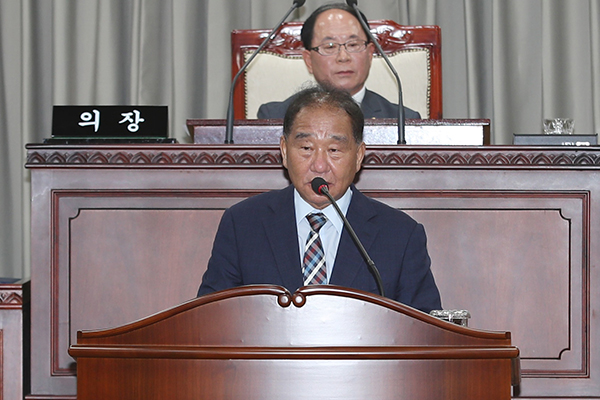 Councilor So Byung-hong is giving a 5-minute speech regarding the national food cluster apartment complex at the 228th extraordinary session. Photo by Iksan City Council provided
[Asia Economy Honam Reporting Headquarters Reporter Hong Jae-hee] A claim has emerged from the Iksan City Council in Jeonbuk that joint housing construction must be promptly promoted in the National Food Cluster Industrial Complex, where residential conditions are not yet established.
On the 15th, Councilor So Byung-hong of Iksan City stated during a 5-minute free speech at the 228th extraordinary session, “The non-start of joint housing construction within the National Food Cluster causes inconvenience to workers and reduces the effect of population inflow,” urging the city to take active measures.
The National Food Cluster is a project to create a food-specialized industrial complex on a 2.32 million square meter site in the Wanggung-myeon area, which was completed in 2018 and is currently building its infrastructure.
This site plans to include industrial, residential, support, and infrastructure facilities, and upon completion of the first phase, 11 support facilities and 94 companies are expected to move in.
Among these, 55.9% of the industrial land has been sold, with 58 companies having started construction, 33 companies having completed construction and currently operating, employing 684 workers.
The issue is that 674 units of joint housing, which were approved in 2018 to be built in the National Food Cluster Industrial Complex, have yet to begin construction.
Because residential conditions are not established, workers employed at the National Food Cluster, which is located quite far from the urban area, are enduring inconvenience.
Additionally, the city is supporting dormitory and transportation costs amounting to 660 million KRW for employees working in the Food Cluster Industrial Complex.
Regarding this, Councilor So pointed out that unnecessary budget is being spent due to the delayed construction by the project implementer and the lack of administrative drive.
Councilor So emphasized, “As the construction of joint housing is delayed, workers here are residing in nearby Wanju County and commuting, which diminishes the population inflow effect,” adding, “Joint housing construction must begin as soon as possible.”
In response, a city official said, “Approval was granted in 2018, and construction only needs to start within five years,” and added, “It seems that private developers who purchased the land will only begin construction once about 2,000 workers are employed at the Food Cluster.”
The official continued, “Developers have requested project subsidies from the city, but that is not possible,” and added, “The administration has met with developers several times urging them to expedite construction, but due to the risks involved in the project, they have not proceeded.”
© The Asia Business Daily(www.asiae.co.kr). All rights reserved.

















