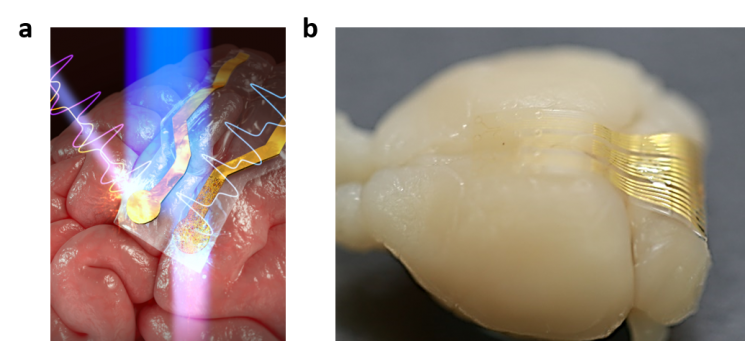
[Asia Economy Reporter Junho Hwang] A technology has been developed that can produce electrodes capable of real-time measurement of cortical conduction during optical stimulation, aimed at identifying causes and developing treatments for brain diseases such as dementia, epilepsy, and sleep disorders.
The Korea Advanced Institute of Science and Technology (KAIST) announced on the 15th that a joint research team including Professors Hyunju Lee and Jeongyong Lee from the Department of Electrical Engineering and Computer Science, and Professor Jungho Lee from the Graduate School of Medical Science, developed a microelectrode array capable of real-time cortical conduction measurement by applying polymer electrospinning technology to microelectromechanical systems (MEMS) processes. The research results were recently published in Advanced Functional Materials.
The research team developed a technology to produce microelectrodes by applying a technique that generates nanofibers by applying high voltage to a polymer solution composed of more than 10,000 molecules. These electrodes are evaluated as new electrodes that can replace the existing metal thin-film electrodes used in brain research.
The team reported excellent performance in various aspects such as resistance changes due to external deformation, electrochemical impedance over electrospinning time, and charge storage capacity. In particular, when measuring the 'photoelectric artifact' generated by these electrodes, the attenuation effect was more than 10 times greater than that of existing electrodes. Additionally, the electrodes are transparent and flexible, enabling light delivery even to deep areas of the brain.
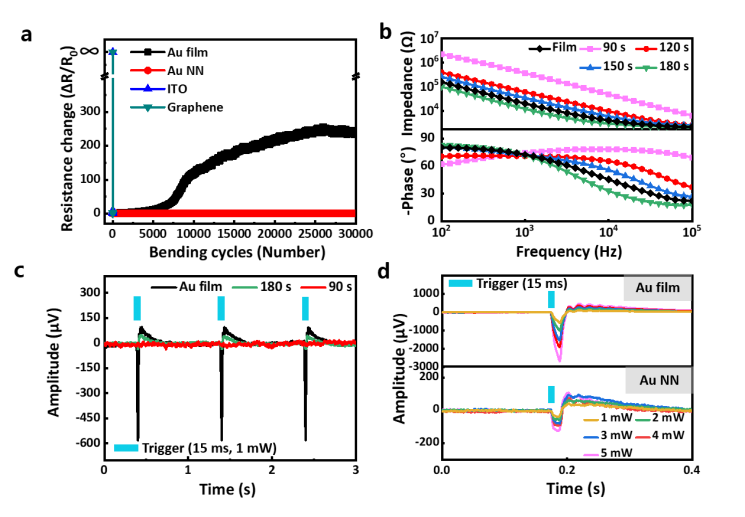 Figure (a) is a graph comparing the change in resistance according to external deformation, (b) compares the change in electrochemical impedance over electrospinning time, (c) compares the noise signal magnitude caused by photo-stimulation, and (d) is a graph comparing the noise signal magnitude according to the intensity of photo-stimulation.
Existing electrodes interfere with light transmission due to high reflectivity and low transmittance, and when exposed to light, the Becquerel effect (a phenomenon where a potential difference occurs in metal electrodes causing current flow) generates noise signals called 'photoelectric artifacts.' As a result, it was difficult to measure physiological signals generated when the brain recognizes light.
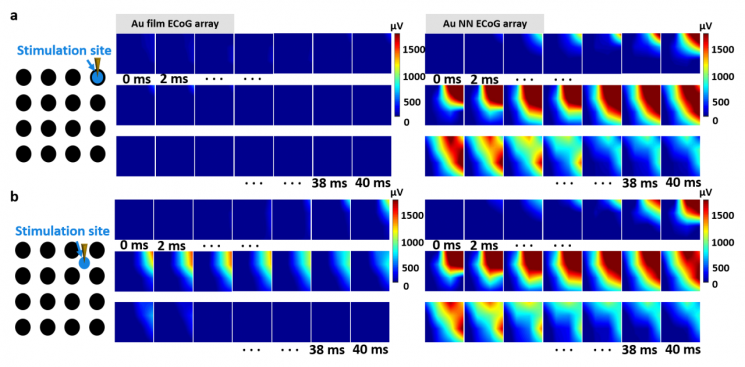
Based on these electrodes, the research team is developing a multifunctional microelectrode array integrated with micro light sources that can accurately measure cortical conduction in real time along with optical stimulation. The team explained that if the development of multifunctional devices integrating light sources and electrodes succeeds, it will lead to the development of neuro tools that brain scientists conducting research in optogenetics or phototherapy can use conveniently.
Professor Hyunju Lee said, "Previously, it was impossible to measure cortical conduction simultaneously with optical stimulation due to unavoidable noise signals caused by the photoelectric effect, but with the development of flexible and transparent microelectrodes, real-time cortical conduction measurement independent of optical stimulation has become possible."
© The Asia Business Daily(www.asiae.co.kr). All rights reserved.



















