The Latest Opening Ceremony Since 1987
Sexual Harassment Allegations Against Park Wonsoon
Ruling and Opposition Parties Set for Clashes at Hearings for Lee Inyoung and Park Jieon
CIO Launch Emerges as Fiercest Battleground
Stalemate Expected Over Real Estate Legislation
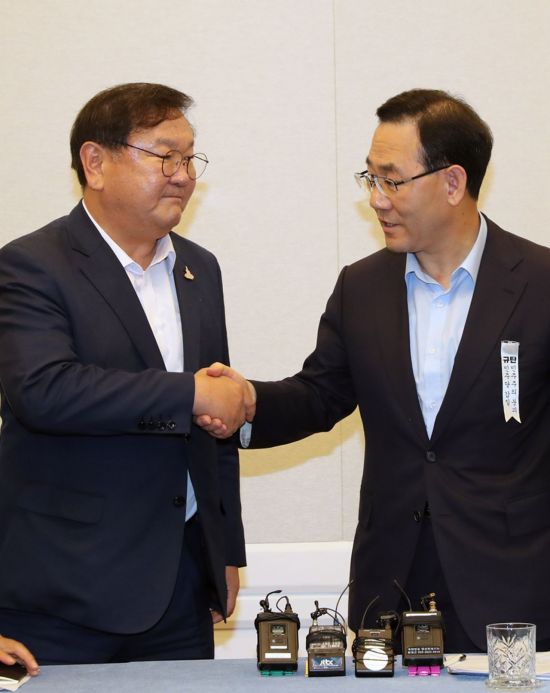
[Asia Economy, reporter Kim Hyemin] The 21st National Assembly will hold its opening ceremony on July 16, officially beginning its activities. This comes a month and a half after the term began on May 30. Although it has earned the dubious distinction of being the latest opening since the 1987 system was established, the rare sight of bipartisan agreement was seen. However, after the opening ceremony, it is expected that sharp confrontations between the ruling and opposition parties will unfold over each pending issue.
With the July extraordinary session of the National Assembly set to begin in earnest after the opening ceremony, the ruling and opposition parties are expected to enter a fierce legislative battle. In particular, contentious issues that are likely to trigger clashes between the parties are already scattered throughout the agenda, leading to predictions that smooth parliamentary operations will be difficult.
Most immediately, at the confirmation hearing for Kim Changryong, nominee for Commissioner General of the National Police Agency, scheduled for July 20, the sexual harassment allegations against the late Park Wonsoon, former Mayor of Seoul, are expected to become a major point of contention. These allegations are considered the most volatile issue of the July session. The United Future Party and other opposition parties are determined to thoroughly investigate how the fact that a complaint was filed became public. The United Future Party has also expanded its attacks to include ruling party lawmakers who worked with the late mayor, insisting that the role of the Seoul mayor’s office in concealing or abetting the incident must be investigated as well.
On July 23, a confirmation hearing is scheduled for Lee Inyoung, nominee for Minister of Unification. The opposition is already raising issues regarding the nominee’s son’s military exemption, overseas education expenses, and Lee’s views on North Korea, setting the stage for a likely clash with the ruling party’s defense. The following confirmation hearing for Park Jieon, nominee for Director of the National Intelligence Service, is also expected to see heated exchanges between the parties.
The fiercest battleground will be the launch of the Corruption Investigation Office for High-ranking Officials (CIO). According to the CIO Act, the Democratic Party and the United Future Party, as negotiation blocs, must each select two members for the candidate recommendation committee, which will recommend two candidates for CIO chief to the president. However, even by the legal deadline of the 15th, this had not been finalized.
The Democratic Party selected its recommendation committee members, pledging to launch the CIO in line with the enforcement date of the law. However, controversy erupted when a lawyer who had defended a perpetrator in the "Doctor’s Room" case was appointed and then withdrawn just four hours later. The United Future Party, meanwhile, has refused to recommend any candidates, insisting it will wait until the Constitutional Court rules on the constitutionality of the CIO Act.
Choi Hyungdoo, floor spokesperson for the United Future Party, said on tbs radio that “the government and ruling party’s obsession with the CIO Act is acting as a political black hole,” emphasizing, “Instead of laws disconnected from people’s livelihoods, we will ensure both parties come together to address the suffering of the public and revive the stagnant economy.”
In contrast, Park Sungjoon, floor spokesperson for the Democratic Party, stated, “We deeply regret not meeting the legal deadline for the CIO Act,” adding, “We will process follow-up bills as soon as possible so that the CIO can be launched quickly. The opposition party must also actively cooperate on the appointment of the CIO chief.”
Fierce debate is also expected over legislative proposals such as raising the comprehensive real estate tax (CRRT) for owners of multiple homes to a maximum of 6%, as outlined in the “7·10 Real Estate Measures.” The Democratic Party has expressed its determination to pass real estate tax reforms and the three major tenant protection bills during the July session.
In addition, further clashes are expected over the so-called “Working National Assembly Act,” which includes the Democratic Party’s top-priority bill to abolish the Legislative and Judiciary Committee’s authority to review the structure and wording of bills, institutionalize year-round parliamentary sessions, and disclose the names of lawmakers who are absent from plenary and standing committee meetings.
© The Asia Business Daily(www.asiae.co.kr). All rights reserved.

















