[Asia Economy (Uijeongbu) = Reporter Lee Young-gyu] Gyeonggi Province will convert 81% of all metropolitan buses in the province to 'Gyeonggi Public Bus' based on a route bidding system.
Gyeonggi Province announced on the 15th that it plans to suspend the 'Revenue Joint Management Semi-Public System,' which has been applied to some metropolitan bus routes since the second half of this year, and convert 81% of all metropolitan buses in the province to 'Gyeonggi Public Bus' based on a route bidding system by next year.
The Revenue Joint Management Semi-Public System is a method where the private sector owns and operates the routes, and the public sector provides financial support for deficits based on standard transportation costs. It was introduced in April 2018 and currently operates 71 routes in 14 cities and counties.
Although this system has contributed to establishing a two-shift system and improving compliance with operation frequency, issues such as moral hazard by companies owning permanent licenses and exercising property rights, as well as safety and service deficiencies, have emerged.
In fact, during the operation period of the Revenue Joint Management Semi-Public System, three executives were registered redundantly in eight companies. Executive A reportedly received 1.9 billion KRW, and the three executives collectively received a total annual salary of 4.8 billion KRW. Additionally, cases that reduced transparency in financial management were detected, such as applying for depreciation costs of used vehicles at the purchase price of new vehicles.
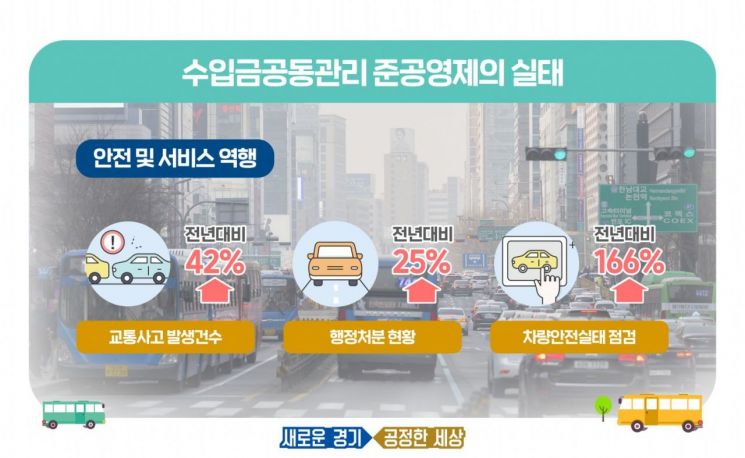
In particular, the average monthly number of traffic accidents increased by 42%, from 5.17 cases in 2018 to 7.33 cases in 2019, and the average monthly number of administrative sanctions increased by about 25%, from 9.17 cases in 2018 to 11.5 cases in 2019. The number of vehicle safety non-compliance cases also increased 2.6 times, from 3 cases in 2018 to 8 cases in 2019.
Moreover, a satisfaction survey conducted from May 21 to June 4 with 1,012 users of the bus semi-public system found that the Revenue Joint Management Semi-Public System scored lower than the Gyeonggi Public Bus in all four areas: safe operation, human service, vehicle management, and user convenience.
Accordingly, the province decided to uphold the original purpose of the semi-public system, which is to "promote safe and convenient commuting transportation," and notified the suspension of the Revenue Joint Management Semi-Public System this month after reporting to the provincial council and passing a resolution by the Revenue Joint Management Committee. Following a one-year grace period according to the ordinance, the system will be converted to the 'Gyeonggi Public Bus.'
The Gyeonggi Public Bus is one of Governor Lee Jae-myung's transportation pledges to "realize a Gyeonggi Province where public transportation is more convenient than private cars." It is the nation's first operation system based on a route bidding system that strengthens publicness.
Unlike the existing private system, the public sector owns the route rights and entrusts the operation rights of bus routes to selected private transport operators through competitive bidding for a certain period. The project started in March this year, and currently, 120 buses operate on 16 routes.
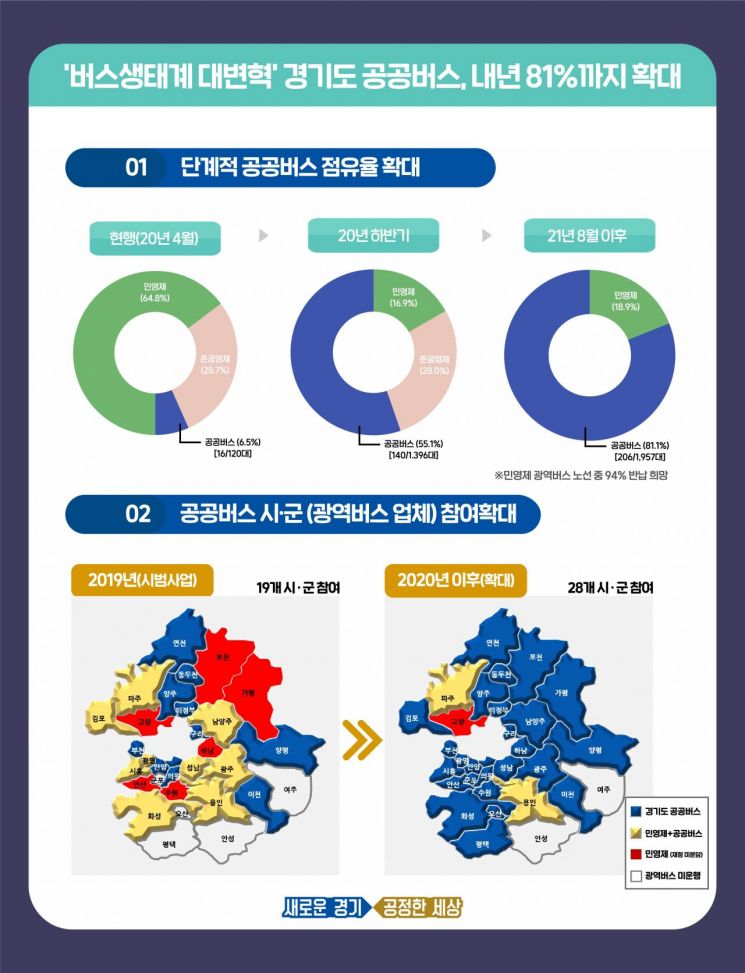
The province plans to convert the operation system of metropolitan buses (254 routes) to 'public buses,' gradually increasing the share to 55% (140 routes) in the second half of this year and 81% (206 routes) in 2021.
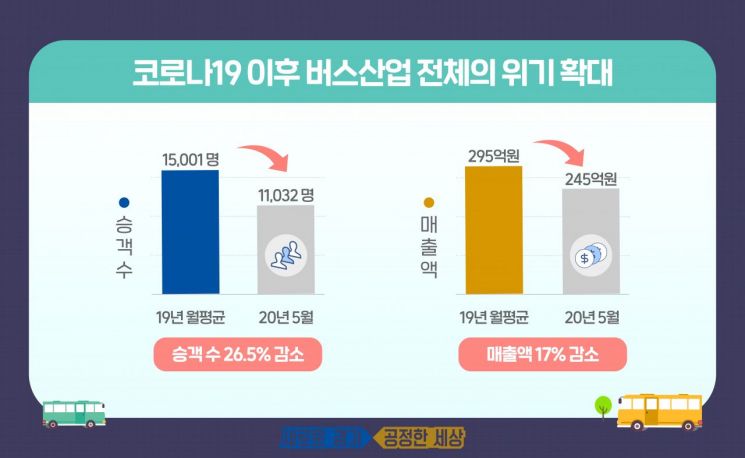
Park Tae-hwan, Director of the Transportation Bureau of the province, said, "Due to the recent sharp decline in passengers and sales caused by COVID-19, metropolitan bus companies are facing ongoing management difficulties, which is causing inconvenience to residents due to reductions or discontinuations of routes. Now is the time to fundamentally change the metropolitan bus operation system to provide stable transportation services."
Director Park added, "To this end, we will make this year the first year of a major transformation of the bus ecosystem by suspending the existing Revenue Joint Management Semi-Public System and actively expanding the Gyeonggi Public Bus, which operates with fair competition and transparent financial support."
© The Asia Business Daily(www.asiae.co.kr). All rights reserved.



















