Harvard and MIT Suddenly Change Stance in First Hearing of Injunction Application
Korean-American International Students Avoid Deportation Risk
[Asia Economy New York=Correspondent Baek Jong-min] The U.S. government has abruptly withdrawn its stance to cancel visas for international students taking 100% online courses in the fall semester.
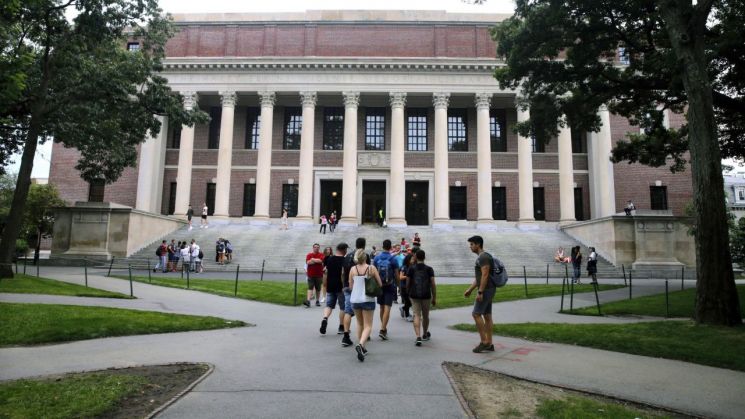
As a result, international students studying in the U.S., including those from Korea and around the world, will not face difficulties staying in the U.S. even if their schools switch to online classes amid the COVID-19 pandemic.
On the 14th (local time), Allison Burroughs, a federal district court judge in Massachusetts, announced that the Trump administration had reached an agreement with Harvard University and the Massachusetts Institute of Technology (MIT) on this matter.
After the U.S. government’s announcement, Harvard and MIT filed for an injunction to block the enforcement of this measure, and the first hearing was held that day.
The highly anticipated hearing ended unexpectedly quickly. Judge Burroughs explained, "The U.S. government has agreed to withdraw," canceling not only the enforcement of the policy but the decision itself, and then concluded the hearing.
The Immigration and Customs Enforcement (ICE) under the U.S. Department of Homeland Security had on the 6th released a revised "Student and Exchange Visitor Program" (SEVP) regulation banning F-1 and M-1 nonimmigrant visa students attending schools conducting all classes online from staying in the U.S. or obtaining new visas, causing a huge stir in the U.S. education sector.
In response, Harvard and MIT, which had announced 100% online classes for the fall semester, argued that this measure did not consider the special circumstances of international students due to COVID-19 and would have immediate and serious impacts on students’ course conditions and employment, thus turning to the courts.
Over 200 U.S. universities, including other Ivy League schools, and major IT companies submitted amicus briefs supporting Harvard and MIT, spreading public opposition to the U.S. government’s decision. Criticism also mounted that the decision failed to consider the economic impact international students have on local communities.
U.S. information technology companies strongly opposed the international student restrictions. Before the hearing began, Google, Facebook, Twitter, and others expressed concerns that the government’s measure would negatively affect their businesses.
Korean international students are also expected to face no issues staying in the U.S. regardless of whether their schools offer online classes. According to statistics from the Institute of International Education (IIE), as of last year, there were 1,095,299 international students enrolled in U.S. higher education institutions, with Korean students accounting for about 4.8%, or 52,250 students.
With this decision, the U.S. government’s position, which had hoped for in-person classes at U.S. universities in the fall semester, has returned to square one. However, no clear explanation has been provided as to why the government changed its stance.
© The Asia Business Daily(www.asiae.co.kr). All rights reserved.
![Clutching a Stolen Dior Bag, Saying "I Hate Being Poor but Real"... The Grotesque Con of a "Human Knockoff" [Slate]](https://cwcontent.asiae.co.kr/asiaresize/183/2026021902243444107_1771435474.jpg)











