58.2 trillion won investment in Digital New Deal by 2025... Creation of 903,000 jobs
"The speed of digital economic transition will determine future national competitiveness"
38.5 trillion won focused on strengthening the D.N.A. ecosystem
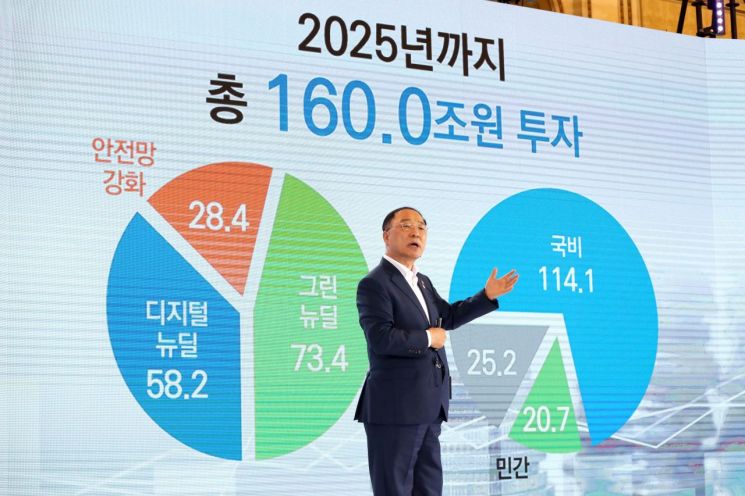 Hong Nam-ki, Deputy Prime Minister and Minister of Economy and Finance, is announcing the comprehensive plan at the 'Korean New Deal National Report Conference' held at the Blue House State Guest House on the 14th.
 [Image source=Yonhap News]
[Sejong=Asia Economy Reporter Joo Sang-don] The government has decided to invest a total of 58.2 trillion won in the Digital New Deal by 2025, recognizing that the speed of transition to a digital economy?accelerated by non-face-to-face interactions and digitalization amid the COVID-19 pandemic?will determine the competitiveness of the nation’s industries and companies. The government has selected data dams, intelligent (AI) government, and smart medical infrastructure as representative projects to focus its capabilities on.
On the 14th, the government announced the comprehensive plan for the "Korean New Deal" jointly with related ministries.
The government included three digital New Deal projects?data dam, AI government, and smart medical infrastructure?among the 10 detailed tasks of the Korean New Deal. A total of 28 trillion won (25.3 trillion won in national funds) will be invested in these projects by 2025 to create 482,000 jobs.
The data dam, which will receive the largest budget (a total of 18.1 trillion won), aims to accelerate the data economy by strengthening the foundation for data collection, processing, trading, and utilization, and to expand the convergence of 5G and AI across all industries through a nationwide 5G network. Specifically, the number of sector-specific big data platforms will be expanded to 30, and 142,000 public data sets will be rapidly opened. Additionally, 1,300 types of AI training data will be built to expand data resources. To expedite the construction of the 5G network, tax incentives such as reductions in registration license tax and investment tax credits will be promoted. The government will also develop 5G convergence services including digital content for education, tourism, and culture applying immersive technologies like VR and AR, as well as autonomous driving technologies. Furthermore, 12,000 smart factories and 17 AI home services such as indoor fine dust purification will be distributed, alongside the promotion of seven AI+X projects in daily life sectors including infectious disease prognosis and prediction, medical image reading and diagnosis, crime prevention and response, coastal security and landmine detection, counterfeit product identification, quality control of regional specialized industries, and energy efficiency in industrial complexes. The government plans to establish a public-private joint control tower in the second half of this year to formulate a nationwide data policy, activate integrated management, linkage, and utilization of public and private data, and support the data industry.
A total of 9.7 trillion won will be invested in the AI government, which uses digital new technologies such as 5G and blockchain to provide smart government services that notify citizens of customized public services in advance and process them promptly. This includes all-digital civil service processing based on mobile IDs, provision of non-face-to-face public services such as customized guidance on national subsidies and pensions, and expansion of blockchain technology application in areas with high public impact such as welfare benefit duplication management, real estate transactions, and online voting. Additionally, a 5G national network will be established in 39 central government ministries, and public information systems will be migrated and converted to private and public cloud centers.
The government will also build a foundation for non-face-to-face medical services by expanding smart medical infrastructure. By 2025, 200 billion won will be invested to establish 18 smart hospitals based on digital technologies such as 5G and the Internet of Things (IoT), enabling real-time monitoring of inpatients and collaborative treatment among medical institutions. Furthermore, 1,000 respiratory clinics will be set up to pre-check and respond to respiratory and fever symptoms and provide safe treatment upon visits. Development and demonstration of software (SW) capable of AI precision diagnosis for 12 diseases including liver disease, lung cancer, and diabetes will also be pursued.
Including the three key projects, the government presented the main areas for promoting the Digital New Deal as ▲ strengthening the D.N.A. (Data-Network-AI) ecosystem ▲ digital transformation of educational infrastructure ▲ fostering non-face-to-face industries ▲ digitalization of SOC (social overhead capital). Strengthening the D.N.A. ecosystem means accelerating the use and convergence of data, 5G, and AI across all industries to create new digital products and services and improve the productivity of the Korean economy. A total project cost of 38.5 trillion won (31.9 trillion won in national funds) will be invested by 2025 to create 567,000 jobs.
A total of 1.3 trillion won will be invested in the digital transformation of educational infrastructure, which promotes the establishment of digital infrastructure and expansion of educational content to create an online-offline integrated learning environment for elementary, middle, and high schools, universities, and vocational training institutions nationwide. High-performance Wi-Fi will be installed in all classrooms nationwide, and support for smart devices such as tablet PCs will be provided. The government will also build an "online education integrated platform" that offers customized learning content using various educational content and big data.
2.5 trillion won will be invested in fostering non-face-to-face industries. This aims to lay the foundation for the growth of related non-face-to-face industries by building non-face-to-face infrastructure in areas closely related to citizens’ lives such as medical care, work, and business. Alongside this, the government will promote the digitalization of social overhead capital (SOC), focusing on establishing digital management systems for four core infrastructure sectors: transportation, digital twins, water resources, and disaster response.
© The Asia Business Daily(www.asiae.co.kr). All rights reserved.
![Clutching a Stolen Dior Bag, Saying "I Hate Being Poor but Real"... The Grotesque Con of a "Human Knockoff" [Slate]](https://cwcontent.asiae.co.kr/asiaresize/183/2026021902243444107_1771435474.jpg)
















