Government to Announce Comprehensive Plan for Korean New Deal on the 14th
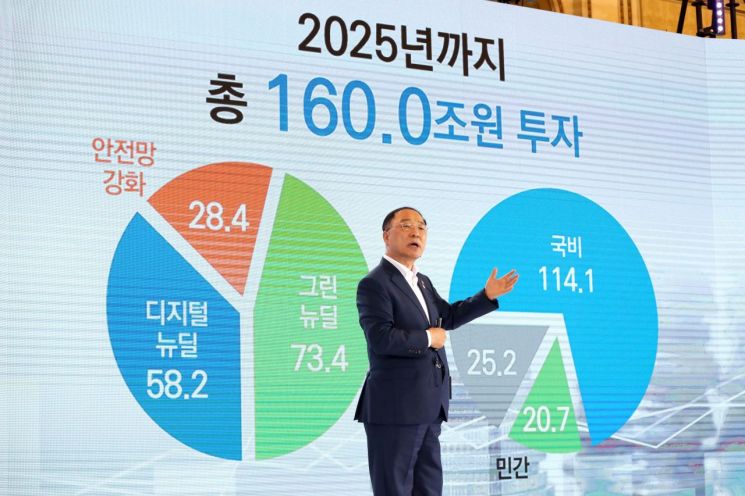
[Sejong=Asia Economy Reporter Kim Hyunjung] The government will invest a total of 28.4 trillion won to create 339,000 new jobs to strengthen the employment social safety net. Along with this, to protect vulnerable groups and eliminate blind spots in employment, the scope of employment insurance coverage will be significantly expanded, and the National Employment Support System will be fully introduced in January next year.
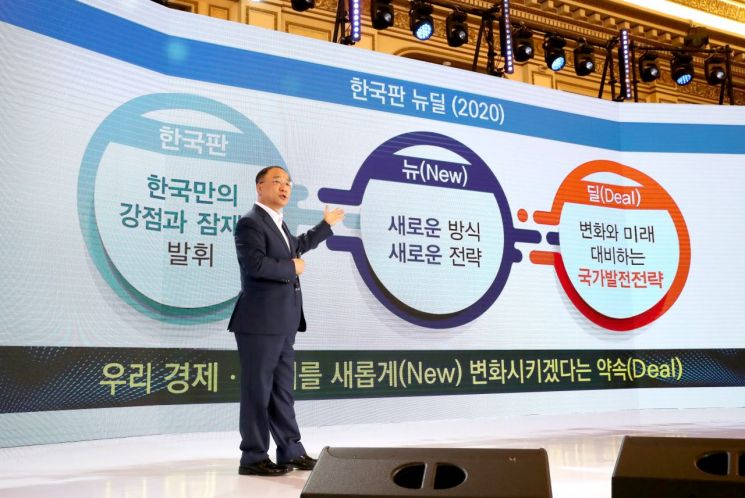
Deputy Prime Minister and Minister of Strategy and Finance Hong Nam-ki reported this comprehensive plan at the 'Korean New Deal' briefing held by President Moon Jae-in at the Blue House on the 14th.
First, to establish an employment safety net, the coverage of employment insurance will be gradually expanded so that workers in special types of employment and freelancers can benefit from employment insurance. By the end of this year, a separate roadmap to eliminate blind spots in employment insurance will also be prepared and disclosed. The scope of industrial accident insurance for special-type workers (special employment workers, or "teukgo") will be expanded this month to include five additional occupations?door-to-door salespersons, rental product inspectors, home appliance installation technicians, freight truck owners, etc.?in addition to the current nine occupations such as insurance planners, caddies, private tutors, delivery drivers, substitute drivers, and credit card solicitors.
The number of employment insurance subscribers, currently about 13.67 million, will increase to 21 million by 2025. The second employment safety net, the National Employment Support System, will be fully introduced from January next year. This system supports low-income working-poor groups with programs such as vocational training and work experience, and provides job-seeking promotion allowances and employment success allowances. Each allowance is 500,000 won per month for six months, and up to 1.5 million won can be supported depending on the employment retention period. A total of 12.2 trillion won will be invested in strengthening this employment safety net by 2025, and the creation of 159,000 jobs is expected.
In the area of strengthening the social safety net, the government will abolish the support obligation criteria for basic livelihood security living allowances by 2022 (excluding high-income and high-asset individuals) and reform the method of calculating the median income standard to enhance coverage. A research project to introduce a Korean-style sickness allowance will be promoted, and a pilot project targeting low-income groups will be implemented in 2022. A total of 11.8 trillion won will be invested in strengthening the social safety net by 2025.
Along with this, the government plans to create an additional 180,000 jobs through projects worth a total of 4.4 trillion won. The policy aims to increase 'inclusive human investment' such as workforce training, employment support, and digital gap reduction to facilitate movement to new jobs in line with economic structural changes.
Through this, 100,000 core talents in artificial intelligence and software, and 20,000 talents in green convergence technologies will be nurtured. By reforming the vocational training system to be future-adaptive, 180,000 practical talents in new technology fields will be trained, and digital convergence training at beginner and intermediate levels will be supported for vocational training participants. Joint training centers, previously available only to partner institutions, will be opened to local small and medium enterprises and training institutions to provide digital convergence training.
Additionally, to strengthen digital accessibility for rural and vulnerable groups, high-speed internet networks will be established in 1,200 rural villages, and outdated public wireless internet (18,000 locations) will be replaced or high-performance new installations (41,000 locations) will be carried out. A total of 6,000 digital competency centers will be created nationwide to provide education on booking train tickets or using financial services via internet and mobile. To expand information access rights for people with disabilities, non-face-to-face alternative materials will be expanded from the current 12% of total book publications to 27% by 2025.
© The Asia Business Daily(www.asiae.co.kr). All rights reserved.
![Clutching a Stolen Dior Bag, Saying "I Hate Being Poor but Real"... The Grotesque Con of a "Human Knockoff" [Slate]](https://cwcontent.asiae.co.kr/asiaresize/183/2026021902243444107_1771435474.jpg)












