Incheon City Urges 28,000 Households to Refrain from Drinking
Suspension of Meals at Kindergartens and Elementary, Middle, and High Schools in 5 Districts of Seo-gu
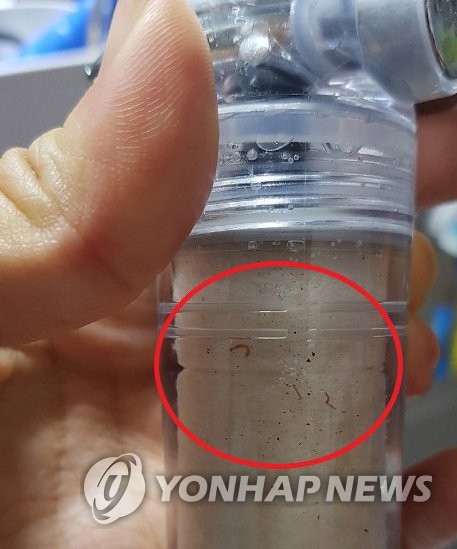
[Asia Economy Reporter Park Hyesook] In Incheon’s Seo-gu district, where the red tap water incident occurred last year, residents have reported larvae appearing in the tap water, prompting an ongoing investigation by the city of Incheon.
According to the city on the 14th, since a complaint was filed on the 9th about larvae found in tap water at a villa in Wanggil-dong, Seo-gu, a total of 18 similar reports have been received by noon of the same day from areas including Dangha-dong and Wondang-dong.
Residents affected expressed anxiety, stating that larvae were found in filters installed on faucets. Some residents have stopped using tap water and are relying on bottled water.
Posts related to larvae in tap water, accompanied by videos and photos, have also been continuously uploaded on local mom cafes in Seo-gu.
A video posted online by a user identifying as a resident of Majon-dong shows larvae crawling on a filter installed on a faucet, and residents of Wondang-dong, Gyeongseo-dong, and Geomdan-dong have also posted similar content with photos.
The Incheon Waterworks Headquarters estimates that the larvae found this time are a type that typically appears in stagnant water areas such as water tanks or sinks during the summer temperature rise, but the exact cause has not yet been identified.
The Waterworks Headquarters is conducting an analysis of the cause of larvae appearing in the tap water in collaboration with the Korea Water Resources Corporation and the Han River Basin Environmental Office.
Incheon City is also conducting intensive 24-hour monitoring at 2-3 hour intervals on the meters of households where larvae have been found. To identify the cause of the larvae, the city switched the water purification process from advanced treatment to standard treatment around 11 p.m. the previous day.
The city has urged the 28,262 households in Wanggil-dong, Dangha-dong, and Wondang-dong, where larvae were reported, to refrain from drinking tap water directly. Additionally, for households unable to drink tap water due to larvae, the city plans to provide bottled tap water called Michuholcham Water.
An Incheon city official stated, "The reported areas where larvae appeared are villa areas connected directly to the Gongchon Water Purification Plant. Although water quality test results meet standards, we are investigating all possibilities including the tap water supply process."
The Incheon Metropolitan Office of Education has also suspended school meals from this day onward at kindergartens, elementary, middle, and high schools in five districts including Wanggil-dong and Dangha-dong where larvae complaints occurred, and is providing alternative meals.
Superintendent Doseong Hoon plans to visit schools in Seo-gu to assess the damage and is reviewing additional response measures in consultation with Incheon City, the Western Education Support Office, and Seo-gu Office.
Since last year’s red tap water incident, the education office has completed the installation of filters in school cafeterias and switched to direct water supply to stabilize school tap water.
Meanwhile, Seo-gu in Incheon was the area most severely affected when the red tap water first occurred in May last year.
At that time, the red tap water was caused by an abrupt increase in water pressure in existing pipelines during the water system transition, which dislodged sediment inside the pipes and flowed into households, affecting an estimated 635,000 people.
© The Asia Business Daily(www.asiae.co.kr). All rights reserved.

















