Joo Ho-young: "Promoting Differential Application of Minimum Wage by Industry and Scale"
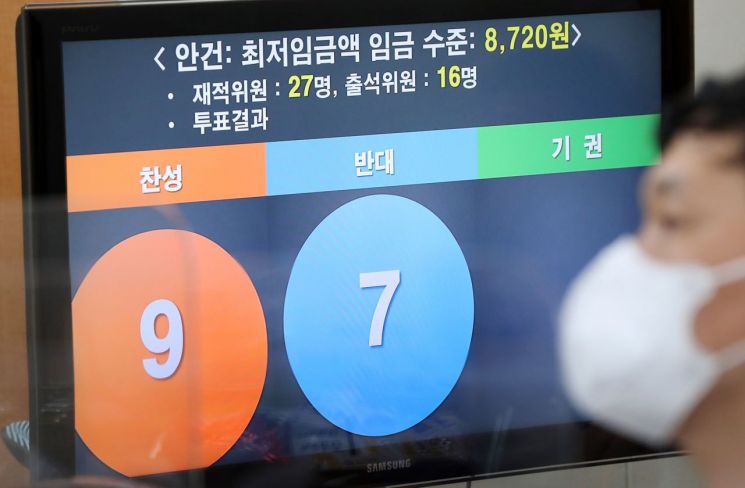
[Asia Economy Reporter Lim Chun-han] Controversies surrounding the minimum wage increase are repeated every year. However, the bills proposed in the National Assembly are only drifting without progress. Although the opposition party's proposals to amend the Minimum Wage Act have surged explosively since the Moon Jae-in administration, the possibility of passing these bills in the 21st National Assembly also looks bleak.
According to the National Assembly's legislative information system on the 14th, a total of nine "Partial Amendments to the Minimum Wage Act" have been proposed in the 21st National Assembly. Following the previous National Assembly, a large number of amendments to the Minimum Wage Act are being proposed. The number of Minimum Wage Act amendment bills proposed were 3 in the 16th National Assembly, 9 in the 17th, 12 in the 18th, 25 in the 19th, and 91 in the 20th. The main contents of these bills include new composition plans for the Minimum Wage Commission and differential application of minimum wages by industry and company size.
Song Eon-seok, a member of the United Party, submitted a bill to legally stipulate the appointment of worker and employer members of the Minimum Wage Commission and to have public interest members recommended by the Speaker of the National Assembly and negotiation groups. The purpose is to make the minimum wage decision process more neutral. The Minimum Wage Commission has been criticized for inevitably leaning towards a pro-government stance because the government has appointed the public interest members. Additionally, the bill includes a provision to mandate that minimum wages be set separately by business type, size, region, and age, while ensuring that the gap does not exceed a certain ratio.
Hong Joon-pyo, a member of the United Party, proposed a bill to exclude foreign workers from the minimum wage application and to revise the current mandatory minimum wage regulations into recommended guidelines. Hong pointed out that small and medium-sized enterprises have a relatively large number of foreign workers, raising significant concerns about worsening management due to increased labor costs from minimum wage hikes.
Choi Seung-jae, a member of the United Party, proposed a bill to add economic growth rate and inflation rate as criteria for determining the minimum wage and to freeze the minimum wage if the previous year's consumer price inflation rate exceeds the previous year's nominal economic growth rate. Yoon Han-hong, also from the United Party, submitted a bill to change the decision cycle to once every two years to secure sufficient time for review and analysis of the effects of minimum wage increases.
The United Party has taken aim directly at the minimum wage increase policy. At the first meeting of the Special Committee for Reviving Small Business Owners held the day before, floor leader Joo Ho-young said, "The wage-paying ability of small business owners has already exceeded its limit, forcing inevitable workforce reductions," and added, "To overcome the economic crisis, our society must pool wisdom, and as one method, we will promote support measures such as differential application of minimum wages by industry and size, and expansion of social safety nets for small business owners."
© The Asia Business Daily(www.asiae.co.kr). All rights reserved.

















