Investigation Review Committee Conclusion Inevitably Influences Prosecution Direction
Even if Chief Prosecutor Han Dong-hoon’s Application Is Rejected, There Is an Opportunity to Attend and Present Opinions at the Investigation Review Committee
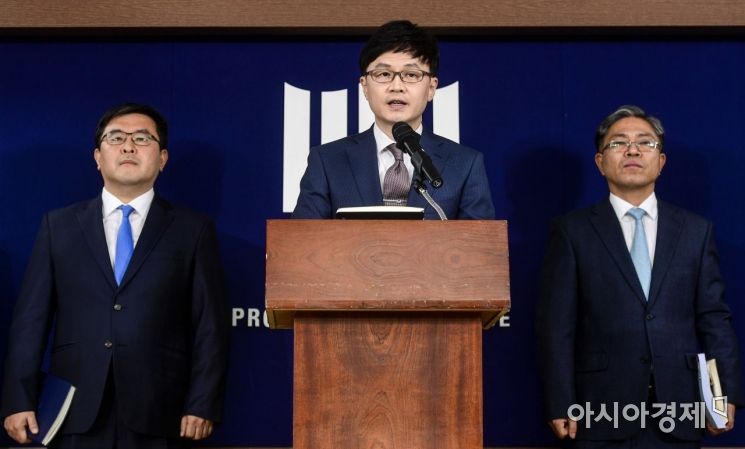 Handonghun, Research Fellow at the Judicial Research and Training Institute (Chief Prosecutor). / Photo by Jinhyung Kang aymsdream@
[Asia Economy Reporter Choi Seok-jin] Is it 'prosecutor-media collusion' or 'power-media collusion'?
The investigation into the so-called 'prosecutor-media collusion,' where a media reporter allegedly conspired with a prosecution official to intimidate a specific individual and uncover misconduct by a political figure, now faces the possibility of being reframed as 'collusion between the government and the media.'
This is the 'one move' made by Prosecutor Han Dong-hoon, who has been implicated in the prosecutor-media collusion case. Depending on how this issue is defined, the current prosecution investigation could change direction by 180 degrees.
According to the legal community on the 14th, Prosecutor Han applied for the convening of the 'Prosecution Investigation Deliberation Committee' (Investigation Deliberation Committee) the day before, sparking a new controversy over the definition of this matter. Prosecutor Han defined this case as 'power-media collusion,' claiming that a whistleblower with a criminal record for fraud colluded with ruling party politicians to carry out a plot.
Even if the request for convening the Investigation Deliberation Committee made by Prosecutor Han fails, he still has an opportunity to present his opinion. According to related guidelines, since the committee has already been decided to convene upon the application of former VIK CEO Lee Cheol, Han can submit a written opinion and appear in person to make a statement.
Ultimately, whether Prosecutor Han's request to convene the Investigation Deliberation Committee is accepted and the two cases are merged and held, or the request is rejected and Han submits his opinion, the committee members will have the opportunity to judge between former CEO Lee's claim of 'prosecutor-media collusion' and Prosecutor Han's claim of 'power-media collusion.'
If the Investigation Deliberation Committee issues an opinion to 'continue investigation and prosecution' regarding former reporter Lee and Prosecutor Han, the prosecution investigation framed as 'prosecutor-media collusion' is expected to gain momentum. Additionally, the cases in which whistleblower Ji Mo and Choi Kang-wook, leader of the Open Democratic Party, have been accused of obstruction of business and other charges are likely to conclude with 'no charges.'
On the other hand, if the committee issues an opinion to 'stop investigation and not prosecute' both individuals, the prosecution will face a difficult decision on whether to accept the committee's opinion. This could also give new impetus to investigations into Choi and others, whose investigations have been questioned for lack of prosecutorial will.
If the committee members' opinions are evenly split without leaning to either side, the prosecution is expected to continue the investigation with the burden of conducting a balanced investigation into both former reporter Lee and Prosecutor Han, as well as Ji and Choi, to uncover the truth.
© The Asia Business Daily(www.asiae.co.kr). All rights reserved.

















