Despite 2% Wage Increase Rate During Economic Crises
Serious Assessment of COVID-19 'Economic Uncertainty'
"Wage Gap Resolution Limited by Minimum Wage Alone"
Focus on Employment Retention... Speed Adjustment for 2nd Year
[Asia Economy Reporter Kim Bo-kyung] On the 14th, the Minimum Wage Commission decided on the lowest minimum wage increase rate in history, with the novel coronavirus disease (COVID-19) crisis at the center of the background. The greatest factor was the uncertainty about when and to what extent the COVID-19 aftermath would affect our economy.
In particular, the public interest commissioners, who held the key to deciding the minimum wage increase rate, placed emphasis on 'preserving jobs' rather than workers' income. This aligns with the government's policy of prioritizing employment maintenance during the COVID-19 crisis.
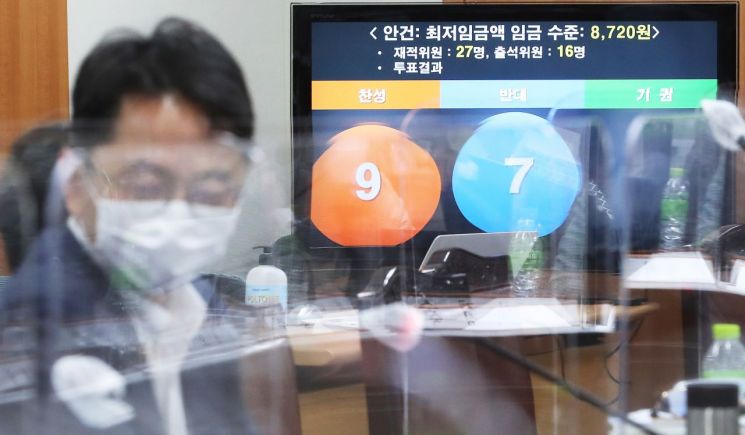
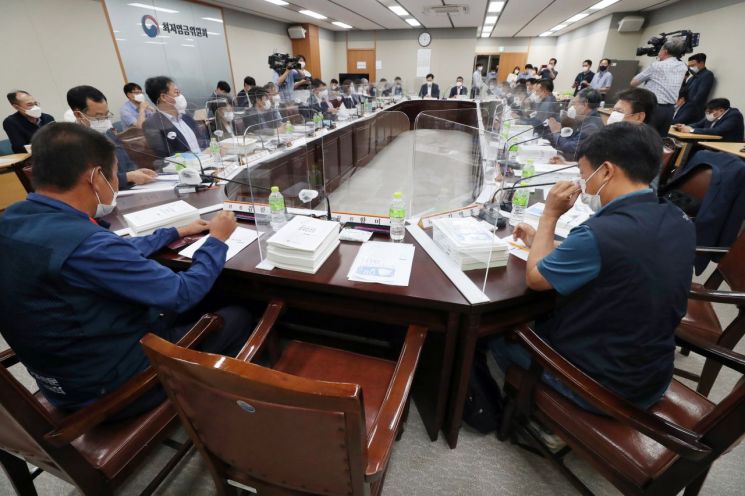
The Minimum Wage Commission decided at around 2:10 a.m. on the 14th that next year's minimum hourly wage would be increased by 1.5% from this year to 8,720 won (monthly conversion 1,822,480 won). This was the result of consecutive 8th and 9th plenary meetings held from the previous day with overnight discussions. The minimum wage approved this time was a single proposal presented by nine public interest commissioners, including Chairman Park Jun-sik of the Minimum Wage Commission. With all nine worker representatives having left, a total of 16 public interest and employer representatives voted on the public interest commissioners' proposal, with nine voting in favor.
The public interest commissioners held a press briefing immediately after the meeting to explain the criteria and background for the minimum wage decision. They stated that the 1.5% increase rate was the sum of ▲this year's economic growth forecast of 0.1%, ▲this year's consumer price inflation forecast of 0.4%, and ▲a 1.0% improvement in workers' living expenses.
"More Uncertainty than During the IMF Crisis and Financial Crisis"
During the International Monetary Fund (IMF) foreign exchange crisis and the global financial crisis, the minimum wage increase rate was in the 2% range, but this time it dropped sharply to the 1% range. It is even lower than last year's minimum wage increase rate (2.87%), which faced adverse factors such as the US-China trade conflict and Japan's export restrictions. This reflects the serious view of the economic crisis caused by the COVID-19 aftermath.
Chairman Park Jun-sik of the Minimum Wage Commission said, "Last year, economic variables were largely within a predictable range, and the government's policy goals were clearly set," adding, "This year, we face the challenge of wrestling with this issue amid much greater future uncertainty." He also said, "During the IMF period, Korea had many low-wage workers and industries reliant on labor were the main industries of our society," and "Comparing the ratio from 20 years ago to now alone could lead to misjudgment."
The public interest commissioners also had a different perception regarding the evaluation of the 'lowest increase rate in history.' Kwon Soon-won, a professor at Sookmyung Women's University and secretary of the public interest commissioners, said, "The minimum wage 'size' has already grown," and "It is difficult to make a simple horizontal comparison." He explained that the minimum wage increase rate of 2.70% during the foreign exchange crisis corresponds to 40 won in amount, and the 2.75% during the financial crisis corresponds to 110 won. In terms of the increase amount, it is not the lowest level in history.
Public Interest Commissioners Emphasize Employment, "Limitations of Minimum Wage Alone in Closing Gaps"
The public interest commissioners emphasized job preservation amid the COVID-19 crisis as the background for deciding the minimum wage increase rate. During the IMF foreign exchange crisis, restructuring centered on large corporations took place, but in the COVID-19 situation, employment shocks are concentrated on non-regular, temporary, and daily workers. These groups are all directly affected by the minimum wage. The public interest commissioners judged that an increase in the minimum wage could potentially act as a pressure factor for layoffs in small businesses. Professor Kwon said, "We have witnessed many cases on the ground such as split contracts, ultra-short working hours, jobs under 15 hours per week, reducing workers, and families running self-employed businesses," adding, "The public interest commissioners also shared the uncertainty of the crisis through workshops."
This decision may be criticized for putting aside the original intent and purpose of the minimum wage, such as reducing wage gaps and solving the livelihood of low-wage workers. Regarding this, Chairman Park said, "There are limitations in approaching the issue of wage gap reduction in the labor market solely through the minimum wage," and "I do not think the minimum wage is the primary policy tool to solve structural problems in the labor market." He continued, "This issue is a national task that requires comprehensive judgment of structural and institutional factors in the labor market and our collective best efforts," and "It is not appropriate to shift this burden to the Minimum Wage Commission to decide."
31.7% Surge Over 4 Years... About 8% Annually
As a result, a 'speed adjustment' of minimum wage increases considering the economic situation was made for the second consecutive year following last year. The sharp rise in minimum wage increase rates to 16.4% and 10.9% in 2018 and 2019, respectively, after the inauguration of the Moon Jae-in administration, is also analyzed as a cause of this decision. Since the Moon Jae-in administration took office, the minimum wage has risen by 31.7%. Professor Kwon said, "Considering the cumulative increase rate of the minimum wage under the current government, it is about 8% annually," adding, "The increase rate level should be judged comprehensively. It is unreasonable to judge solely based on the minimum wage increase rate applied in 2021."
© The Asia Business Daily(www.asiae.co.kr). All rights reserved.
![User Who Sold Erroneously Deposited Bitcoins to Repay Debt and Fund Entertainment... What Did the Supreme Court Decide in 2021? [Legal Issue Check]](https://cwcontent.asiae.co.kr/asiaresize/183/2026020910431234020_1770601391.png)