[Asia Economy Reporter Junho Hwang] A technology has been developed that can effectively respond to chemical leakage accidents by shooting neutralizing agents contained in small beads, similar to BB pellets used in toy guns. It can suppress leakage accidents from a distance, enhancing the safety of firefighters, and the properties of the leaked substances, such as acidity or alkalinity, can be distinguished by color, which is expected to speed up the response work.
The Korea Research Institute of Chemical Technology announced on the 14th that it has developed a 'neutralizing agent manufacturing technology for hazardous pollutants removal,' transferred the technology to JNK Heater Co., Ltd., and is moving forward with product commercialization.
Responding to Chemical Accidents with Shootable Neutralizing Agents
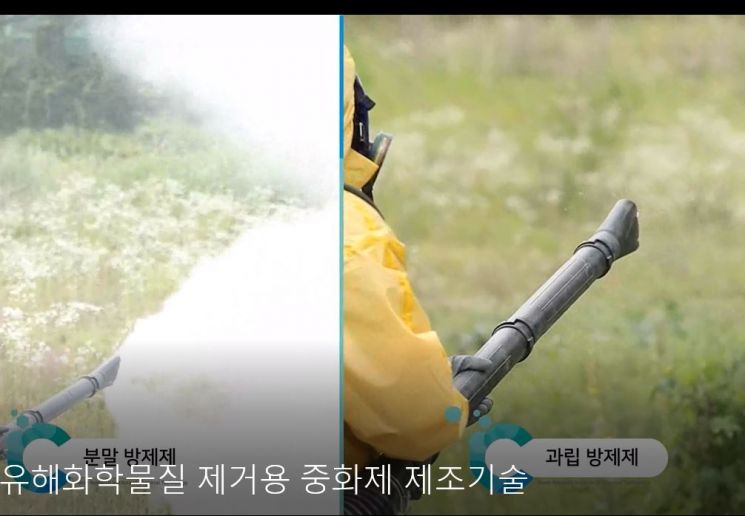
The neutralizing agent developed by the Chemical Institute is in granular form. When shot at an area of 25㎡ from a distance of 15 meters, it shows an 80% hit rate. Existing powder neutralizing agents have a hit rate below 10%. The neutralizing agent is a chemical that neutralizes (to pH 7) and removes acidic or alkaline chemicals leaked in chemical accidents.
The neutralization heat of the granular neutralizing agent is 60℃, which is about one-third of the 180℃ neutralization heat of powder neutralizing agents. It is expected to improve the safety of firefighters dispatched to suppress chemical accidents.
The neutralizing agents developed by the research team are divided into those for acidic chemicals and those for alkaline (ammonia) chemicals. For acidic chemicals (hydrochloric acid, nitric acid, sulfuric acid, hydrofluoric acid), sodium bicarbonate (baking soda) is used, and for alkaline chemicals, aluminum sulfate hydrate (alum) is used as the neutralizing substance. The neutralizing agent for alkaline substances developed by the research team was created for the first time this time. Typically, alkaline chemical accidents are handled by diluting the chemicals with water.
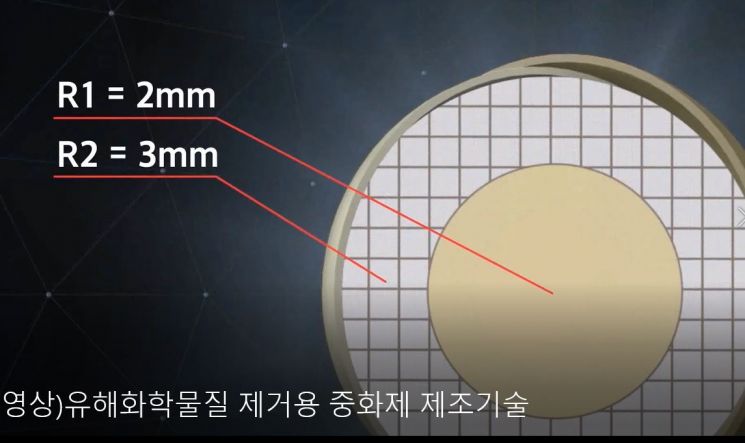
The research team configured the optimal neutralizing agent form through computer simulation. Clay is contained in the core of the neutralizing agent, and the neutralizing substance is contained on the outside. The neutralizing substance is again wrapped with clay.
Development of Indicator Neutralizing Agents
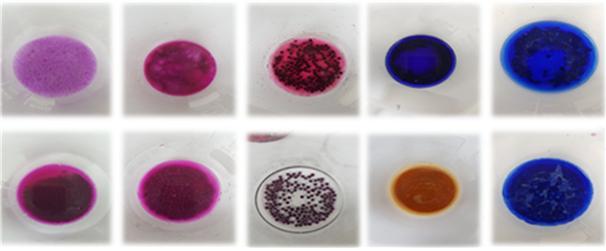
The research team also developed indicator neutralizing agents. When the leaked substance is unknown, these can be used to distinguish the nature of the leaked substance by color. The research team coated the outermost layer of the neutralizing agent with an indicator, making it red for acidic substances (thymol blue) and blue for alkaline substances.
Byung-Hwan Yoo, Ph.D., of the Chemical Safety Research Center at the Korea Research Institute of Chemical Technology, explained, "When it is unknown whether the leaked chemical is acidic or alkaline, spreading granules with indicator function allows immediate identification of acidity or alkalinity and enables prompt initial response."
Mi-Hye Lee, President of the Korea Research Institute of Chemical Technology, said, "With the development of this hazardous substance response agent, it can be used for public safety," adding, "It secures the golden time for accident management and can reduce accident damage."
© The Asia Business Daily(www.asiae.co.kr). All rights reserved.
![User Who Sold Erroneously Deposited Bitcoins to Repay Debt and Fund Entertainment... What Did the Supreme Court Decide in 2021? [Legal Issue Check]](https://cwcontent.asiae.co.kr/asiaresize/183/2026020910431234020_1770601391.png)


















