Sharp Conflicts Revealed as They Are
Importance of Building Social Consensus on Merits and Demerits
Political Debate Escalates... Is Inclusion and Cooperation Possible?
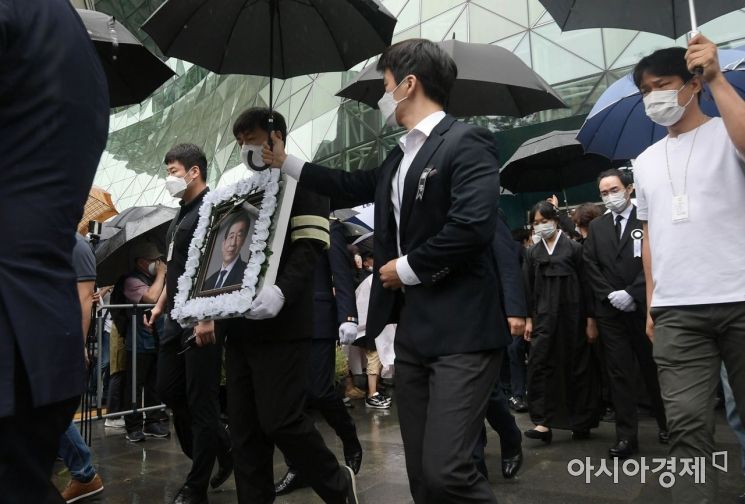 On the 13th, the funeral ceremony of the late Mayor Park Won-soon of Seoul was held, and the portrait and memorial tablet of the deceased were being taken towards the memorial park at Seoul City Hall in Jung-gu, Seoul. Photo by Kim Hyun-min kimhyun81@
[Asia Economy Reporter Lee Gwan-joo] Mayor Park Won-soon of Seoul has passed away, leaving our society to bear the heavy challenges he left behind. Each of these issues is difficult, but they are long-standing controversies that must eventually be resolved for society to mature further.
Our society, faced with the extreme choice of a politician whose social influence is great and whose support and opposition sharply divide opinions on his merits and faults, has revealed the raw face of sharp conflicts characterized more by blame than understanding, and division rather than inclusion. Attempts to use a single incident as a stepping stone to foster better discussions have found no footing. The successive scandals of sexual misconduct involving local government heads clearly indicate that there is a structure (mechanism) that made this possible, but progressive discussions on why this structure emerged and how it can be blocked remain stagnant.
Analyses suggest that at the heart of 'power-based sexual crimes' lies the 'imperial power' enjoyed by local government heads. Whether they are 'Eogong (accidental public officials)' or 'Neulgong (career public officials),' it is not easy to raise issues against local government heads who hold overwhelming authority in a region, from personnel rights to policy directions. Even if they witness acts of sexual harassment or assault, the structure that prevents them from speaking out lowers the sexual sensitivity of local government heads.
It becomes even more difficult for victims to raise issues if close 'Eogong' associates are guarding the local government head. Compared to the president, the Blue House, or ministers and other cabinet members who are under intense scrutiny from the National Assembly, media, and the public, it is time to reflect on whether oversight and checks on local governments and their leaders have been relatively neglected.
All major social figures we pay attention to leave the world with both merits and faults. The controversy lies only in whether their merits outweigh their faults or vice versa, depending on political camps. Debates over whether it is appropriate to hold the late Mayor Park’s funeral as a Seoul Metropolitan City funeral or conflicts over the burial of General Baek Seon-yeop in the National Cemetery are essentially the same. Mayor Park has left us the importance of forming a social consensus on how memorials, criticism, and objective evaluations should be conducted and discussed in what order.
The police are expected to close the case related to Mayor Park’s death without a separate investigation, citing 'no prosecution' since the subject of the case has died. This is a decision based on the principle of criminal justice that punishment is impossible if the accused is deceased. However, there are claims that the case should not be simply closed while the accuser who claimed victimization is still alive.
Professor Lee Soo-jung of the Department of Criminal Psychology at Kyonggi University pointed out, "This is very unfortunate, but the victim who claimed sexual assault is alive, and there may be others who have abetted this. An investigation to uncover the truth is necessary."
There are also criticisms that the death of a prominent politician repeatedly sparks political controversies, increasing public fatigue. Conflict is inevitable in a democratic society. However, endless and unproductive debates inevitably lead to enormous social costs.
Kim Young-rae, an emeritus professor of political science at Ajou University, suggested, "In a reality where many citizens are struggling due to the novel coronavirus (COVID-19), a spirit of consideration and inclusion for others is needed," adding, "It should start with the national leadership, including the president, moving beyond partisan logic and reflecting a spirit of inclusion and cooperative governance for national unity in actual politics."
© The Asia Business Daily(www.asiae.co.kr). All rights reserved.

















