Losses Expected to Continue in Q2
Refining Margins Still Below Break-Even Point
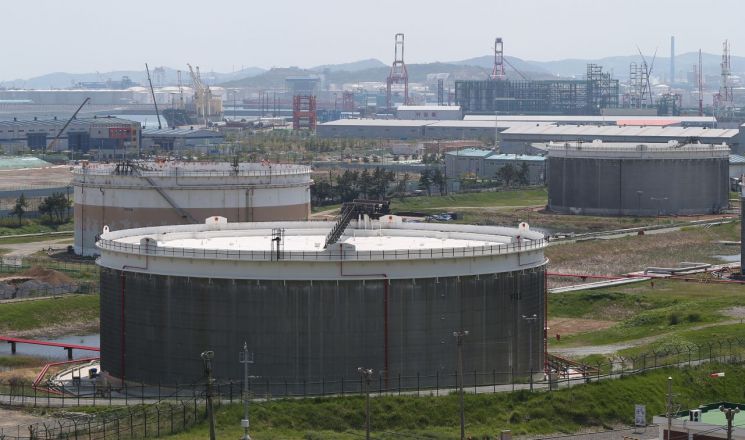
[Asia Economy Reporter Hwang Yoon-joo] The refining industry, which recorded the largest deficit in history in the first quarter of this year, is expected to escape the bottom of its performance in the second quarter. However, the refining industry anticipates a prolonged downturn in market conditions as demand for petroleum products continues to shrink due to concerns over the resurgence of COVID-19 in the United States, Brazil, and other countries.
According to securities information provider FnGuide on the 14th, SK Innovation's operating loss in the second quarter of this year is expected to reach 421 billion KRW. GS Caltex and S-OIL are each forecasted to have deficits of around 100 billion KRW. Hyundai Oilbank is mentioned as having the possibility of turning a profit.
The main reason for the reduced deficit is the decline in the official selling price (OSP) of Middle Eastern crude oil in May and June. South Korea imports about 70% of its crude oil from the Middle East. Saudi Arabia's OSP, which is the margin added to the Dubai crude oil price exported to Asia, recorded a negative value, easing the burden.
Additionally, the rise of international oil prices to around $40 helped significantly alleviate the refining companies' inventory valuation losses. West Texas Intermediate (WTI) crude oil was priced at $40.55, while Brent and Dubai crude oils maintained levels around $43.
Although there is optimism that oil demand will recover from the second half of the year, industry and market experts generally agree that it will take a long time for the market to return to pre-COVID-19 levels. A major concern is the rising number of COVID-19 cases in the United States. The U.S. reported 66,281 new cases, marking the highest daily increase on the 10th.
Reflecting this situation, refining margins, which turned positive in the third week of June, reverted to negative (-$0.5) in the first week of July before barely recovering to $0.1.
In response, the refining industry is considering requesting the government to extend the tax deferrals that were recently granted. Previously, the government deferred payment of transportation, energy, and environmental taxes (National Tax Service) for April until the end of July to support the struggling refining industry due to COVID-19, and extended the petroleum import charges (Ministry of Trade, Industry and Energy) for April to June by three months each. The taxes payable by the four major refiners amount to approximately 1.44 trillion KRW. However, with an expected deficit of up to 400 billion KRW in the second quarter, the industry is concerned about the burden of paying the deferred taxes all at once.
A refining industry official said, "Even if refining margins turn positive, it seems difficult to return to pre-COVID-19 levels within this year," adding, "If oil demand does not recover to the level of late 2019, it is expected to be difficult for refiners to improve their profitability."
Jeon Woo-je, a researcher at Heungkuk Securities, also forecasted, "The operating profit margin (OPM) of refiners has shrunk from 4-6% during 2015-18 to 0-2%," and predicted, "The refining market is expected to remain sluggish for a long time."
© The Asia Business Daily(www.asiae.co.kr). All rights reserved.

















