[Asia Economy Reporter Seungjin Lee] Emart is introducing new potatoes at about one-third of the usual price through improvements in the distribution structure.
Starting from the 16th for one week, Emart will sell 2kg of this year’s first harvested ‘fresh Sumi potatoes’ for 1,980 KRW. Compared to Emart’s average potato price last month of 5,980 KRW for 2kg, this is about 66% cheaper.
For this event, Emart secured 200 tons (t) from Gumi, 200t from Yeongju, and 400t from Buyeo, preparing a total of 800t of stock. Considering that Emart’s potato sales volume in June this year was about 350t, this amount corresponds to roughly two months’ worth of supply.
The secret to Emart’s fresh Sumi potatoes being so affordable lies in significantly lowering production costs by adjusting the harvest timing considering the rainy season and heat waves, as well as reducing distribution and sorting stages.
Usually, when the rainy season or heat waves occur, potato freshness decreases and the rate of spoilage increases, causing sorting costs to rise sharply. Emart predicted, through analysis of previous purchase data, that potato production costs would increase with early heat waves and rainy seasons, so they advanced the timing from sowing to harvest, securing both freshness and price.
To advance this year’s potato harvest, Emart started sowing at the end of February. Considering that sowing was done in early March last year, this was about 12 days earlier. This allowed harvesting to begin around June 20, about 13 days earlier than last year, avoiding heat waves and the rainy season.
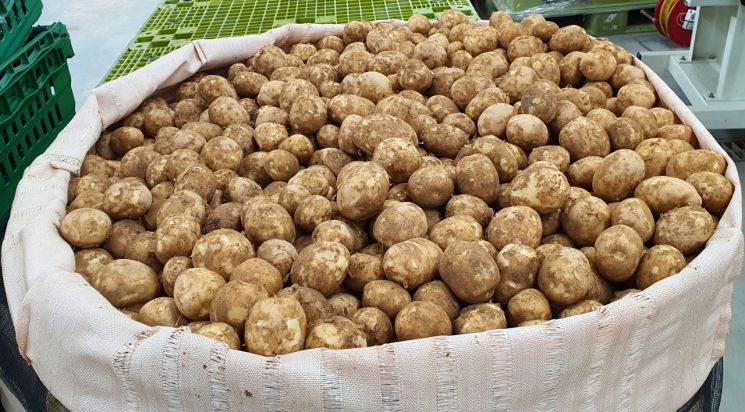
Another secret to Emart’s reduced potato price is the use of ‘ton bags.’ A ton bag is a large sack that can hold up to 550kg of potatoes. By using ton bags, Emart boldly eliminated the paper box packaging stage used when packing potatoes, reducing material costs and labor.
This time, Emart’s Sumi potato ton bags have a capacity of 400kg, equivalent to the weight of twenty 20kg boxes. Removing paper boxes also reduced labor costs for dividing potatoes. Additionally, ton bags are made of durable material, allowing them to be moved by excavators instead of manual labor, and even when heavily loaded, the weight is distributed through the spaces between potatoes, preventing bruising.
Emart drastically reduced sorting and logistics stages through full-set purchasing. Full-set purchasing means buying all products, including ‘ugly’ potatoes that are rejected due to irregular size or shape but have no difference in freshness or taste.
In December last year, 30t of irregularly sized ugly potatoes sold out in less than two days, and in April, 300t of large-sized ugly Haenam sweet potatoes, which were previously rejected, sold out within a week, proving their popularity.
Considering the popularity of ugly products, Emart began focusing on freshness, taste, and price rather than shape and size. Usually, potatoes are sorted into four sizes: 70g?100g, 100g?200g, 200g?300g, and 300g?400g. Sorting into various sizes significantly increased labor and operational costs.
Recognizing unnecessary operational costs, Emart operated this batch of Sumi potatoes in only one size range, 70g?400g, greatly reducing sorting costs.
© The Asia Business Daily(www.asiae.co.kr). All rights reserved.

















