Busan City Applies Korea's First Thermal Desorption Method for Dioxin Purification
Former DRMO US Military Site Reborn to Embrace Citizens
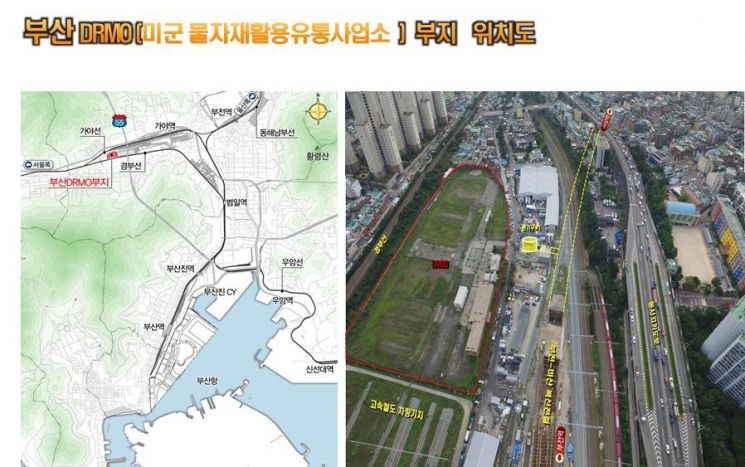 Location map of the Busan Gaegum-dong DRMO site, which will be reborn as a community sports park after soil environment restoration.
[Asia Economy Yeongnam Reporting Headquarters Reporter Kim Yong-woo] Soil restoration work has been completed at the DRMO (Defense Reutilization and Marketing Office) site in Gaegum-dong, Busanjin-gu, Busan, which was formerly used by the U.S. military and had been embroiled in soil contamination controversies involving dioxins and other pollutants. Currently, a sports park development project is underway on this site.
Busan City, Busanjin-gu, and the Public-Private Soil Remediation Council announced on the 12th that they completed soil purification and restoration of the surrounding soil environment at the former DRMO site, which was granted to the U.S. military in April 1973 and used for over 40 years as a storage area for recyclables and a waste incineration site. The sports park is currently being developed on the site.
The site had been left as an eyesore for nine years, contaminated with dioxins?classified as a Group 1 carcinogen?various heavy metals, and waste oil. The soil environment restoration was achieved through the joint efforts of Busan City, Busanjin-gu, and the Public-Private Soil Remediation Council.
After persistent persuasion of the government, the Ministry of Land, Infrastructure and Transport and the Korea Rail Network Authority invested 8.2 billion KRW to carry out the restoration of the site, which had been used as a U.S. military recycling and waste incineration site. Notably, this project is recognized as the first successful application of the thermal desorption method for dioxin purification in Korea.
In September 2018, Busan City and civic environmental organizations formed a public-private council consisting of soil environment experts, civic environmental groups, and public officials to ensure the safety and transparency of the soil remediation. Over 14 sessions, they discussed and advised on efficient purification methods, verification procedures, and monitoring to carry out the soil remediation project.
The main soil contaminants at the former DRMO main base and surrounding areas were TPH (total petroleum hydrocarbons), five types of heavy metals (cadmium, lead, copper, zinc, hexavalent chromium), and dioxins, which are highly toxic to humans.
A total of 8,615 cubic meters of contaminated soil has been excavated and purified. In particular, the dioxin-contaminated soil, which measured 536 pg-TEQ/g before purification, was cleaned to 43.8 pg-TEQ/g?well below the Ministry of Environment’s recommended standard of 100 pg-TEQ/g?reflecting residents’ opinions to ensure no harm to human health.
Busan City and the two other organizations requested strict adherence to occupational safety and health regulations to protect workers at the soil contamination remediation site and nearby residents. As a result, the purification process was completed without a single safety accident. The Korea Rail Network Authority plans to submit a completion report to Busanjin-gu soon, including the verification report from the inspection agency.
A Busan City official stated, “This remediation project will serve as a valuable role model for future soil remediation projects on U.S. military return sites in Korea.” He added, “To compensate residents for the damages endured due to the U.S. military base and to improve citizens’ welfare, we plan to consult with the Ministry of Land, Infrastructure and Transport and the Korea Rail Network Authority to develop part of the site into a citizens’ sports park with tennis courts and gateball fields.”
The site is subject to strict standards for land use (such as sports parks) after base return under the “Special Act on Support for Areas Surrounding U.S. Military Bases in Korea.” The purified site will be thoroughly managed, including soil remediation status surveys, to prevent further contamination until it is used for other purposes.
© The Asia Business Daily(www.asiae.co.kr). All rights reserved.

















