Jeju Travel Trends Seen Through KT Big Data
[Asia Economy Reporter Kim Heung-soon] Due to the impact of the novel coronavirus infection (COVID-19), overseas travel demand has been cut off, resulting in a rapid increase in tourists visiting Jeju Island. It was found that crowds are flocking to ecological tourist sites such as oreums and recreational forests rather than indoor locations, and the increase in visitors in their 30s was particularly notable.
KT announced on the 12th that, based on big data analysis of major tourist sites and visitors in Jeju Island this year, the number of tourists at ecological tourist sites in the province has increased significantly.
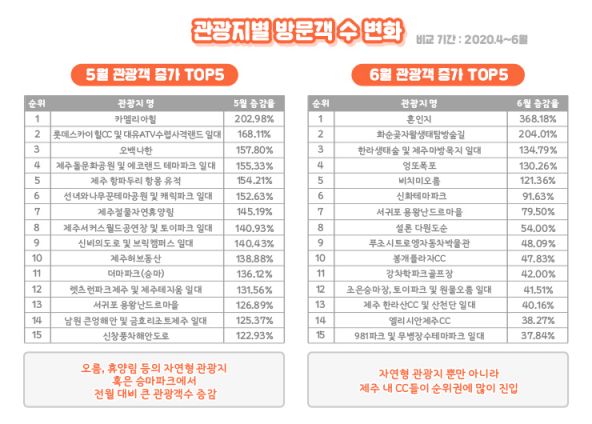
According to KT's big data analysis, in May, the number of visitors increased sharply compared to the previous month at Camellia Hill, famous for hydrangeas (202.98%), the area around Lotte Skyhill CC (168.11%), Obaek Nahan, composed of hundreds of bizarre rock formations (157.80%), Jeju Stone Culture Park and Eco Land (155.33%), and Jeju Hangpaduri Mongol Invasion Historic Site (154.21%).
In June, the number of tourists surged compared to the previous month in the following order: Honinji Pond, a representative pond of Jeju Island (368.18%), Hwasun Gotjawal Ecological Exploration Forest Trail (204.01%), Halla Ecological Forest and Jeju Horse Pasture area (134.79%), Eongtto Waterfall (130.26%), and Beachmi Oreum (121.36%).
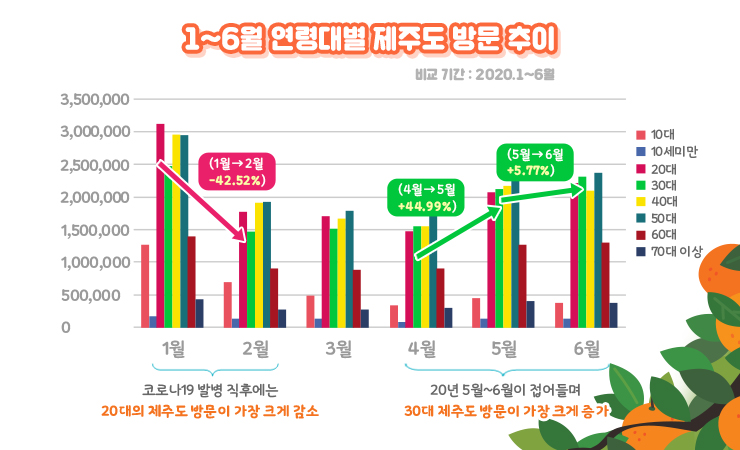
After the spread of COVID-19, changes also occurred in the age groups of travelers visiting Jeju. Among visitors to Jeju in February, when COVID-19 became full-scale, those in their 20s decreased by 42.52% compared to the previous month, showing the largest decline. On the other hand, visitors in their 30s increased by 44.99% in May compared to the previous month, showing the largest growth. In June, visitors in their 30s also increased by 5.77% compared to the previous month.
Popular tourist sites in Jeju also differed by age group. Based on June visitors, those in their 20s most frequently visited the Lee Jung-seop Culture Street, while those in their 30s most often visited Ssangyong Cave and Hyeopjae Cave. Visitors in their 40s and 50s frequently visited Seogwipo Maeil Olle Market, those in their 60s visited Udo Seongsanpo Cruise, and those in their 70s mainly visited the Jungmun Tourist Complex for sightseeing purposes.
In addition, Gimpo Airport and Jeju Airport, used by domestic flight passengers, are rapidly recovering in visitor numbers. In the case of Gimpo Airport, the number of users in February, when COVID-19 became full-scale, plummeted by 39.28% compared to the previous month and by 25.35% compared to the same period last year. However, after turning upward from March, it recovered by about 20% compared to the previous month in May.
Kim Chae-hee, Executive Director of KT AI & Big Data Business Division, said, "We were able to confirm the changes in travel trends caused by COVID-19 through big data statistics," adding, "We will continue to provide useful information to customers and the public based on big data statistics in the future."
© The Asia Business Daily(www.asiae.co.kr). All rights reserved.


















